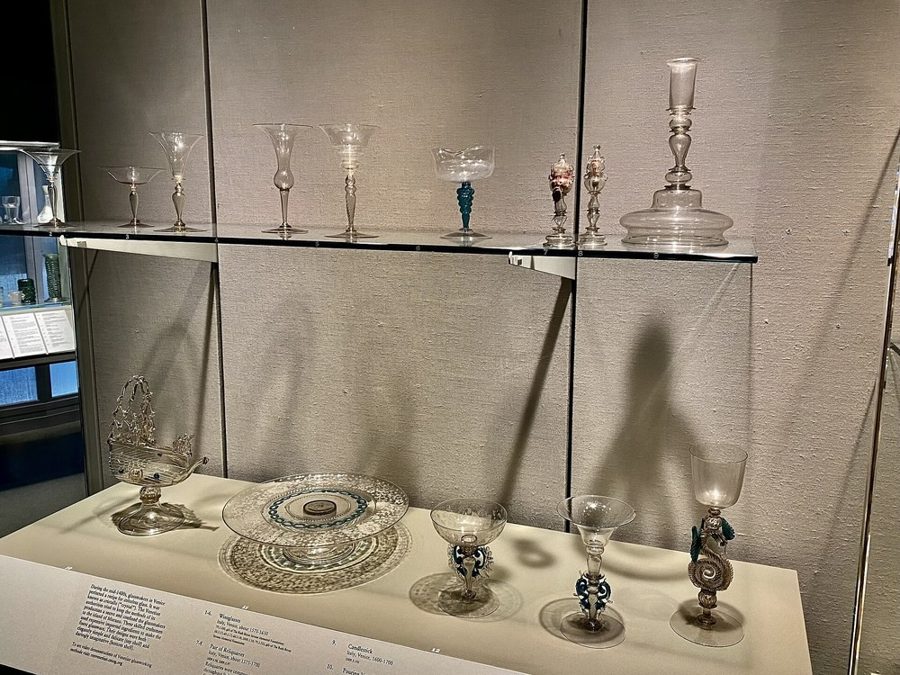
Glass powder
Polvere di vetro
- Known today as
- Powdered glass.
- Kind
- Mineral, in 1 older authority
- Constituents
- sand, pot-ashes, lead
- In other databases
- Wikidata search
- In the Canale glossary
- On the Manner of Discerning and Healing the Bewitched, Appendix A: Part Three, Chapter 9: Anointings
Revised October 17, 2026: Tradition, lore, modern assessment, and sources extended. Checked against its sources, each read in full, in part, or in its abstract. Version 1, first published September 25, 2026.
Caution. Hazardous in some form or dose; see Safety, below.
Glass powder: what did Canale use it for?
In the distilled oil for hexes (Canale, Part 3).
Glass powder: what does modern science say?
Christison judged powdered glass probably inert: it is insoluble, cannot act chemically, and animals and men given drachms of it came to no harm; but fragments of moderate size, swallowed on an empty stomach, may wound the bowel, and broken glass has occasionally killed.
Glass powder: is it poisonous?
Yes, in some form or dose. Historical description, not medical advice; in a poisoning, call a poison centre.
The toxic dose and the poisoning
- Toxic dose
- Drachms of the powder were taken without harm; fragments have occasionally killed.
The references for these lines are listed under Pharmacognosy, in Science. Doses are as the references give them, for description only; this is not medical advice. In a poisoning, call a poison centre.
Glass powder: what did the older authorities say?
- The old pharmacy
- A common notion held pounded glass an active poison; Christison grants only that it irritates the nostrils and eyes, and that fragments of moderate size may wound the viscera.
Glass powder: what lore surrounds it?
The belief that ground glass kills was tested on animals and men: Lesauvage gave a dog seven ounces in eight days without harm and swallowed fragments himself, and in Italy Caldani and Mandruzzato took drachms of it unhurt; yet in Paris a husband was imprisoned on the charge until Baudelocque and Chaussier declared that pounded glass is not deleterious.
Pharmacognosy
- Constituents
- Mechanism
- Insoluble, it cannot act chemically or by absorption, and when finely powdered it is kept from the lining of the gut by mucus; fragments of moderate size may wound the viscera. Christison found the poisoner’s pounded glass generally harmless, though broken glass may sometimes prove injurious or even fatal.
- Standing
- A material of the glass-makers.
- Christison, R. (1845). A Treatise on Poisons, 4th ed., “Of powdered glass.” Read in part · the text read
Constituent names open the compound’s record at PubChem, and “ChEMBL” beside a name opens its record at ChEMBL, the European Bioinformatics Institute’s database of bioactive molecules. Where a mechanism line was checked against ChEMBL (ChEMBL 37, read 1 October 2026), the check is shown with the measured value and its source paper, or says plainly that nothing has been measured. Doses are as the references give them, for description only; this is not medical advice. Each source carries the result of its check against Crossref, PubMed, or the authority’s page: see Verification.
Sources
- Canale, F. (1622). Del modo di conoscer et sanare i maleficiati. Brescia: Bartolomeo Fontana. Read in part · the text read
- Pomet, P. (1712). A Compleat History of Druggs. London: R. Bonwicke et al. Read in part · the text read
Verification
- Checked
- October 1, 2026, October 17, 2026
- Passes
- Read against its sources in the pass over the remaining 343 entries
- Every dated or regulatory claim checked by category across the database
- Every source read, in full, in part, or in its abstract, and every sentence checked against what was read (October 17, 2026)
- Sources
- 3 cited: 3 read in part.
- Corrections
- None recorded.
What was checked, how, and what was found is set out on the Verification page. A checked source is one whose record was found; it does not make the entry medical advice.
Club members can point at a technical term in this entry, such as a constituent, an action, or a word of Jung’s, to read its definition from the source. The Club.
Cite This Entry
Version 1 · first published September 25, 2026 · last revised October 17, 2026
- Chicago
“Glass powder.” In Materia Medica, edited by B. C. P. Statema. Version 1. The Thinking Press, 2026–. Last modified October 17, 2026. https://thethinkingpress.org/materia-medica/glass-powder.
- MLA
“Glass powder.” Materia Medica, edited by B. C. P. Statema, version 1, The Thinking Press, 17 Oct. 2026, thethinkingpress.org/materia-medica/glass-powder. Accessed 22 Nov. 2026.
- APA
Glass powder. (2026, October 17). In B. C. P. Statema (Ed.), Materia medica (Version 1). The Thinking Press. Retrieved November 22, 2026, from https://thethinkingpress.org/materia-medica/glass-powder
See Also
Drawing on the same sources: Canale, Pomet
Goat’s rue · Fox’s heart · Gold leaf · Isinglass · Gamboge · Jalap · the bibliography →
Nearby in the alphabet
Glauber’s salt · Ginseng · Ginkgo · Goji berry · Ginger (The rhizome of Zingiber officinale) · Ghost pipe
Historical description, not medical advice.
