
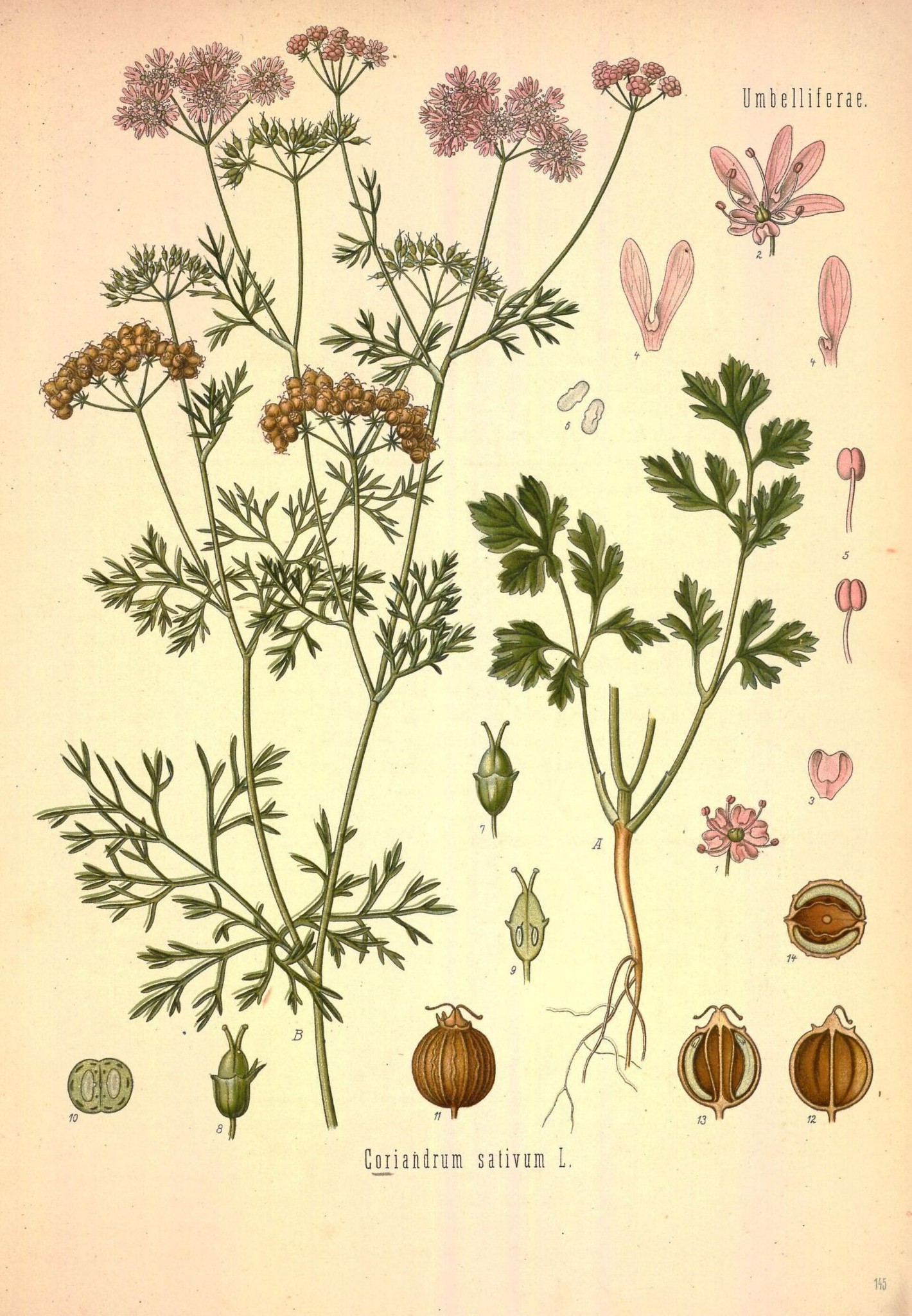
Coriander
Coriandrum
- Known today as
- Coriandrum sativum, seed and leaf.
- Kind
- Plant, in 1 older authority
- Constituents
- linalool, geranyl acetate, decanal and (E)-2-decenal
- In other databases
- Plants of the World Online · GBIF · Wikidata
Revised October 17, 2026: Lore added from texts read in full. Checked against its sources, each read in full, in part, or in its abstract. Version 1, first published September 25, 2026.
Coriander: what was it used for?
The seed, candied or powdered, for wind and the stomach, and to temper strong purges.
Coriander: what does modern science say?
A mild carminative.
The toxic dose and the poisoning
- Toxic dose
- A common spice; the EU monograph on digestive teas bars them to people sensitive to plants of the carrot family, coriander among them, and Grieve writes that the seeds taken too freely become narcotic.
The references for these lines are listed under Pharmacognosy, in Science. Doses are as the references give them, for description only; this is not medical advice. In a poisoning, call a poison centre.
Coriander: what did the older authorities say?
- Exodus
- The manna in the wilderness “was like coriander seed, white; and the taste of it was like wafers made with honey.”
Coriander: what lore surrounds it?
Folkard notes that in Numbers manna “is likened to Coriander-seed,” that the bitter coriander is one of the Mishna's five “bitter herbs” of the Passover, and that “its seeds, when covered with sugar, form the well-known Coriander comfits.” Robert Turner says the powdered seed in wine stimulates the passions, and Gerarde “affirms that the juice of the green leaves, ‘taken in the quantity of four dragmes, killeth and poisoneth the body.’”
Pharmacognosy
- Constituents
- linalool ChEMBL60–73 per cent of the fruit oil in a Portuguese study
- geranyl acetate ChEMBL1–5 per cent of the fruit oil
- decanal and (E)-2-decenalthe “soapy” aldehydes of the leaf
- Mechanism
- Linalool, the chief compound of the fruit oil, has shown sedative and calming effects in animals; the fruit is a carminative and was used to correct the griping of purgatives, which is why it tempered the purges. The soapy taste some people find in the leaf is linked to a genetic variant near a cluster of smell-receptor genes, among them OR6A2, which binds several of the leaf’s aldehydes.
- Standing
- The EMA’s 2022 assessment of digestive tea mixtures (Species digestivae) lists marketed teas that contain coriander fruit, but coriander is not among the herbs that its monograph covers.
- EMA/HMPC (2024). Assessment report on Species digestivae. Read in part · the text read
- Eriksson, N., et al. (2012). “A genetic variant near olfactory receptor genes influences cilantro preference.” Flavour 1. Abstract read · the text read
The abstract of each source, beneath its citation. For Club members. About the Club or sign in.
Constituent names open the compound’s record at PubChem, and “ChEMBL” beside a name opens its record at ChEMBL, the European Bioinformatics Institute’s database of bioactive molecules. Where a mechanism line was checked against ChEMBL (ChEMBL 37, read 1 October 2026), the check is shown with the measured value and its source paper, or says plainly that nothing has been measured. Doses are as the references give them, for description only; this is not medical advice. Each source carries the result of its check against Crossref, PubMed, or the authority’s page: see Verification.
Sources
- Exodus 16:31. Read in part · the text read
- Numbers 11:7. Read in part · the text read
- Folkard, R. (1884). Plant Lore, Legends, and Lyrics, “Coriander.” Project Gutenberg #44638. Primary text
- Canale, F. (1622). Del modo di conoscer et sanare i maleficiati, et dell’antichissimo, et ottimo uso del benedire: trattati due. Brescia: Bartolomeo Fontana. Internet Archive, bub_gb_0kwtt7zDrz4C. Read in part · the text read
- Grieve, M. (1931). A Modern Herbal, “Coriander.” botanical.com/botanical/mgmh/c/corian99.html Read in full · the text read
- Machado, A. M., et al. (2023). Chemical variability of the essential oils from two Portuguese Apiaceae: Coriandrum sativum L. and Foeniculum vulgare Mill. Plants 12: 2749. Read in part · the text read
- Hajhashemi, V., and Safaei, A. (2015). Hypnotic effect of Coriandrum sativum, Ziziphus jujuba, Lavandula angustifolia and Melissa officinalis extracts in mice. Research in Pharmaceutical Sciences 10: 477–484. Read in part · the text read
- European Medicines Agency, HMPC (2022). European Union herbal monograph on Species digestivae. Read in part · the text read
Verification
- Checked
- October 1, 2026, October 17, 2026
- Passes
- Read against its sources in the pass over the remaining 343 entries
- The Standing line checked against the EMA, among the sources below
- Every dated or regulatory claim checked by category across the database
- Each quotation from the older authorities checked word for word against the text, read in full
- Every source read, in full, in part, or in its abstract, and every sentence checked against what was read (October 17, 2026)
- Sources
- 10 cited: 1 read in full, 7 read in part, 1 abstract read, 1 primary text. 1 with the abstract on file.
- Corrections
- None recorded.
What was checked, how, and what was found is set out on the Verification page. A checked source is one whose record was found; it does not make the entry medical advice.
Club members can point at a technical term in this entry, such as a constituent, an action, or a word of Jung’s, to read its definition from the source. The Club.
Cite This Entry
Version 1 · first published September 25, 2026 · last revised October 17, 2026
- Chicago
“Coriander.” In Materia Medica, edited by B. C. P. Statema. Version 1. The Thinking Press, 2026–. Last modified October 17, 2026. https://thethinkingpress.org/materia-medica/coriander.
- MLA
“Coriander.” Materia Medica, edited by B. C. P. Statema, version 1, The Thinking Press, 17 Oct. 2026, thethinkingpress.org/materia-medica/coriander. Accessed 22 Nov. 2026.
- APA
Coriander. (2026, October 17). In B. C. P. Statema (Ed.), Materia medica (Version 1). The Thinking Press. Retrieved November 22, 2026, from https://thethinkingpress.org/materia-medica/coriander
See Also
Sharing linalool
Lavandula angustifolia · Salvia sclarea · Lilium candidum · Citrus bergamia
Drawing on the same sources: Folkard, Canale, Grieve
Cranberry · Cinquefoil · Cumin · Cyclamen, greater · Coltsfoot · Damascus prunes · Corn silk · Compound fumitory · the bibliography →
Nearby in the alphabet
Cordial flowers and fruits · Corn smut · Coral, red (Corallium rubrum, of the western Mediterranean, prepared as powder) · Cornicello · Copal · Couch grass · Contact relics
Historical description, not medical advice.
