
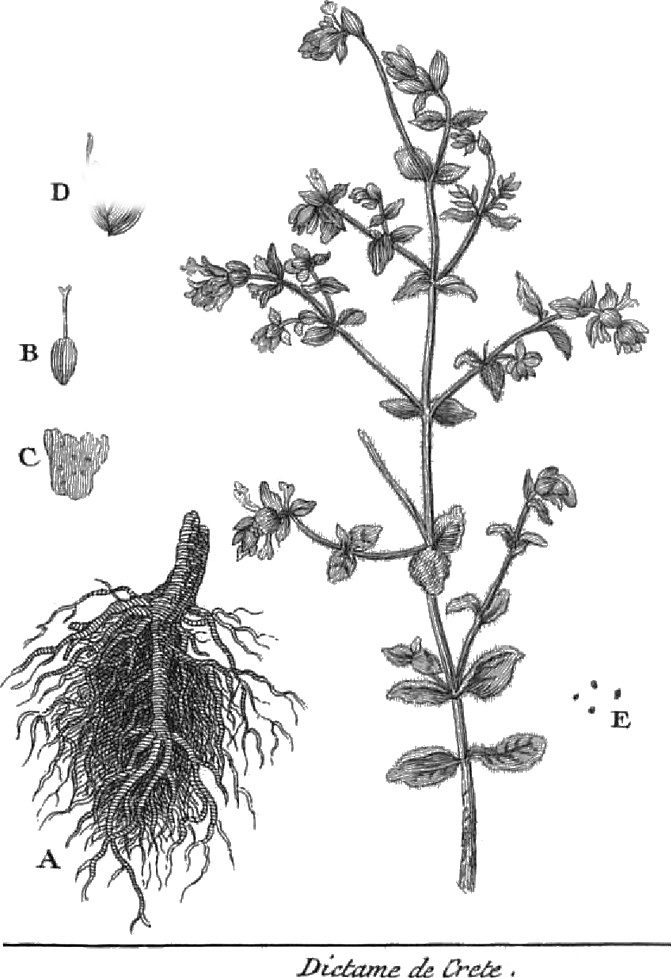
Dittany
Dittamo
- Known today as
- Dittany of Crete, Origanum dictamnus, famous in antiquity for drawing out arrows.
- Kind
- Plant, in 2 older authorities
- Constituents
- carvacrol, dictamnine, bergapten and xanthotoxin
- Poisoning
- Phytophotodermatitis
- Earliest authority here
- Aristotle (384–322 BC)
- In other databases
- Plants of the World Online search · GBIF search · Wikidata search
- In the Canale glossary
- On the Manner of Discerning and Healing the Bewitched, Appendix A: Part Three, Chapters 7–8: The Bath and Fumigations
Revised October 1, 2026: Lore added from texts read in full. Version 1, first published September 25, 2026.
Dittany: what did Canale use it for?
In the bath for cold complexions (ch. 7).
Dittany: what does modern science say?
Aromatic, like oregano, with some antiseptic action.
Pharmacognosy & Toxicology
- Constituents
- carvacrol ChEMBLin dittany of Crete, Origanum dictamnus
- dictamnine ChEMBLa furoquinoline alkaloid of white dittany, Dictamnus albus
- bergapten and xanthotoxinfuranocoumarins of white dittany
- Mechanism
- Two plants share the name. Dittany of Crete is an oregano, antimicrobial by its carvacrol; white dittany, the burning bush, is one of the most phototoxic plants of Europe, its furanocoumarins and dictamnine giving blistering burns in sunlight, and dictamnine is mutagenic in the laboratory.
- Toxic dose
- Cretan dittany is safe as tea; white dittany should not touch skin that will see the sun.
- Syndrome
- Phytophotodermatitis
- Standing
- Dittany of Crete has an EMA monograph (2013) for coughs and mild digestive complaints; white dittany has none.
- EMA/HMPC (2013). Community herbal monograph on Origanum dictamnus L., herba (EMA/HMPC/200429/2012). Verified against its record
- Schempp, C. M., et al. (1996). “Dermatitis bullosa striata pratensis durch Dictamnus albus L.” Hautarzt 47. Verified against its record · doi:10.1007/s001050050494
Constituent names open the compound’s record at PubChem, and “ChEMBL” beside a name opens its record at ChEMBL, the European Bioinformatics Institute’s database of bioactive molecules. Where a mechanism line was checked against ChEMBL (ChEMBL 37, read 1 October 2026), the check is shown with the measured value and its source paper, or says plainly that nothing has been measured. Doses are as the references give them, for description only; this is not medical advice. Each source carries the result of its check against Crossref, PubMed, or the authority’s page: see Verification.
Dittany: what lore surrounds it?
“The ancients consecrated the Dittany of Crete (Origanum Dictamnus) to the goddess Lucina, who presided over the birth of children; and she was often represented wearing a crown of this Dittany.” Folkard gives Gerarde's report “that the wilde goats or deere in Candy, when they be wounded with arrowes, do shake them out by eating of this plant, and heal their wounds,” Virgil's Venus healing Æneas with it, and Plutarch's Cretan women who, seeing the goats, “learnt to make use of the plant to aid them in childbirth.” The juice by its mere smell “drives away venomous beasts, and doth astonish them.” He warns that the Cretan dittany “is not to be confounded with the Dittany, Dittander, or Pepper-wort of the English Herbals.”
Thiselton-Dyer writes that the juice of dittany “drives away venomous beasts, and doth astonish them,” that its virtues “were famous as far back as Plutarch's time,” and that Gerarde “speaks of its marvellous efficacy in drawing forth splinters of wood, &c., and in the healing of wounds, especially those ‘made with envenomed weapons, arrows shot out of guns, and such like.’”
Dittany: what did the older authorities say?
Sources
- [112] Solomou, A. D., Fountouli, A., Molla, A., Petrakis, M., Manolikaki, I., & Skoufogianni, E. (2024). Ecology, cultivation, and utilization of the dittany of Crete (Origanum dictamnus L.) from ancient times to the present: a short review. Agronomy 14(5): 1066. doi:10.3390/agronomy14051066 Verified against its record · doi:10.3390/agronomy14051066
- Folkard, R. (1884). Plant Lore, Legends, and Lyrics, “Dittany.” Project Gutenberg #44638. Primary text
- Thiselton-Dyer, T. F. (1889). The Folk-lore of Plants. Project Gutenberg #10118. Read in part · the text read
Verification
- Checked
- October 1, 2026
- Passes
- Every sentence read against its sources, in the pass over the remaining 343 entries
- The Standing line checked against the authority it names (EMA, WHO, FDA, CITES, Commission E)
- Every dated or regulatory claim checked by category across the database
- Each quotation from the older authorities checked word for word against the text, read in full
- Sources
- 5 cited: 1 read in part, 3 verified against its record, 1 primary text.
- Corrections
- None were needed.
What was checked, how, and what was found is set out on the Verification page. A checked source is one whose record was found; it does not make the entry medical advice.
Cite This Entry
Version 1 · first published September 25, 2026 · last revised October 1, 2026
- Chicago
“Dittany.” In Materia Medica, edited by B. C. P. Statema. Version 1. The Thinking Press, 2026–. Last modified October 1, 2026. https://thethinkingpress.org/materia-medica/dittany.
- MLA
“Dittany.” Materia Medica, edited by B. C. P. Statema, version 1, The Thinking Press, 1 Oct. 2026, thethinkingpress.org/materia-medica/dittany. Accessed 8 Oct. 2026.
- APA
Dittany. (2026, October 1). In B. C. P. Statema (Ed.), Materia medica (Version 1). The Thinking Press. Retrieved October 8, 2026, from https://thethinkingpress.org/materia-medica/dittany
Club members keep entries on a shelf with private notes, print the plates as cards, and receive an entry by email each week. Create a free account before January 1, 2027 and all of it is yours for good. About the Club
See Also
Poisoned alike: phytophotodermatitis
Fig · Citron · Lovage · Masterwort and angelica · the syndrome, with all of them →
Sharing carvacrol
Drawing on the same sources: Folkard, Thiselton-Dyer
Elecampane · Dill · Endive · Fennel · the bibliography →
Nearby in the alphabet
Dover’s powder (with salts, in a powder) · Dragon’s blood · Diatrion piperion (with aniseed and ginger) · Eagle-stone (A hollow nodule of iron oxide with a loose stone rattling inside) · Diascordium (cinnamon, bole, and other drugs) · Earth of the Holy Land · Diaphenicon (with turpeth, scammony, and spices)
Historical description, not medical advice.