
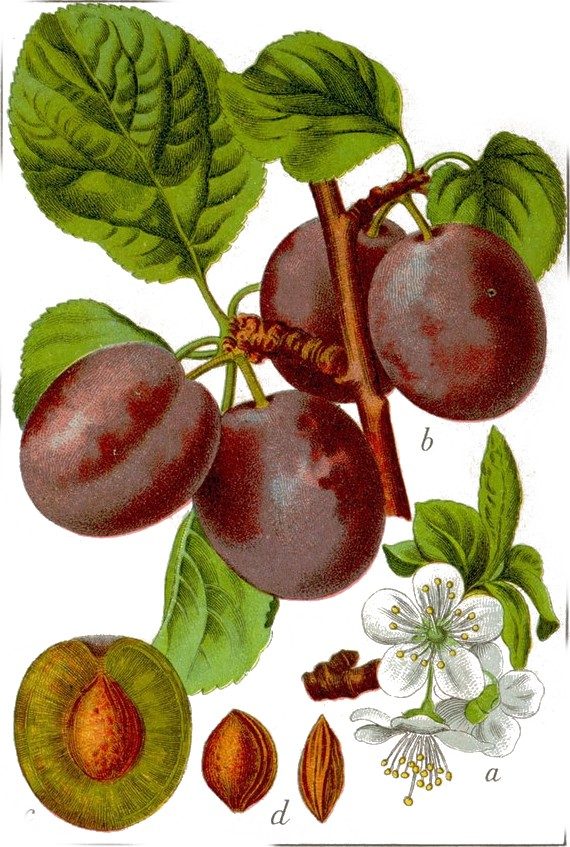
Damascus prunes
Prugne damaschine
- Known today as
- Damson plums, Prunus insititia, dried.
- Kind
- Food & Drink, in 1 older authority
- Constituents
- sorbitol, fibre, chlorogenic acid
- Earliest authority here
- Pliny (AD 23/24–79)
- In other databases
- GBIF search · Wikidata search
- In the Canale glossary
- On the Manner of Discerning and Healing the Bewitched, Appendix A: Part Three, Chapter 4: Stronger Purgatives and Compound Medicines
Revised October 3, 2026: An older authority added from a text read in full. Checked against its sources, each read in full, in part, or in its abstract. Version 1, first published September 25, 2026.
Damascus prunes: what did Canale use it for?
In a purge for the melancholic humour.
Damascus prunes: what does modern science say?
In a trial, more effective than psyllium for mild to moderate constipation.
Pharmacognosy & Toxicology
- Constituents
- sorbitol ChEMBLdraws water into the large intestine
- fibreabout 7 per cent of the weight
- chlorogenic acid ChEMBL
- Mechanism
- Sorbitol draws water into the large intestine, and the fibre may add bulk: the reference article credits the two together with the prune’s laxative effect. In a crossover trial prunes beat psyllium for constipation (Attaluri, 2011).
- Toxic dose
- A food; the trial gave 50 g twice a day, and foods with sorbitol can upset the bowel.
- Standing
- A food with a controlled trial.
- Attaluri, A., et al. (2011). “Randomised clinical trial: dried plums (prunes) vs. psyllium for constipation.” Alimentary Pharmacology and Therapeutics 33. Abstract read · the text read
The abstract of each source, beneath its citation. For Club members. About the Club or sign in.
Constituent names open the compound’s record at PubChem, and “ChEMBL” beside a name opens its record at ChEMBL, the European Bioinformatics Institute’s database of bioactive molecules. Where a mechanism line was checked against ChEMBL (ChEMBL 37, read 1 October 2026), the check is shown with the measured value and its source paper, or says plainly that nothing has been measured. Doses are as the references give them, for description only; this is not medical advice. Each source carries the result of its check against Crossref, PubMed, or the authority’s page: see Verification.
What Medicine Makes of It
- Ergot and the Witch TrialsThe 1976 hypothesis, and why most historians reject it.
Damascus prunes: what lore surrounds it?
The name traces to Damascus by way of the Latin prunum damascenum, though the classical damascenum was more like a sweet dessert plum than the modern damson, so the two share a name more than an identity. Damson stones have been found in an excavation at Hungate, York, dated to the late Anglo-Saxon period.
Used in These Compounds
Damascus prunes is an ingredient of 1 compound medicine in the database. For Club members. Create a free account or sign in.
Damascus prunes: what did the older authorities say?
- Pliny
- Names a plum of Syria, “There is a plum, too, which grows upon Mount Damascus,” since naturalized in Italy, and says of the Damascene plum, “so called from Damascus, in Syria,” that its stone is larger than usual and its flesh smaller, and that “this plum will never dry so far as to wrinkle; to effect that, it needs the sun of its own native country.”
Sources
- [6] Attaluri, A., Donahoe, R., Valestin, J., Brown, K., & Rao, S. S. (2011). Randomised clinical trial: dried plums (prunes) vs. psyllium for constipation. Alimentary Pharmacology & Therapeutics 33(7): 822–828. doi:10.1111/j.1365-2036.2011.04594.x Abstract read · the text read
- [28] Culpeper, N. (1653). Pharmacopœia Londinensis, or, The London Dispensatory [the Royal College of Physicians’ pharmacopoeia in English, with Culpeper’s commentary]. London: Peter Cole. Text Creation Partnership edition A35381. Read in part · the text read
- “Damson” (reference article). Read in full · the text read
- Pliny the Elder, Natural History 13.10, 15.12, trans. J. Bostock & H. T. Riley (1855), Perseus Digital Library. Read in part · the text read
- “Prune.” Wikipedia (read 2 October 2026). Read in full · the text read
- “Sorbitol.” Wikipedia (read 2 October 2026). Read in part · the text read
- Canale, F. (1622). Del modo di conoscer et sanare i maleficiati. Brescia. Read in part · the text read
- “Chlorogenic acid.” Wikipedia (read 2 October 2026). Read in full · the text read
Verification
- Checked
- October 1, 2026, and October 3, 2026
- Passes
- Every sentence read against its sources, in the pass over the remaining 343 entries
- The Standing line checked against the authority it names (EMA, WHO, FDA, CITES, Commission E)
- Every dated or regulatory claim checked by category across the database
- Each quotation from the older authorities checked word for word against the text, read in full
- Every source read, in full, in part, or in its abstract, and every sentence checked against what was read (October 3, 2026)
- Sources
- 9 cited: 3 read in full, 4 read in part, 2 abstract read. 2 with the abstract on file.
- Corrections
- None were needed.
What was checked, how, and what was found is set out on the Verification page. A checked source is one whose record was found; it does not make the entry medical advice.
Cite This Entry
Version 1 · first published September 25, 2026 · last revised October 3, 2026
- Chicago
“Damascus prunes.” In Materia Medica, edited by B. C. P. Statema. Version 1. The Thinking Press, 2026–. Last modified October 3, 2026. https://thethinkingpress.org/materia-medica/damascus-prunes.
- MLA
“Damascus prunes.” Materia Medica, edited by B. C. P. Statema, version 1, The Thinking Press, 3 Oct. 2026, thethinkingpress.org/materia-medica/damascus-prunes. Accessed 8 Oct. 2026.
- APA
Damascus prunes. (2026, October 3). In B. C. P. Statema (Ed.), Materia medica (Version 1). The Thinking Press. Retrieved October 8, 2026, from https://thethinkingpress.org/materia-medica/damascus-prunes
Club members keep entries on a shelf with private notes, print the plates as cards, and receive an entry by email each week. Create a free account before January 1, 2027 and all of it is yours for good. About the Club
See Also
Sharing sorbitol, fibre, chlorogenic acid
Also in Pliny the Elder
Dragon’s blood in Pliny the Elder · Cyprus powder in Pliny the Elder · Eagle-stone in Pliny the Elder · Cyclamen, greater in Pliny the Elder · everything Pliny the Elder names →
Drawing on the same sources: Canale
Nearby in the alphabet
Dandelion (of the daisy family) · Deadly fibrecap (of spring and summer woods) · Cypress (Cupressus sempervirens) · Deadly nightshade (of the nightshade family) · Cyclosporin fungus (A soil fungus) · Deadly webcap
Historical description, not medical advice.