
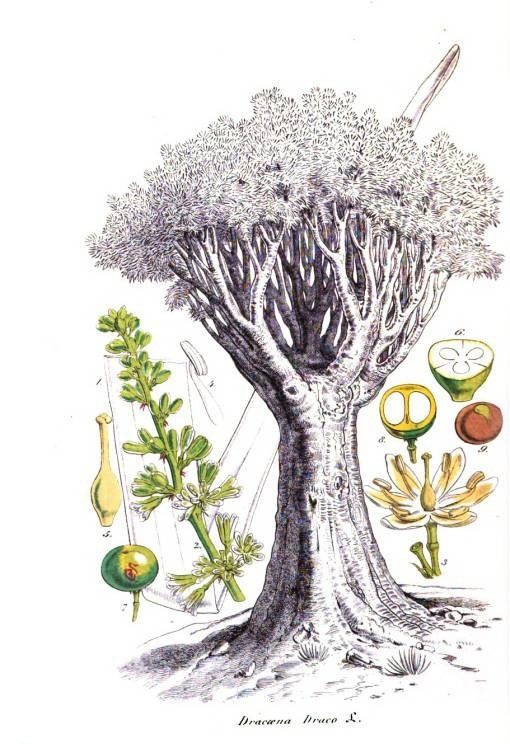
Dragon’s blood
Sangue di drago
- Known today as
- The red resin of Dracaena cinnabari of Socotra, which came in tears (drops), or of the rattan palm Calamus draco (formerly Daemonorops draco).
- Kind
- Resin & Wood, in 1 older authority
- Constituents
- dracorhodin and dracorubin, taspine, proanthocyanidin oligomers (SP-303)
- Earliest authority here
- Pliny (AD 23/24–79)
- In other databases
- Plants of the World Online search · GBIF search · Wikidata search
- In the Canale glossary
- On the Manner of Discerning and Healing the Bewitched, Appendix A: Part Three, Chapter 9: Anointings
Revised October 1, 2026: Lore added from texts read in full. Version 1, first published September 25, 2026.
Dragon’s blood: what did Canale use it for?
In the oil for hexes (ch. 9).
Dragon’s blood: what does modern science say?
Astringent; a varnish colorant; still used in traditional medicine in many cultures.
Pharmacognosy & Toxicology
- Constituents
- dracorhodin and dracorubinthe red flavylium pigments of Daemonorops resin
- taspine ChEMBLan alkaloid of Croton lechleri sap, the American dragon’s blood
- proanthocyanidin oligomers (SP-303)in the croton sap
- Mechanism
- Two resins share the name: the East Indian rattan resin, an astringent pigment and varnish, and the Amazonian Croton lechleri latex, whose taspine speeds wound closure in animals and whose proanthocyanidin fraction blocks chloride secretion in the gut. The latter was approved by the FDA in 2012 as crofelemer (Mytesi) for diarrhoea in HIV patients, the first botanical drug from a rainforest sap.
- Toxic dose
- The resins are safe; crofelemer is given at 125 mg twice daily.
- Standing
- Crofelemer is an FDA-approved prescription drug; the Asian resin is a dye and varnish.
- Macarthur, R. D., et al. (2013). “Efficacy and safety of crofelemer for noninfectious diarrhea in HIV-seropositive individuals (ADVENT trial).” HIV Clinical Trials 14. Verified against its record · doi:10.1310/hct1406-261
- Gupta, D., et al. (2008). “Dragon’s blood: botany, chemistry and therapeutic uses.” Journal of Ethnopharmacology 115. Verified against its record · doi:10.1016/j.jep.2007.10.018
The abstract of each source, beneath its citation. For Club members. About the Club or sign in.
Constituent names open the compound’s record at PubChem, and “ChEMBL” beside a name opens its record at ChEMBL, the European Bioinformatics Institute’s database of bioactive molecules. Where a mechanism line was checked against ChEMBL (ChEMBL 37, read 1 October 2026), the check is shown with the measured value and its source paper, or says plainly that nothing has been measured. Doses are as the references give them, for description only; this is not medical advice. Each source carries the result of its check against Crossref, PubMed, or the authority’s page: see Verification.
Dragon’s blood: what lore surrounds it?
Grieve notes the uses of the resin “as a colouring matter for varnishes, tooth-pastes, tinctures, plasters, for dyeing horn to imitate tortoiseshell,” and that the dragon tree, Dracaena Draco, “shares with the baobab tree the distinction of being the oldest living representative of the vegetable kingdom, being much reverenced by the Guanches of the Canaries, who use its product for embalming in the fashion of the Egyptians.”
Dragon’s blood: what did the older authorities say?
- Pliny
- Repeats the fable that the red cinnabaris was the mingled blood of a dragon and an elephant slain in their combat.
Sources
- [16] The British Pharmaceutical Codex (1911). London: Pharmaceutical Society of Great Britain. Monographs as transcribed at Henriette’s Herbal Homepage, henriettes-herb.com. Read in full · the text read
- [38] Encyclopaedia Britannica, online edition, britannica.com. Articles: Ambergris; Aristolochiaceae; Asafetida; Azurite; Castor-oil plant; Civet; Dragon’s blood; Garden cress; Jet; Kermes; Laudanum; Lye; Monemvasía; Musk; Precious coral; Saltpetre; Sulfur dioxide; Tartar emetic; Tropaeolum. Book, seen in reviews
- [57] Gupta, D., Bleakley, B., & Gupta, R. K. (2008). Dragon’s blood: botany, chemistry and therapeutic uses. Journal of Ethnopharmacology 115(3): 361–380. doi:10.1016/j.jep.2007.10.018 Verified against its record · doi:10.1016/j.jep.2007.10.018
- Grieve, M. (1931). A Modern Herbal, “Dragon’s Blood.” botanical.com/botanical/mgmh/d/dragon20.html Standard reference work
Verification
- Checked
- October 1, 2026
- Passes
- Every sentence read against its sources, in the pass over the remaining 343 entries
- The Standing line checked against the authority it names (EMA, WHO, FDA, CITES, Commission E)
- Every dated or regulatory claim checked by category across the database
- Each quotation from the older authorities checked word for word against the text, read in full
- Sources
- 6 cited: 1 read in full, 3 verified against its record, 1 standard reference work, 1 book, seen in reviews. 1 with the abstract on file.
- Corrections
- None were needed.
What was checked, how, and what was found is set out on the Verification page. A checked source is one whose record was found; it does not make the entry medical advice.
Cite This Entry
Version 1 · first published September 25, 2026 · last revised October 1, 2026
- Chicago
“Dragon’s blood.” In Materia Medica, edited by B. C. P. Statema. Version 1. The Thinking Press, 2026–. Last modified October 1, 2026. https://thethinkingpress.org/materia-medica/dragons-blood.
- MLA
“Dragon’s blood.” Materia Medica, edited by B. C. P. Statema, version 1, The Thinking Press, 1 Oct. 2026, thethinkingpress.org/materia-medica/dragons-blood. Accessed 8 Oct. 2026.
- APA
Dragon’s blood. (2026, October 1). In B. C. P. Statema (Ed.), Materia medica (Version 1). The Thinking Press. Retrieved October 8, 2026, from https://thethinkingpress.org/materia-medica/dragons-blood
Club members keep entries on a shelf with private notes, print the plates as cards, and receive an entry by email each week. Create a free account before January 1, 2027 and all of it is yours for good. About the Club
See Also
Also in Pliny the Elder
Eagle-stone in Pliny the Elder · Damascus prunes in Pliny the Elder · Elecampane in Pliny the Elder · Cyprus powder in Pliny the Elder · everything Pliny the Elder names →
Drawing on the same sources: Grieve, Gupta
Elder · Devil’s-bit scabious · Rosemary rice water · Sulfur · the bibliography →
Nearby in the alphabet
Dover’s powder (with salts, in a powder) · Earth of the Holy Land · Dittany (Origanum dictamnus, famous in antiquity for drawing out arrows) · Earthworm (washed in wine, dried, powdered, or boiled in oil) · Dill (Anethum graveolens) · Diatrion piperion (with aniseed and ginger)
Historical description, not medical advice.