
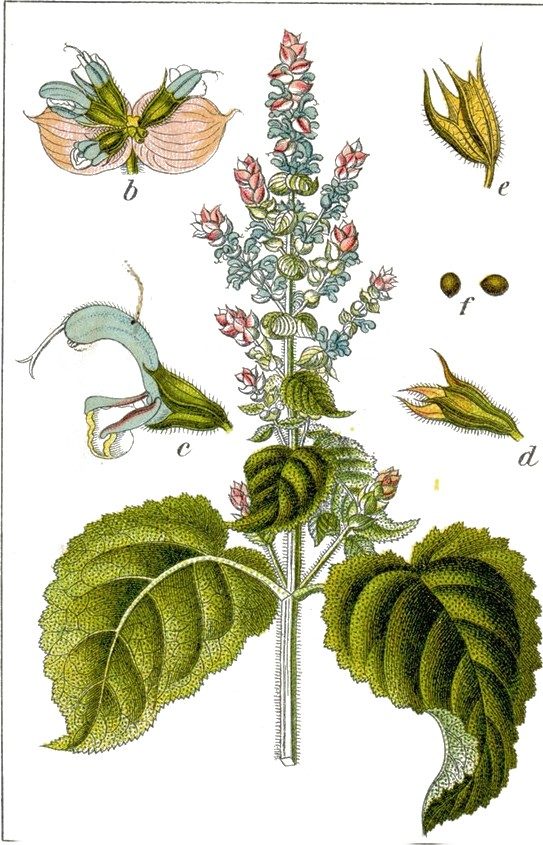
Clary, garden
Sclarea hortense
- Known today as
- Clary sage, Salvia sclarea.
- Kind
- Plant, in 1 older authority
- Constituents
- linalyl acetate, linalool, sclareol
- Earliest authority here
- Pliny (AD 23/24–79)
- In other databases
- Plants of the World Online search · GBIF search · Wikidata search
- In the Canale glossary
- On the Manner of Discerning and Healing the Bewitched, Appendix A: Part Three, Chapter 9: Anointings
Revised October 1, 2026: An older authority added from a text read in full. Version 1, first published September 25, 2026.
Clary, garden: what did Canale use it for?
In the oil for the bewitched; among the amulets (chs. 9–10).
Clary, garden: what does modern science say?
Aromatic; its oil is used in perfumery.
Pharmacognosy & Toxicology
- Constituents
- Mechanism
- Clary oil is a sedative in the sense that its inhalation lowered cortisol and blood pressure in small trials; sclareol is the industrial starting point for synthetic ambergris. The seed’s mucilage, placed in the eye, gathers grit, which is the “clear eye” of the name.
- Toxic dose
- Safe at perfumery doses; the oil is not thujone-bearing like common sage and lacks its convulsant risk.
- Standing
- No monograph; a perfumery material with small aromatherapy trials.
- Seol, G. H., et al. (2013). “Randomized controlled trial for Salvia sclarea or Lavandula angustifolia: differential effects on blood pressure in female patients with urinary incontinence undergoing urodynamic examination.” Journal of Alternative and Complementary Medicine 19. Verified against its record · doi:10.1089/acm.2012.0148
The abstract of each source, beneath its citation. For Club members. About the Club or sign in.
Constituent names open the compound’s record at PubChem, and “ChEMBL” beside a name opens its record at ChEMBL, the European Bioinformatics Institute’s database of bioactive molecules. Where a mechanism line was checked against ChEMBL (ChEMBL 37, read 1 October 2026), the check is shown with the measured value and its source paper, or says plainly that nothing has been measured. Doses are as the references give them, for description only; this is not medical advice. Each source carries the result of its check against Crossref, PubMed, or the authority’s page: see Verification.
Clary, garden: what lore surrounds it?
Its English name, “clear eye,” and its epithet sclarea both point to its old use as an eyewash for irritated and clouded eyes, a use well attested across the herbals.
Clary, garden: what did the older authorities say?
- Pliny
- Of horminum: it resembles cumin in its seed and the leek in other respects, grows some nine inches high, and is of two kinds, the darker-seeded “in request as an aphrodisiac, and for the cure of argema and albugo in the eyes.”
Sources
- [67] Jan, S., Khaliq, T., Sultan, P., Hassan, Q. P., Gupta, S., & Ahmed, Z. (2026). Salvia sclarea: a comprehensive review of its pharmacology, phytochemistry, ethnobotany and traditional uses. Current Plant Biology 47: 100604. doi:10.1016/j.cpb.2026.100604 Verified against its record · doi:10.1016/j.cpb.2026.100604
- NC State Extension, Salvia sclarea. Book, seen in reviews
- Pliny the Elder, Natural History 22.76, trans. J. Bostock & H. T. Riley (1855), Perseus Digital Library. Primary text
Verification
- Checked
- October 1, 2026
- Passes
- Every sentence read against its sources, in the pass over the remaining 343 entries
- The Standing line checked against the authority it names (EMA, WHO, FDA, CITES, Commission E)
- Every dated or regulatory claim checked by category across the database
- Each quotation from the older authorities checked word for word against the text, read in full
- Sources
- 4 cited: 2 verified against its record, 1 primary text, 1 book, seen in reviews. 1 with the abstract on file.
- Corrections
- None were needed.
What was checked, how, and what was found is set out on the Verification page. A checked source is one whose record was found; it does not make the entry medical advice.
Cite This Entry
Version 1 · first published September 25, 2026 · last revised October 1, 2026
- Chicago
“Clary, garden.” In Materia Medica, edited by B. C. P. Statema. Version 1. The Thinking Press, 2026–. Last modified October 1, 2026. https://thethinkingpress.org/materia-medica/clary-garden.
- MLA
“Clary, garden.” Materia Medica, edited by B. C. P. Statema, version 1, The Thinking Press, 1 Oct. 2026, thethinkingpress.org/materia-medica/clary-garden. Accessed 8 Oct. 2026.
- APA
Clary, garden. (2026, October 1). In B. C. P. Statema (Ed.), Materia medica (Version 1). The Thinking Press. Retrieved October 8, 2026, from https://thethinkingpress.org/materia-medica/clary-garden
Club members keep entries on a shelf with private notes, print the plates as cards, and receive an entry by email each week. Create a free account before January 1, 2027 and all of it is yours for good. About the Club
See Also
Sharing linalyl acetate, linalool
Lavandula angustifolia · Coriandrum sativum · Ocimum basilicum
Also in Pliny the Elder
Clove in Pliny the Elder · Citron in Pliny the Elder · Coral, red in Pliny the Elder · Cinquefoil in Pliny the Elder · everything Pliny the Elder names →
Nearby in the alphabet
Civet (The glandular secretion of the civet cat) · Cochia pills · Cochineal (a parasite of the prickly-pear cactus of Mexico and South America) · Coffee (The roasted seeds of Coffea arabica) · Cinnamon (The bark of Cinnamomum verum)

Historical description, not medical advice.