
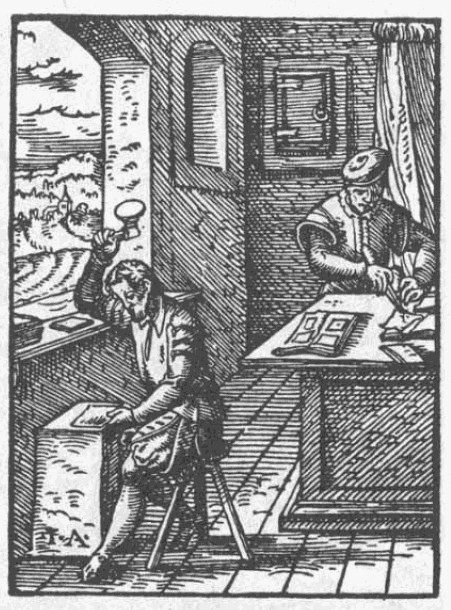
Gold leaf
Foglie d’oro
- Known today as
- Beaten gold.
- Kind
- Mineral, in 1 older authority
- Constituents
- gold, auranofin
- Earliest authority here
- Pliny (AD 23/24–79)
- In other databases
- Wikidata search
- In the Canale glossary
- On the Manner of Discerning and Healing the Bewitched, Appendix A: Part Three, Chapter 9: Anointings
Revised October 1, 2026: An older authority added from a text read in full. Version 1, first published September 25, 2026.
Gold leaf: what did Canale use it for?
Seven leaves in the oil for the bewitched; gold is also blessed at Epiphany and ground into the blessed oil of Treatise Two (ch. 9; Treatise Two).
Gold leaf: what does modern science say?
Metallic gold is practically inert in the body; its value here was symbolic, as the Magi’s gift.
Pharmacognosy & Toxicology
- Constituents
- Mechanism
- Metallic gold is inert and passes through the body; the gold salts of the twentieth century, sodium aurothiomalate by injection and auranofin by mouth, modify the immune system and were a standard treatment of rheumatoid arthritis from 1929 until the biologics.
- Toxic dose
- The salts injure the kidney and the marrow; gold leaf does nothing.
- Standing
- Auranofin remains licensed and is studied against parasites and cancers.
- Forestier, J. (1935). “Rheumatoid arthritis and its treatment by gold salts.” Journal of Laboratory and Clinical Medicine 20. Verified against its record · doi:10.1016/s0140-6736(00)82169-8
- Kean, W. F., and Kean, I. R. L. (2008). “Clinical pharmacology of gold.” Inflammopharmacology 16. Abstract read · the text read
The abstract of each source, beneath its citation. For Club members. About the Club or sign in.
Constituent names open the compound’s record at PubChem, and “ChEMBL” beside a name opens its record at ChEMBL, the European Bioinformatics Institute’s database of bioactive molecules. Where a mechanism line was checked against ChEMBL (ChEMBL 37, read 1 October 2026), the check is shown with the measured value and its source paper, or says plainly that nothing has been measured. Doses are as the references give them, for description only; this is not medical advice. Each source carries the result of its check against Crossref, PubMed, or the authority’s page: see Verification.
Used in These Compounds
Gold leaf is an ingredient of 2 compound medicines in the database. For Club members. Create a free account or sign in.
Gold leaf: what did the older authorities say?
- Pliny
- Gold is prized, Pliny argues, not for colour or weight but “because gold is the only substance in nature that suffers no loss from the action of fire,” and “the oftener gold is subjected to the action of fire, the more refined in quality it becomes.” Of the leaf itself: “a single ounce of it admits of being beaten out into seven hundred and fifty leaves, or more, four fingers in length by the same in breadth. The thickest kind of gold-leaf is known as ‘leaf of Præneste,’ it still retaining that name from the excellence of the gilding upon the statue of Fortune there. The next in thickness is known as the ‘quæstorian leaf.’” Gold, he adds, “is subject to no rust, no verdigris,” and “admits, too, beyond all other metals, of being spun out and woven like wool.”
Sources
- [35] EFSA Panel on Food Additives and Nutrient Sources added to Food (2016). Scientific opinion on the re-evaluation of gold (E 175) as a food additive. EFSA Journal 14(1): 4362. doi:10.2903/j.efsa.2016.4362 Standard reference work
- Pliny the Elder, Natural History 33.19, trans. J. Bostock & H. T. Riley (1855), Perseus Digital Library. Primary text
In Symbols of the Psyche
Gold: what it stood for in alchemy and in analytical psychology.
Verification
- Checked
- October 1, 2026
- Passes
- Every sentence read against its sources, in the pass over the remaining 343 entries
- The Standing line checked against the authority it names (EMA, WHO, FDA, CITES, Commission E)
- Every dated or regulatory claim checked by category across the database
- Each quotation from the older authorities checked word for word against the text, read in full
- Sources
- 4 cited: 1 abstract read, 1 verified against its record, 1 primary text, 1 standard reference work. 1 with the abstract on file.
- Corrections
- None were needed.
What was checked, how, and what was found is set out on the Verification page. A checked source is one whose record was found; it does not make the entry medical advice.
Cite This Entry
Version 1 · first published September 25, 2026 · last revised October 1, 2026
- Chicago
“Gold leaf.” In Materia Medica, edited by B. C. P. Statema. Version 1. The Thinking Press, 2026–. Last modified October 1, 2026. https://thethinkingpress.org/materia-medica/gold-leaf.
- MLA
“Gold leaf.” Materia Medica, edited by B. C. P. Statema, version 1, The Thinking Press, 1 Oct. 2026, thethinkingpress.org/materia-medica/gold-leaf. Accessed 8 Oct. 2026.
- APA
Gold leaf. (2026, October 1). In B. C. P. Statema (Ed.), Materia medica (Version 1). The Thinking Press. Retrieved October 8, 2026, from https://thethinkingpress.org/materia-medica/gold-leaf
Club members keep entries on a shelf with private notes, print the plates as cards, and receive an entry by email each week. Create a free account before January 1, 2027 and all of it is yours for good. About the Club
See Also
Also in Pliny the Elder
Gorse in Pliny the Elder · Goji berry in Pliny the Elder · Greater celandine in Pliny the Elder · Ginger in Pliny the Elder · everything Pliny the Elder names →
Drawing on the same sources: Kean
Nearby in the alphabet
Gold, frankincense, and myrrh (The gifts of the Magi) · Golden pills (a standard compound of aloes, scammony, and colocynth) · Goat’s rue (French lilac) · Glauber’s salt · Glass powder (Powdered glass)
Historical description, not medical advice.