
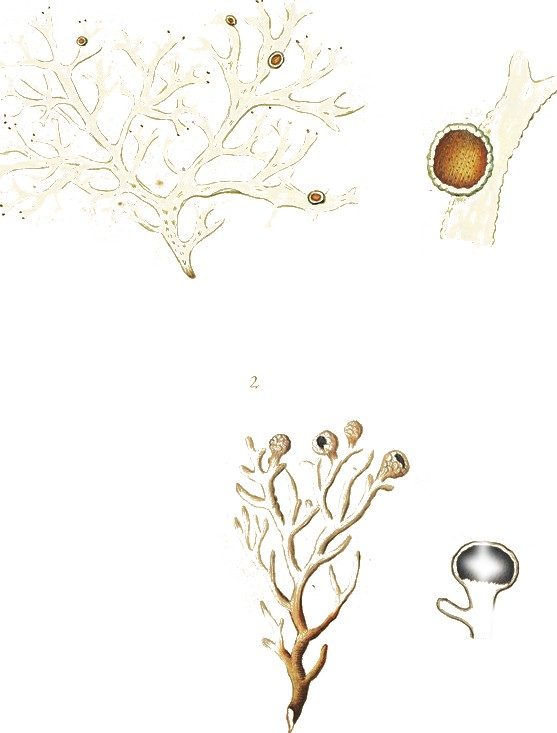
Cyprus powder
Polvere di Cipro
- Known today as
- Poudre de Chypre, a perfumed toilet powder.
- Kind
- Compound, in 1 older authority
- Constituents
- atranol and chloratranol, evernic acid
- Earliest authority here
- Pliny (AD 23/24–79)
- In the Canale glossary
- On the Manner of Discerning and Healing the Bewitched, Appendix A: Part Three, Chapter 9: Anointings
Revised October 3, 2026: An older authority added from a text read in full. Checked against its sources, each read in full, in part, or in its abstract. Version 1, first published September 25, 2026.
Cyprus powder: what did Canale use it for?
In the oil for the bewitched (ch. 9).
Cyprus powder: what does modern science say?
A perfume.
Pharmacognosy & Toxicology
- Constituents
- atranol and chloratranolthe fragrance allergens of oak moss
- evernic acid ChEMBL
- Mechanism
- A scented powder of oak moss (Evernia prunastri): its atranol and chloroatranol were judged by the EU’s scientific committee to be the fragrance allergens that caused the most contact allergies, and Regulation 2017/1410 barred cosmetics containing them from being placed on the Union market from 23 August 2019, and from being made available there from 23 August 2021.
- Toxic dose
- Allergenic on the skin.
- Standing
- A perfumery base (chypre); the European Union prohibits atranol and chloratranol in cosmetics.
- European Commission (2017). Regulation (EU) 2017/1410 prohibiting atranol, chloratranol and HICC in cosmetic products. Read in full · the text read
Constituent names open the compound’s record at PubChem, and “ChEMBL” beside a name opens its record at ChEMBL, the European Bioinformatics Institute’s database of bioactive molecules. Where a mechanism line was checked against ChEMBL (ChEMBL 37, read 1 October 2026), the check is shown with the measured value and its source paper, or says plainly that nothing has been measured. Doses are as the references give them, for description only; this is not medical advice. Each source carries the result of its check against Crossref, PubMed, or the authority’s page: see Verification.
Cyprus powder: what lore surrounds it?
The name preserves an old tradition: oakmoss powder scented as poudre de Chypre was in use by the sixteenth century, long before the modern chypre perfumes. Guerlain made an “Eau de Chypre” in 1840, and the modern family was defined in 1917 by François Coty’s perfume of that name, built on a Mediterranean accord of bergamot, labdanum, and oakmoss that became the template for a whole line of descendants.
Cyprus powder: what did the older authorities say?
- Pliny
- His cypros is another thing from the chypre of the perfumers: “a tree of Egypt, with the leaves of the ziziphus, and seeds like coriander, white and odoriferous,” boiled in olive oil and pressed, sold at five denarii the pound, the best from the Nile near Canopus; some, he says, hold it to be the tree the Italians call ligustrum.
Sources
- “Chypre” (reference article). Read in full · the text read
- Pliny the Elder, Natural History 12.51, trans. J. Bostock & H. T. Riley (1855), Perseus Digital Library. Read in part · the text read
- Wikipedia, “Evernic acid,” en.wikipedia.org (read 2 October 2026). Read in full · the text read
- Wikipedia, “Evernia prunastri,” en.wikipedia.org (read 2 October 2026). Read in full · the text read
Verification
- Checked
- October 1, 2026, and October 3, 2026
- Passes
- Every sentence read against its sources, in the fifty-entry sample
- The Standing line checked against the authority it names (EMA, WHO, FDA, CITES, Commission E)
- Every dated or regulatory claim checked by category across the database
- Each quotation from the older authorities checked word for word against the text, read in full
- Every source read, in full, in part, or in its abstract, and every sentence checked against what was read (October 3, 2026)
- Sources
- 5 cited: 4 read in full, 1 read in part.
- Corrections
- said atranol and chloratranol were "limited to parts per million since 2017." They are prohibited in cosmetics from 2019 under Regulation 2017/1410.
What was checked, how, and what was found is set out on the Verification page. A checked source is one whose record was found; it does not make the entry medical advice.
Cite This Entry
Version 1 · first published September 25, 2026 · last revised October 3, 2026
- Chicago
“Cyprus powder.” In Materia Medica, edited by B. C. P. Statema. Version 1. The Thinking Press, 2026–. Last modified October 3, 2026. https://thethinkingpress.org/materia-medica/cyprus-powder.
- MLA
“Cyprus powder.” Materia Medica, edited by B. C. P. Statema, version 1, The Thinking Press, 3 Oct. 2026, thethinkingpress.org/materia-medica/cyprus-powder. Accessed 8 Oct. 2026.
- APA
Cyprus powder. (2026, October 3). In B. C. P. Statema (Ed.), Materia medica (Version 1). The Thinking Press. Retrieved October 8, 2026, from https://thethinkingpress.org/materia-medica/cyprus-powder
Club members keep entries on a shelf with private notes, print the plates as cards, and receive an entry by email each week. Create a free account before January 1, 2027 and all of it is yours for good. About the Club
See Also
Also in Pliny the Elder
Damascus prunes in Pliny the Elder · Cyclamen, greater in Pliny the Elder · Dragon’s blood in Pliny the Elder · Cumin in Pliny the Elder · everything Pliny the Elder names →
Drawing on the same sources: Wikipedia
Deadly fibrecap · Cyclosporin fungus · Deadly webcap · the bibliography →
Nearby in the alphabet
Cypress (Cupressus sempervirens) · Dandelion (of the daisy family) · Deadly nightshade (of the nightshade family) · Cuttlefish bone (washed up on beaches)
Historical description, not medical advice.