
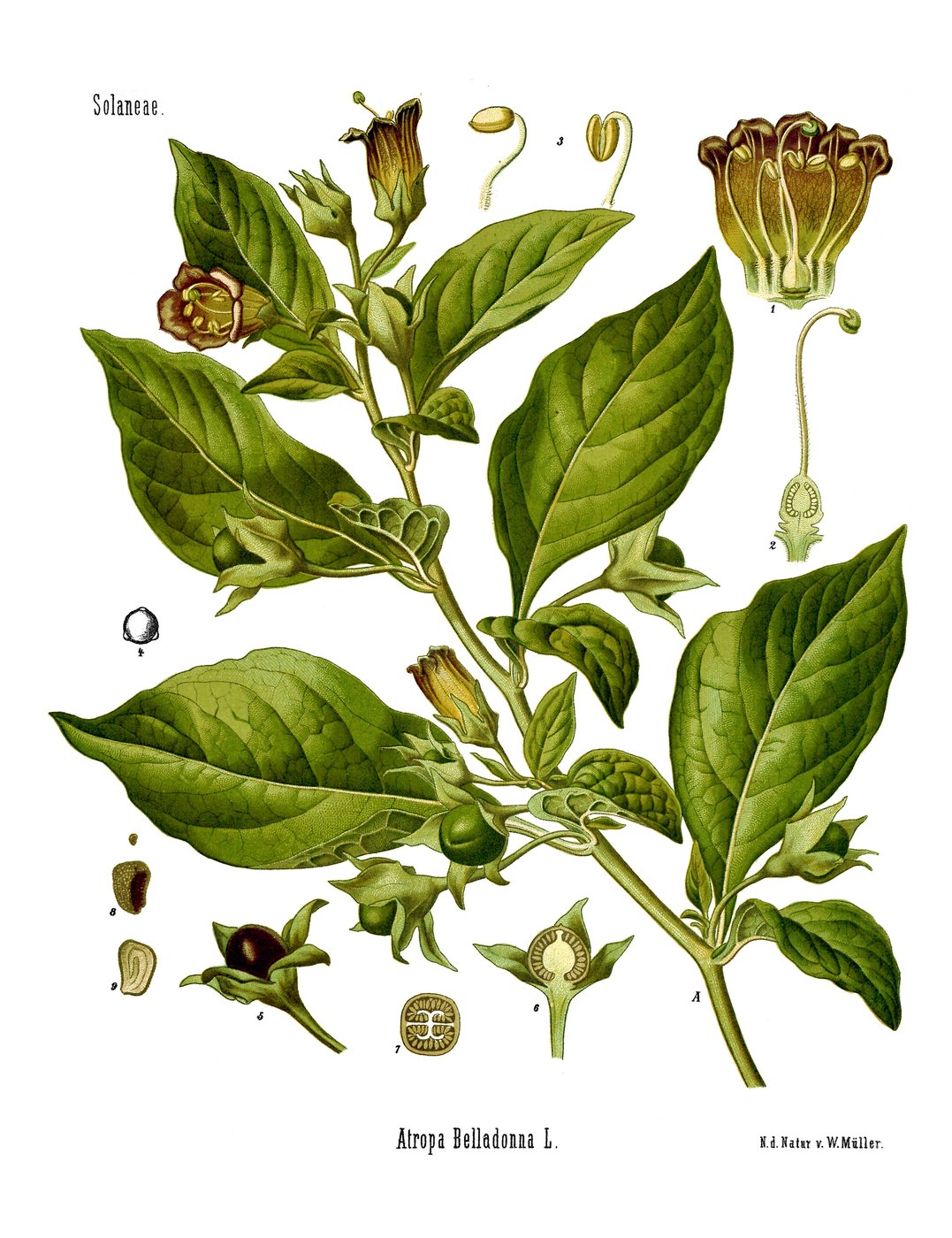
Deadly nightshade
Belladonna; Italian belladonna, “beautiful lady”
- Known today as
- Atropa belladonna, of the nightshade family.
- Kind
- Plant, in 2 older authorities
- Constituents
- atropine, hyoscyamine
- Poisoning
- Tropane (anticholinergic) poisoning
- Earliest authority here
- Renaissance Italy
- In other databases
- Plants of the World Online search · GBIF search · Wikidata search
Caution. Gravely poisonous in every part.
Deadly nightshade: what does modern science say?
Source of atropine, still used to dilate the pupil, to treat certain poisonings, and to steady a slowed heart. The berries are sweet and have killed children.
Deadly nightshade: is it poisonous?
Yes, in some form or dose. Gravely poisonous in every part. Its poisoning is tropane (anticholinergic) poisoning: Thirty minutes to a few hours; longer from the skin. Historical description, not medical advice; in a poisoning, call a poison centre.
Pharmacognosy & Toxicology
- Constituents
- Mechanism
- Muscarinic blockade.
- Checked against ChEMBL
- atropine: ChEMBL’s curated mechanism: antagonist Muscarinic acetylcholine receptor M1; antagonist Muscarinic acetylcholine receptor M2; antagonist Muscarinic acetylcholine receptor M3.
- Toxic dose
- Two or three berries have killed a child, ten to twenty an adult.
- Syndrome
- Tropane (anticholinergic) poisoning
- Standing
- Belladonna extracts survive in a few preparations; atropine is on the WHO list of essential medicines as an antidote and for the eye.
- Goldfrank’s Toxicologic Emergencies, 11th ed. (2019). Standard reference work
Constituent names open the compound’s record at PubChem, and “ChEMBL” beside a name opens its record at ChEMBL, the European Bioinformatics Institute’s database of bioactive molecules. Where a mechanism line was checked against ChEMBL (ChEMBL 37, read 1 October 2026), the check is shown with the measured value and its source paper, or says plainly that nothing has been measured. Doses are as the references give them, for description only; this is not medical advice. Each source carries the result of its check against Crossref, PubMed, or the authority’s page: see Verification.
What Medicine Makes of It
- The Witches’ OintmentNightshades on the skin, and what they do.
Deadly nightshade: what lore surrounds it?
Counted with henbane and mandrake among the herbs of the witches’ ointments.
The sixteenth-century Scottish historian George Buchanan credited Macbeth with poisoning the drink supplied to invading Danish troops during a truce with belladonna, after which his forces slaughtered them in their stupor. The episode is chronicle legend rather than documented history. Later writers have guessed belladonna for the poisons that Roman historians said Livia and Agrippina gave Augustus and Claudius; the sources themselves name figs and mushrooms.
Deadly nightshade: what did the older authorities say?
- Renaissance Italy
- The name is traditionally explained by women’s use of its juice to widen the pupils.
- Linnaeus
- Named the genus Atropa (1753) for Atropos, the Fate who cuts the thread of life.
Sources
- Carl Linnaeus, Species plantarum (1753). Book, seen in reviews
- IMSS (Museo Galileo), on belladonna. Book, not indexed
Verification
- Checked
- October 1, 2026
- Passes
- Every sentence read against its sources, in the pass over the remaining 343 entries
- The Standing line checked against the authority it names (EMA, WHO, FDA, CITES, Commission E)
- Every dated or regulatory claim checked by category across the database
- The mechanism read against ChEMBL (ChEMBL 37): curated mechanisms and measured activity
- Sources
- 3 cited: 1 standard reference work, 1 book, seen in reviews, 1 book, not indexed.
- Corrections
- the claim that Livia and Agrippina used belladonna replaced: later writers guessed it; the Roman sources name figs and mushrooms.
What was checked, how, and what was found is set out on the Verification page. A checked source is one whose record was found; it does not make the entry medical advice.
Cite This Entry
Version 1 · first published September 25, 2026
- Chicago
“Deadly nightshade.” In Materia Medica, edited by B. C. P. Statema. Version 1. The Thinking Press, 2026–. Last modified September 25, 2026. https://thethinkingpress.org/materia-medica/deadly-nightshade.
- MLA
“Deadly nightshade.” Materia Medica, edited by B. C. P. Statema, version 1, The Thinking Press, 25 Sept. 2026, thethinkingpress.org/materia-medica/deadly-nightshade. Accessed 8 Oct. 2026.
- APA
Deadly nightshade. (2026, September 25). In B. C. P. Statema (Ed.), Materia medica (Version 1). The Thinking Press. Retrieved October 8, 2026, from https://thethinkingpress.org/materia-medica/deadly-nightshade
Club members keep entries on a shelf with private notes, print the plates as cards, and receive an entry by email each week. Create a free account before January 1, 2027 and all of it is yours for good. About the Club
See Also
Poisoned alike: tropane (anticholinergic) poisoning
Henbane · Woody nightshade · Mandrake · Thorn apple · Nutmeg and clove · the syndrome, with all of them →
Also in Carl Linnaeus
Fly agaric in Carl Linnaeus · Cinchona in Carl Linnaeus · everything Carl Linnaeus names →
Nearby in the alphabet
Deadly webcap · Deadly fibrecap (of spring and summer woods) · Death cap (white-gilled mushroom of oak and beech woods, now spread worldwide) · Dandelion (of the daisy family) · Destroying angel (Pure white amanitas of Europe and North America) · Damascus prunes (Prunus insititia, dried) · Devil’s-bit scabious (Succisa pratensis) · Cyprus powder (a perfumed toilet powder)

Historical description, not medical advice.