
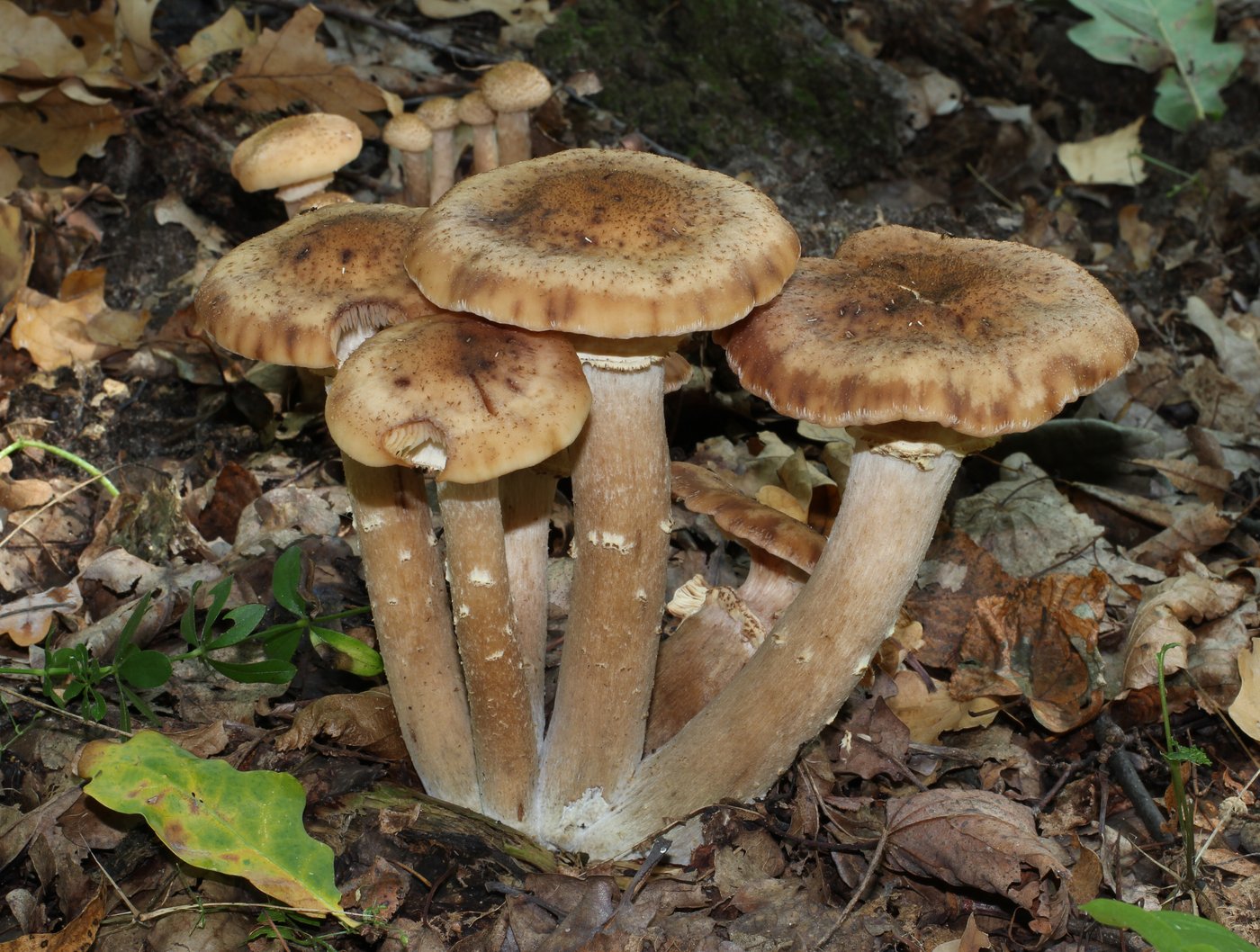
Honey fungus
Armillaria species
- Known today as
- Honey-colored clusters on stumps and trees, from black cords, the “shoestrings,” that spread beneath the bark.
- Kind
- Fungus
- Constituents
- unknown
- Poisoning
- Gastrointestinal irritants
- In other databases
- GBIF search · Wikidata search
Revised October 3, 2026: Checked against its sources, each read in full, in part, or in its abstract. Version 1, first published September 25, 2026.
Caution. Never eat raw.
Honey fungus: what was it used for?
Edible when well cooked; raw it causes illness.
Honey fungus: what does modern science say?
A killer of trees in gardens and forests.
Pharmacognosy & Toxicology
- Constituents
- Mechanism
- Edible thoroughly cooked; mildly poisonous raw, and it can cause sickness when eaten with alcohol.
- Toxic dose
- Raw caps, or caps eaten with alcohol.
- Syndrome
- Gastrointestinal irritants
- Standing
- Prized in Ukraine, Russia, Poland, Germany and elsewhere in Europe, eaten thoroughly cooked; the organism is among the largest living things, one clone in Oregon covering about nine square kilometres.
Constituent names open the compound’s record at PubChem, and “ChEMBL” beside a name opens its record at ChEMBL, the European Bioinformatics Institute’s database of bioactive molecules. Where a mechanism line was checked against ChEMBL (ChEMBL 37, read 1 October 2026), the check is shown with the measured value and its source paper, or says plainly that nothing has been measured. Doses are as the references give them, for description only; this is not medical advice. Each source carries the result of its check against Crossref, PubMed, or the authority’s page: see Verification.
Honey fungus: what lore surrounds it?
Some species make the wood they rot glow in the dark: the “foxfire” that lit the instrument needles of the Turtle, the first submarine used in war, in 1775. Benjamin Franklin is often said to have suggested it, but the letters show he was asked only for another light when the cold put the foxfire out. A single Armillaria in Oregon covers some 965 hectares (about 2,400 acres), among the largest living things on earth.
In Their Own Words
Atkinson describes the honey-coloured tufts, their stems arising from a black rope-like strand, and says the colour gives the species its name.
“The plant occurs in tufts or clusters, several to many individuals growing together, the bases of their stems connected with a black rope-like strand from which they arise. The entire plant is often more or less honey colored, from which the plant gets its specific name.”
George Francis Atkinson, Studies of American Fungi. Mushrooms, Edible, Poisonous, etc., Chapter VI (The White-Spored Agarics), Armillaria mellea. Second edition; New York: Henry Holt and Company, 1903 (Project Gutenberg eBook #26492). The text, read in part
Badham calls it a nauseous, disagreeable fungus however cooked, mentioned only because leaving it out of a book on esculent funguses might seem strange.
“This is a nauseous, disagreeable fungus, however cooked, and merely finds mention here, as its omission in a work on the esculent funguses of England might seem strange to those unacquainted with its demerits;”
Charles David Badham, M.D.; edited by Frederick Currey, A Treatise on the Esculent Funguses of England, Agaricus melleus (Plate IX, fig. 3). London: Lovell Reeve & Co., Henrietta Street, Covent Garden, 1863 (second edition; Project Gutenberg eBook #58853). The text, read in part
Cooke found it among the commonest edible fungi in the Vienna markets, as Hallimasche, though it had no good reputation in England.
“One of the commonest (in our experience the most common) of all edible fungi in the public markets of Vienna is the Hallimasche (Agaricus melleus), which in England enjoys no good reputation for flavour or quality;”
M. C. Cooke, M.A., LL.D.; edited by the Rev. M. J. Berkeley, Fungi: Their Nature and Uses, Chapter IV, Uses. New York: D. Appleton and Company, 1875 (The International Scientific Series, vol. XV; Project Gutenberg eBook #30181). The text, read in part
Each passage is quoted from the text named, which the press fetched and read, and was checked word for word against a fresh copy of it; the link opens that copy. Passages are given as printed, without the editors’ footnote numbers, and with words broken across lines joined.
Sources
- Ferguson, B. A., et al. (2003). Coarse-scale population structure of pathogenic Armillaria species. Canadian Journal of Forest Research 33: 612–623. Abstract read · the text read
- Wikipedia contributors. “Armillaria.” Wikipedia, The Free Encyclopedia. en.wikipedia.org/wiki/Armillaria (read 2 October 2026). Read in full · the text read
- Wikipedia contributors. “Armillaria ostoyae.” Wikipedia, The Free Encyclopedia. en.wikipedia.org/wiki/Armillaria_ostoyae (read 2 October 2026). Read in full · the text read
- Wikipedia contributors. “Foxfire.” Wikipedia, The Free Encyclopedia. en.wikipedia.org/wiki/Foxfire (read 2 October 2026). Read in full · the text read
- Wikipedia contributors. “Turtle (submersible).” Wikipedia, The Free Encyclopedia. en.wikipedia.org/wiki/Turtle_(submersible) (read 2 October 2026). Read in full · the text read
Verification
- Checked
- October 1, 2026, and October 3, 2026
- Passes
- Every sentence read against its sources, in the pass over the remaining 343 entries
- The Standing line checked against the authority it names (EMA, WHO, FDA, CITES, Commission E)
- Every dated or regulatory claim checked by category across the database
- Every source read, in full, in part, or in its abstract, and every sentence checked against what was read (October 3, 2026)
- Sources
- 5 cited: 4 read in full, 1 abstract read. 1 with the abstract on file.
- Corrections
- None were needed.
What was checked, how, and what was found is set out on the Verification page. A checked source is one whose record was found; it does not make the entry medical advice.
Cite This Entry
Version 1 · first published September 25, 2026 · last revised October 3, 2026
- Chicago
“Honey fungus.” In Materia Medica, edited by B. C. P. Statema. Version 1. The Thinking Press, 2026–. Last modified October 3, 2026. https://thethinkingpress.org/materia-medica/honey-fungus.
- MLA
“Honey fungus.” Materia Medica, edited by B. C. P. Statema, version 1, The Thinking Press, 3 Oct. 2026, thethinkingpress.org/materia-medica/honey-fungus. Accessed 8 Oct. 2026.
- APA
Honey fungus. (2026, October 3). In B. C. P. Statema (Ed.), Materia medica (Version 1). The Thinking Press. Retrieved October 8, 2026, from https://thethinkingpress.org/materia-medica/honey-fungus
Club members keep entries on a shelf with private notes, print the plates as cards, and receive an entry by email each week. Create a free account before January 1, 2027 and all of it is yours for good. About the Club
See Also
Poisoned alike: gastrointestinal irritants
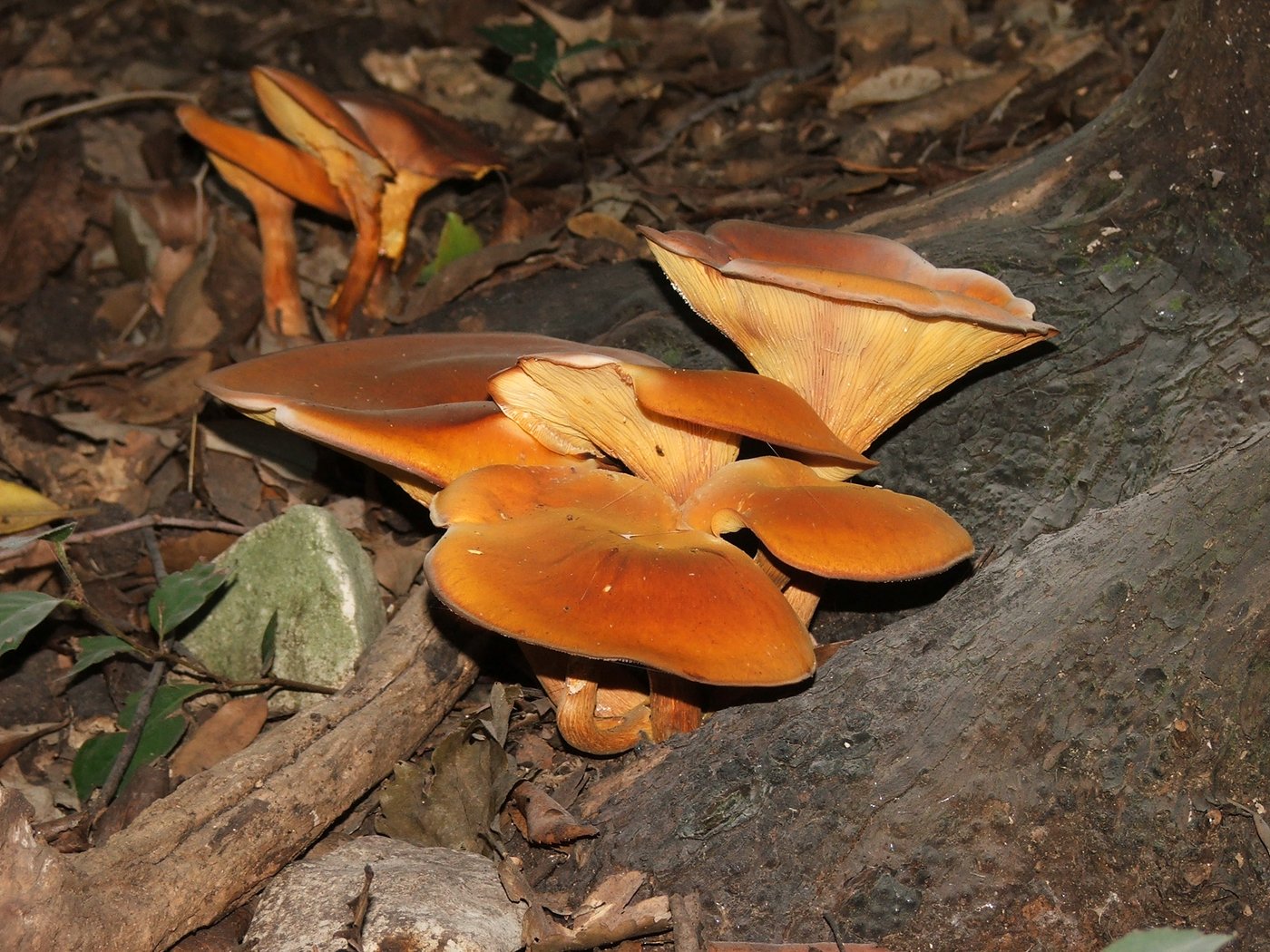
Jack-o’-lantern · Cyclamen, greater · Jalap · Common earthball · Livid pinkgill · Colocynth · Meadow saffron · Castor-oil plant, seeds of · the syndrome, with all of them →
Sharing unknown
Nearby in the alphabet
Honeyed wine and honeyed water (Wine or water sweetened with honey) · Honey (Honey of bees) · Hop (Humulus lupulus) · Holy wells (many of them sacred long before Christianity, visited for cures) · Horehound (Marrubium vulgare) · The holy water stoup (and the small stoups kept in homes) · Houndstongue (Cynoglossum officinale) · Holy water (usually with exorcized salt mixed in)

Historical description, not medical advice.