
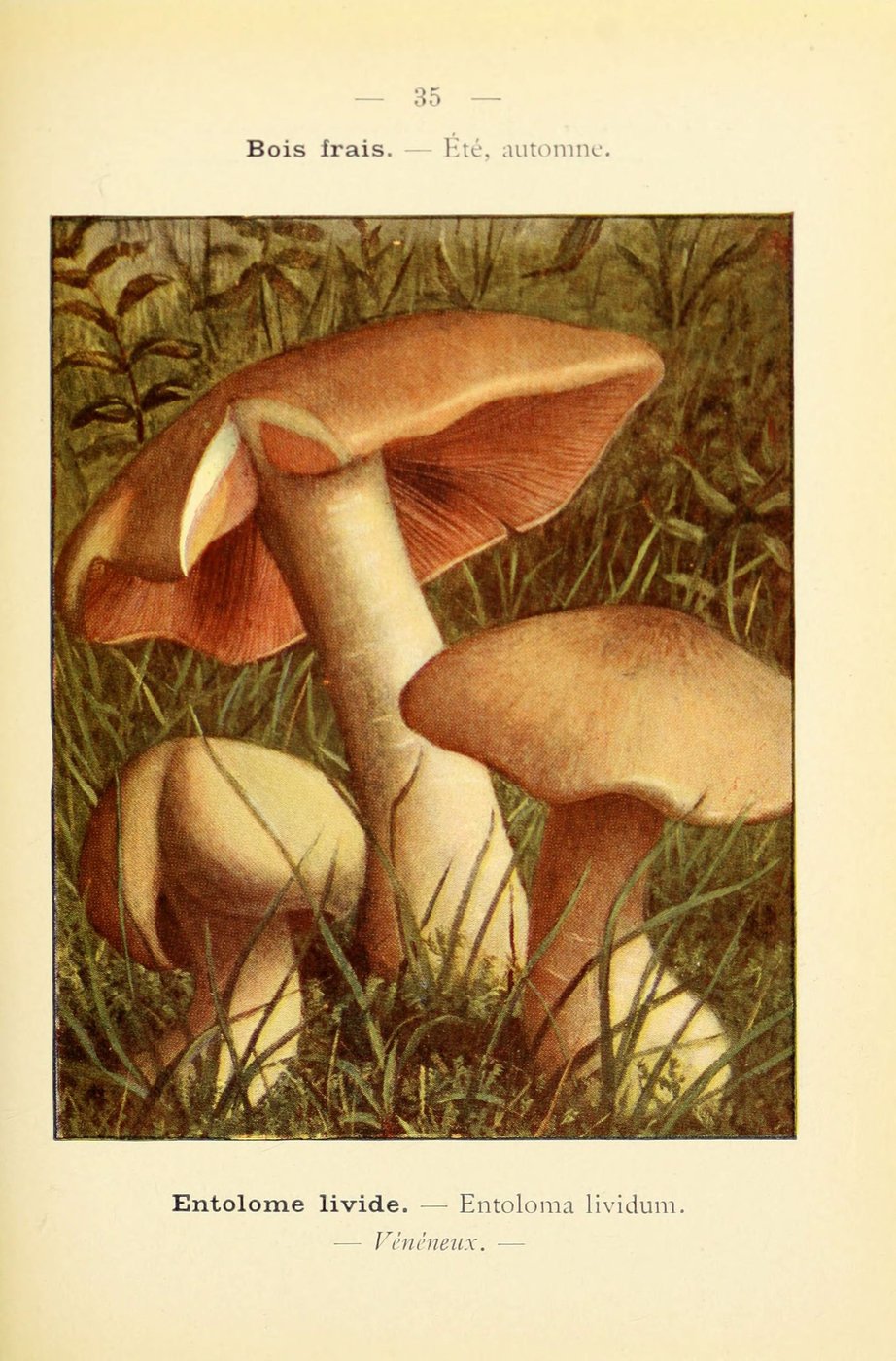
Livid pinkgill
Entoloma sinuatum
- Known today as
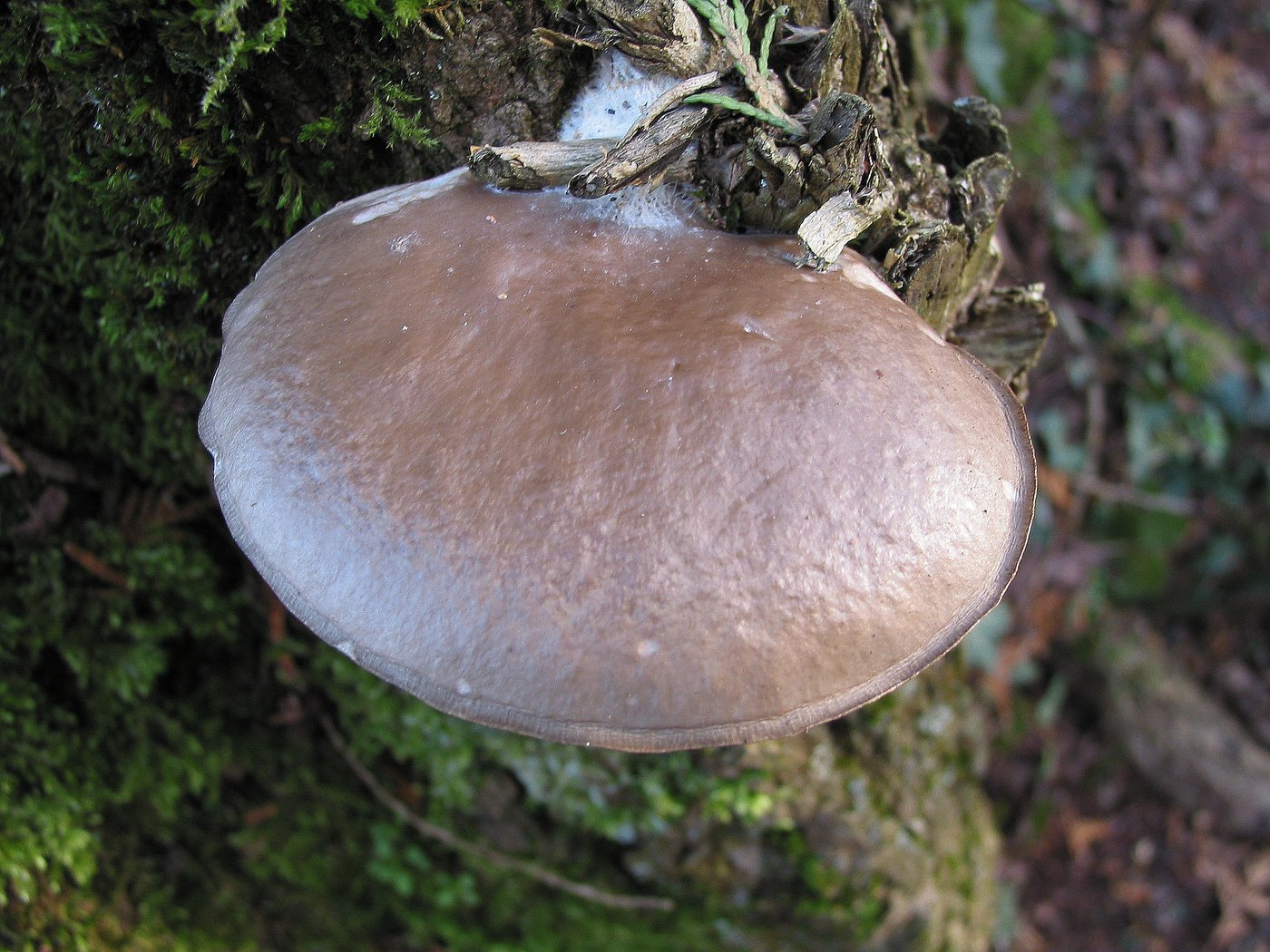
- A large grey mushroom with pinkish gills, of broadleaf woods.
- Kind
- Fungus
- Constituents
- unknown
- Poisoning
- Gastrointestinal irritants
- In other databases
- GBIF search · Wikidata search
Revised October 3, 2026: Checked against its sources, each read in full, in part, or in its abstract. Version 1, first published September 25, 2026.
Caution. Poisonous.
Livid pinkgill: what was it used for?
None.
Livid pinkgill: what does modern science say?
Causes severe vomiting and diarrhea, with some liver injury.
Livid pinkgill: is it poisonous?
Yes, in some form or dose. Poisonous. Its poisoning is gastrointestinal irritants: Thirty minutes to three hours: the short latency is reassuring, since the deadly syndromes come later. Historical description, not medical advice; in a poisoning, call a poison centre.
Pharmacognosy & Toxicology
- Constituents
- Syndrome
- Gastrointestinal irritants
- Standing
- None.
Constituent names open the compound’s record at PubChem, and “ChEMBL” beside a name opens its record at ChEMBL, the European Bioinformatics Institute’s database of bioactive molecules. Where a mechanism line was checked against ChEMBL (ChEMBL 37, read 1 October 2026), the check is shown with the measured value and its source paper, or says plainly that nothing has been measured. Doses are as the references give them, for description only; this is not medical advice. Each source carries the result of its check against Crossref, PubMed, or the authority’s page: see Verification.
In Their Own Words
Worthington Smith calls it without doubt very poisonous, having been very nearly poisoned to death after cooking a very small piece for his lunch.
“Without doubt, this is a very poisonous plant, for I once cooked a very small piece of a specimen for luncheon, and was very nearly poisoned to death thereby.”
Worthington G. Smith, F.L.S., M.A.I., Mushrooms and Toadstools: How to Distinguish Easily the Differences between Edible and Poisonous Fungi, 'Poisonous Forest Mushroom', Fig. 14 (Agaricus [Entoloma] sinuatus). Third edition; London: Hardwicke and Bogue, 192 Piccadilly, 1876 (Project Gutenberg eBook #60561). The text, read in part
McIlvaine, quoting Stevenson, says it produces headache, giddiness, stomach pains and vomiting, and that Worthington Smith's quarter-ounce very nearly proved fatal.
“Very poisonous; producing headache, swimming of the brain, stomach pains, vomiting, etc. Worthington Smith, who first experimented with it, ate about ¼ oz., which very nearly proved fatal.”
Charles McIlvaine and Robert K. Macadam, Toadstools, Mushrooms, Fungi, Edible and Poisonous; One Thousand American Fungi, Entoloma sinuatum, species entry. Revised edition; Indianapolis: The Bowen-Merrill Company, copyright 1900, 1902 (Project Gutenberg eBook #51393). The text, read in part
Each passage is quoted from the text named, which the press fetched and read, and was checked word for word against a fresh copy of it; the link opens that copy. Passages are given as printed, without the editors’ footnote numbers, and with words broken across lines joined.
Verification
- Checked
- October 1, 2026, and October 3, 2026
- Passes
- Every sentence read against its sources, in the pass over the remaining 343 entries
- The Standing line checked against the authority it names (EMA, WHO, FDA, CITES, Commission E)
- Every dated or regulatory claim checked by category across the database
- Every source read, in full, in part, or in its abstract, and every sentence checked against what was read (October 3, 2026)
- Sources
- None cited.
- Corrections
- None were needed.
What was checked, how, and what was found is set out on the Verification page. A checked source is one whose record was found; it does not make the entry medical advice.
Cite This Entry
Version 1 · first published September 25, 2026 · last revised October 3, 2026
- Chicago
“Livid pinkgill.” In Materia Medica, edited by B. C. P. Statema. Version 1. The Thinking Press, 2026–. Last modified October 3, 2026. https://thethinkingpress.org/materia-medica/livid-pinkgill.
- MLA
“Livid pinkgill.” Materia Medica, edited by B. C. P. Statema, version 1, The Thinking Press, 3 Oct. 2026, thethinkingpress.org/materia-medica/livid-pinkgill. Accessed 8 Oct. 2026.
- APA
Livid pinkgill. (2026, October 3). In B. C. P. Statema (Ed.), Materia medica (Version 1). The Thinking Press. Retrieved October 8, 2026, from https://thethinkingpress.org/materia-medica/livid-pinkgill
Club members keep entries on a shelf with private notes, print the plates as cards, and receive an entry by email each week. Create a free account before January 1, 2027 and all of it is yours for good. About the Club
See Also
Poisoned alike: gastrointestinal irritants
Meadow saffron · Jalap · Melon root · Jack-o’-lantern · Mistletoe · Honey fungus · Morel · Cyclamen, greater · the syndrome, with all of them →
Sharing unknown
Nearby in the alphabet
Lodestone (naturally magnetic iron ore) · Liverwort, or hepatica (Hepatica nobilis (syn) · Long pepper (The catkin-like fruit of Piper longum) · Litharge (a byproduct of refining silver) · Lourdes water · Lion’s mane (A single clump of hanging spines on hardwood trees) · Lovage (of the carrot family) · Licorice (The root of Glycyrrhiza glabra)
_(6459638939).jpg)
Historical description, not medical advice.