
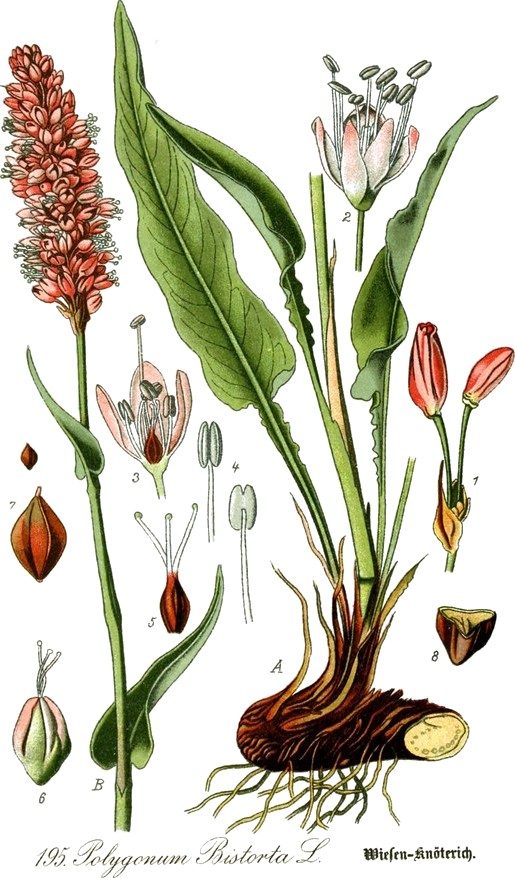
Bistort
Bistorta
- Known today as
- Bistorta officinalis, snakeweed.
- Kind
- Plant, in 1 older authority
- Constituents
- tannins, gallic acid, ellagic acid
- Earliest authority here
- Culpeper (1616–1654)
- In other databases
- Plants of the World Online search · GBIF search · Wikidata search
- In the Canale glossary
- On the Manner of Discerning and Healing the Bewitched, Appendix A: Part Three, Chapter 9: Anointings
Revised October 1, 2026: An older authority added from a text read in full. Version 1, first published September 25, 2026.
Bistort: what did Canale use it for?
Root in the oil (ch. 9).
Bistort: what does modern science say?
Rich in tannins, and long used for diarrhea and bleeding.
Pharmacognosy & Toxicology
- Constituents
- tannins15–20 per cent of the root, condensed and hydrolysable
- gallic acid ChEMBL
- ellagic acid ChEMBL
- Mechanism
- One of the most tannin-rich of the astringent roots: it tightens the gut lining and stops bleeding by protein precipitation, which is the whole of its action.
- Toxic dose
- Safe in the short term; tannin loads of this size irritate the stomach and bind iron if taken for weeks.
- Standing
- No EMA monograph; in the German tradition for diarrhoea and mouth inflammation.
- Wichtl, M. (2004). Herbal Drugs and Phytopharmaceuticals, 3rd ed., “Bistortae rhizoma.” Book, seen in reviews
Constituent names open the compound’s record at PubChem, and “ChEMBL” beside a name opens its record at ChEMBL, the European Bioinformatics Institute’s database of bioactive molecules. Where a mechanism line was checked against ChEMBL (ChEMBL 37, read 1 October 2026), the check is shown with the measured value and its source paper, or says plainly that nothing has been measured. Doses are as the references give them, for description only; this is not medical advice. Each source carries the result of its check against Crossref, PubMed, or the authority’s page: see Verification.
Bistort: what lore surrounds it?
Its young leaves are the essential ingredient of dock pudding, or Easter-ledge pudding, a Lenten dish of the Calder Valley in West Yorkshire, cooked with oatmeal, nettles, and onion and traditionally fried with bacon. It survives in the World Dock Pudding Championship, held at Mytholmroyd every year since 1971.
Bistort: what did the older authorities say?
- Culpeper
- Puts it under Saturn, cold and dry, and says both leaves and roots “have a powerful faculty to resist all poison”: the root in powder, taken in drink, expels the venom of the plague, smallpox, and measles by sweating; the decoction in wine stays all inward bleeding and fluxes, and “hinders abortion or miscarriage in child-bearing.”
Sources
- [49] Georgiev, Y. N., Ognyanov, M. H., & Denev, P. N. (2023). Phytochemical composition and therapeutic potential of Bistorta major Gray: a review. In S. Sotirov et al. (eds.), Recent Contributions to Bioinformatics and Biomedical Sciences and Engineering, Lecture Notes in Networks and Systems 658: 167–191. Cham: Springer. doi:10.1007/978-3-031-31069-0_17 Verified against its record · doi:10.1007/978-3-031-31069-0_17
- “Dock pudding” (reference article). Book, not indexed
- Culpeper, N. (1653). The Complete Herbal, “Bistort, Or Snakeweed.” Project Gutenberg #49513. Primary text
Verification
- Checked
- October 1, 2026
- Passes
- Every sentence read against its sources, in the pass over the remaining 343 entries
- The Standing line checked against the authority it names (EMA, WHO, FDA, CITES, Commission E)
- Every dated or regulatory claim checked by category across the database
- Each quotation from the older authorities checked word for word against the text, read in full
- Sources
- 4 cited: 1 verified against its record, 1 primary text, 1 book, seen in reviews, 1 book, not indexed.
- Corrections
- None were needed.
What was checked, how, and what was found is set out on the Verification page. A checked source is one whose record was found; it does not make the entry medical advice.
Cite This Entry
Version 1 · first published September 25, 2026 · last revised October 1, 2026
- Chicago
“Bistort.” In Materia Medica, edited by B. C. P. Statema. Version 1. The Thinking Press, 2026–. Last modified October 1, 2026. https://thethinkingpress.org/materia-medica/bistort.
- MLA
“Bistort.” Materia Medica, edited by B. C. P. Statema, version 1, The Thinking Press, 1 Oct. 2026, thethinkingpress.org/materia-medica/bistort. Accessed 8 Oct. 2026.
- APA
Bistort. (2026, October 1). In B. C. P. Statema (Ed.), Materia medica (Version 1). The Thinking Press. Retrieved October 8, 2026, from https://thethinkingpress.org/materia-medica/bistort
Club members keep entries on a shelf with private notes, print the plates as cards, and receive an entry by email each week. Create a free account before January 1, 2027 and all of it is yours for good. About the Club
See Also
Sharing tannins, gallic acid, ellagic acid
Potentilla reptans · Betonica officinalis · Succisa pratensis · Rumex crispus · Terminalia chebula · Oak galls · Punica granatum · Bezoar stone
Also in Nicholas Culpeper
Blackthorn in Nicholas Culpeper · Asarabacca in Nicholas Culpeper · Broom in Nicholas Culpeper · The amulet herbs in Nicholas Culpeper · everything Nicholas Culpeper names →
Drawing on the same sources: Culpeper, Wichtl
Nearby in the alphabet
Bitter aloes (A) · Birch polypore (A white bracket of dead birch) · Black hellebore (Helleborus niger) · Black pepper (The dried fruit of Piper nigrum) · Black walnut · Benzoin (the resin of Styrax benzoin of Sumatra)
Historical description, not medical advice.