
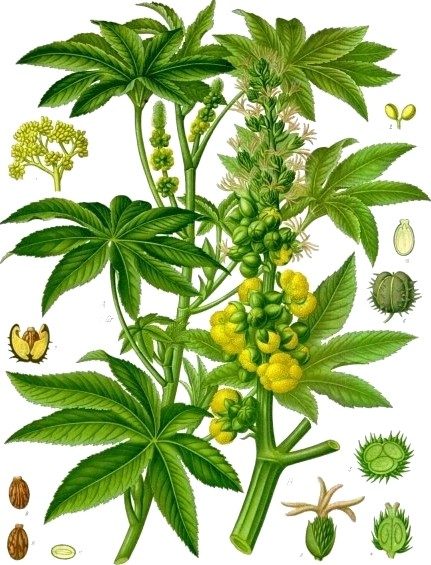
Castor-oil plant, seeds of
Ricino; kerua; grano regale
- Known today as
- Ricinus communis; Canale gives mirasole as its local name.
- Kind
- Plant, in 1 older authority
- Constituents
- ricin, ricinoleic acid
- Poisoning
- Gastrointestinal irritants
- Earliest authority here
- Herodotus (c. 484–c. 425 BC)
- In other databases
- Plants of the World Online search · GBIF search · Wikidata search
- In the Canale glossary
- On the Manner of Discerning and Healing the Bewitched, Appendix A: Part Three, Chapter 5: Vomitory Medicines
Revised October 1, 2026: Lore added from texts read in full. Version 1, first published September 25, 2026.
Caution. Hazardous in some form or dose; see the modern assessment below.
Castor-oil plant, seeds of: what did Canale use it for?
Up to fifteen seeds, cleaned and powdered, or candied, as a vomit that also purges (ch. 5; note XXXVI).
Castor-oil plant, seeds of: what does modern science say?
Dangerous. The seeds contain ricin, one of the most toxic natural substances, and two or three seeds have proved fatal; pressed castor oil, which leaves the ricin behind, is the safe laxative.
Castor-oil plant, seeds of: is it poisonous?
Yes, in some form or dose. Its poisoning is gastrointestinal irritants: Thirty minutes to three hours: the short latency is reassuring, since the deadly syndromes come later. Historical description, not medical advice; in a poisoning, call a poison centre.
Pharmacognosy & Toxicology
- Constituents
- ricinin the seed, not the oil
- ricinoleic acid ChEMBLthe purgative, in the oil
- Mechanism
- Ricin inactivates ribosomes; ricinoleic acid acts on the gut’s prostanoid receptors.
- Checked against ChEMBL
- ricinoleic acid: No measurement in ChEMBL for “acts on the gut's prostanoid receptors” (3 activities recorded, none against the target named); the line rests on its references.
- Toxic dose
- A few chewed seeds can kill; the pressed oil holds no ricin.
- Syndrome
- Gastrointestinal irritants
- Standing
- Castor oil is a licensed laxative; ricin is a scheduled chemical weapon.
- Audi, J., et al. (2005). “Ricin poisoning: a comprehensive review.” JAMA 294. Verified against its record · doi:10.1001/jama.294.18.2342
The abstract of each source, beneath its citation. For Club members. About the Club or sign in.
Constituent names open the compound’s record at PubChem, and “ChEMBL” beside a name opens its record at ChEMBL, the European Bioinformatics Institute’s database of bioactive molecules. Where a mechanism line was checked against ChEMBL (ChEMBL 37, read 1 October 2026), the check is shown with the measured value and its source paper, or says plainly that nothing has been measured. Doses are as the references give them, for description only; this is not medical advice. Each source carries the result of its check against Crossref, PubMed, or the authority’s page: see Verification.
Castor-oil plant, seeds of: what lore surrounds it?
Grieve traces the plant to Herodotus, “who calls it Kiki, and states that it furnishes an oil much used by the Egyptians, in whose ancient tombs seeds of Ricinus are met with,” and to “the Kikajon of the Book of Jonah, rendered by the translators of the English Bible, ‘gourd.’” Albertus Magnus cultivated it in the thirteenth century; the name “Castor” was first applied in Jamaica, “where it seems to have been called ‘Agnus Castus,’” and the botanical name “is from the Latin Ricinus (a dog-tick), from the form and markings of the seed.” In the Canary Islands nursing mothers apply the fresh leaves “to increase the flow of milk.”
Castor-oil plant, seeds of: what did the older authorities say?
- Herodotus
- Says the Egyptians pressed the oil of kiki to burn in their lamps.
Sources
- [16] The British Pharmaceutical Codex (1911). London: Pharmaceutical Society of Great Britain. Monographs as transcribed at Henriette’s Herbal Homepage, henriettes-herb.com. Read in full · the text read
- [22] Centers for Disease Control and Prevention. Ricin. Chemical Emergencies: Chemical Fact Sheets. cdc.gov. Book, not indexed
- [38] Encyclopaedia Britannica, online edition, britannica.com. Articles: Ambergris; Aristolochiaceae; Asafetida; Azurite; Castor-oil plant; Civet; Dragon’s blood; Garden cress; Jet; Kermes; Laudanum; Lye; Monemvasía; Musk; Precious coral; Saltpetre; Sulfur dioxide; Tartar emetic; Tropaeolum. Book, seen in reviews
- Grieve, M. (1931). A Modern Herbal, “Castor Oil Plant.” botanical.com/botanical/mgmh/c/casoil32.html Standard reference work
Verification
- Checked
- October 1, 2026
- Passes
- Every sentence read against its sources, in the pass over the remaining 343 entries
- The Standing line checked against the authority it names (EMA, WHO, FDA, CITES, Commission E)
- Every dated or regulatory claim checked by category across the database
- The mechanism read against ChEMBL (ChEMBL 37): curated mechanisms and measured activity
- Each quotation from the older authorities checked word for word against the text, read in full
- Sources
- 5 cited: 1 read in full, 1 verified against its record, 1 standard reference work, 1 book, seen in reviews, 1 book, not indexed. 1 with the abstract on file.
- Corrections
- None were needed.
What was checked, how, and what was found is set out on the Verification page. A checked source is one whose record was found; it does not make the entry medical advice.
Cite This Entry
Version 1 · first published September 25, 2026 · last revised October 1, 2026
- Chicago
“Castor-oil plant, seeds of.” In Materia Medica, edited by B. C. P. Statema. Version 1. The Thinking Press, 2026–. Last modified October 1, 2026. https://thethinkingpress.org/materia-medica/castor-oil-plant-seeds-of.
- MLA
“Castor-oil plant, seeds of.” Materia Medica, edited by B. C. P. Statema, version 1, The Thinking Press, 1 Oct. 2026, thethinkingpress.org/materia-medica/castor-oil-plant-seeds-of. Accessed 8 Oct. 2026.
- APA
Castor-oil plant, seeds of. (2026, October 1). In B. C. P. Statema (Ed.), Materia medica (Version 1). The Thinking Press. Retrieved October 8, 2026, from https://thethinkingpress.org/materia-medica/castor-oil-plant-seeds-of
Club members keep entries on a shelf with private notes, print the plates as cards, and receive an entry by email each week. Create a free account before January 1, 2027 and all of it is yours for good. About the Club
See Also
Poisoned alike: gastrointestinal irritants
Colocynth · Caper spurge · Common earthball · Bryony · Cyclamen, greater · Yellow stainer · Honey fungus · The sickener · the syndrome, with all of them →
Sharing ricin, ricinoleic acid
Also in Herodotus
Cinnamon in Herodotus · Alum in Herodotus · Frankincense in Herodotus · Storax calamite in Herodotus · everything Herodotus names →
Drawing on the same sources: Grieve, Audi
Nearby in the alphabet
Castoreum (The scent gland secretion of the beaver) · Cassia, flower of (the Indian laburnum) · Caterpillar fungus (sending up a slender stalk) · Cassia wood (Cinnamomum aromaticum (long known as Cinnamomum cassia)) · Cattail · Cardamom
Historical description, not medical advice.