
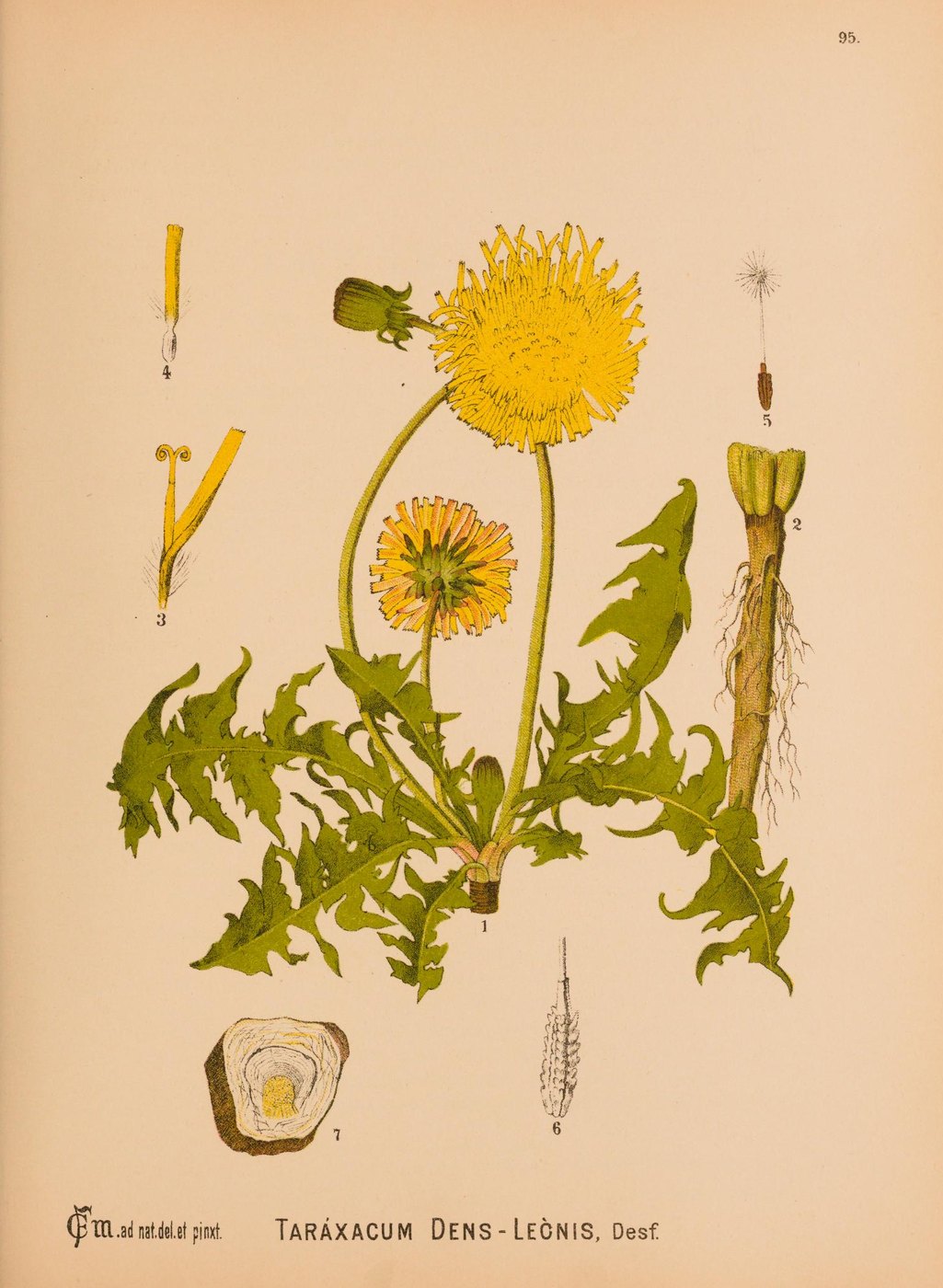
Dandelion
Taraxacum; French dent de lion, pissenlit
- Known today as
- Taraxacum officinale, of the daisy family.
- Kind
- Plant, in 1 older authority
- Constituents
- taraxacin, inulin, potassium, and 1 more
- Earliest authority here
- Its name
- In other databases
- Plants of the World Online search · GBIF search · Wikidata search
Dandelion: what was it used for?
A bitter for the liver and the gall, given for jaundice and obstructions; above all a diuretic, as its French name, pissenlit, says plainly.
Dandelion: foraging it in the Midwest
- Part
- Young leaves; root
- When
- Leaves in spring; root for a tea
The Flambeau Ojibwe gathered the young leaves in spring and cooked them with pork or venison for greens, with a vinegar of soured maple sap; the Pillager Ojibwe made a tea of the root for heartburn.
After Smith. All the foragables of the Midwest. Historical record, not a field guide: identify before you gather, and read the whole entry.
Dandelion: how is it taken as a tea?
An ounce of the herb infused ten minutes in a pint of boiling water, decanted and sweetened with honey, several glasses in the course of the day.
All the herbal teas of the database. Historical directions, not medical advice.
Dandelion: what does modern science say?
The leaf is a mild diuretic in a small human study; the root’s bitter compounds stimulate bile in animal work. No firm clinical evidence beyond that.
Pharmacognosy & Toxicology
- Constituents
- Mechanism
- The leaf is a diuretic because of its potassium load, which is why it does not deplete potassium like the drugs; a single human trial (Clare, 2009) measured the increase. The root’s bitters raise bile flow in animals and its inulin is a prebiotic.
- Toxic dose
- Safe as a vegetable; the latex is a contact allergen.
- Standing
- EMA monographs (2011) for the root with herb for mild dyspepsia and as a diuretic, and for the root for appetite; no trial for jaundice.
- EMA/HMPC (2011). Community herbal monograph on Taraxacum officinale Weber ex Wigg., radix cum herba (EMA/HMPC/212895/2008). Verified against its record
- Clare, B. A., et al. (2009). “The diuretic effect in human subjects of an extract of Taraxacum officinale folium over a single day.” Journal of Alternative and Complementary Medicine 15. Verified against its record · doi:10.1089/acm.2008.0152
The abstract of each source, beneath its citation. For Club members. About the Club or sign in.
Constituent names open the compound’s record at PubChem, and “ChEMBL” beside a name opens its record at ChEMBL, the European Bioinformatics Institute’s database of bioactive molecules. Where a mechanism line was checked against ChEMBL (ChEMBL 37, read 1 October 2026), the check is shown with the measured value and its source paper, or says plainly that nothing has been measured. Doses are as the references give them, for description only; this is not medical advice. Each source carries the result of its check against Crossref, PubMed, or the authority’s page: see Verification.
Dandelion: what lore surrounds it?
Children tell the hour by the number of breaths it takes to blow the seed-clock bare, and lovers blow it to learn whether they are thought of.
Dandelion: what did the older authorities say?
- Its name
- From the French dent de lion, lion’s tooth, for the jagged leaf.
Sources
- Grieve, M. (1931). A Modern Herbal, “Dandelion.” Book, not indexed
- Culpeper, N. (1652). The English Physitian. Primary text
Verification
- Checked
- October 1, 2026
- Passes
- Every sentence read against its sources, in the pass over the remaining 343 entries
- The Standing line checked against the authority it names (EMA, WHO, FDA, CITES, Commission E)
- Every dated or regulatory claim checked by category across the database
- Sources
- 4 cited: 2 verified against its record, 1 primary text, 1 book, not indexed. 1 with the abstract on file.
- Corrections
- None were needed.
What was checked, how, and what was found is set out on the Verification page. A checked source is one whose record was found; it does not make the entry medical advice.
Cite This Entry
Version 1 · first published September 30, 2026
- Chicago
“Dandelion.” In Materia Medica, edited by B. C. P. Statema. Version 1. The Thinking Press, 2026–. Last modified September 30, 2026. https://thethinkingpress.org/materia-medica/dandelion.
- MLA
“Dandelion.” Materia Medica, edited by B. C. P. Statema, version 1, The Thinking Press, 30 Sept. 2026, thethinkingpress.org/materia-medica/dandelion. Accessed 8 Oct. 2026.
- APA
Dandelion. (2026, September 30). In B. C. P. Statema (Ed.), Materia medica (Version 1). The Thinking Press. Retrieved October 8, 2026, from https://thethinkingpress.org/materia-medica/dandelion
Club members keep entries on a shelf with private notes, print the plates as cards, and receive an entry by email each week. Create a free account before January 1, 2027 and all of it is yours for good. About the Club
See Also
Sharing inulin, potassium, taraxasterol
Inula helenium · Cichorium intybus · Cichorium endivia · Burdock · Raisins · Viola odorata
Drawing on the same sources: Grieve, Culpeper
Devil’s-bit scabious · Cumin · Dragon’s blood · Crabs’ eyes · Diacatholicon · the bibliography →
Nearby in the alphabet
Deadly fibrecap (of spring and summer woods) · Damascus prunes (Prunus insititia, dried) · Deadly nightshade (of the nightshade family) · Cyprus powder (a perfumed toilet powder) · Deadly webcap · Cypress (Cupressus sempervirens) · Death cap (white-gilled mushroom of oak and beech woods, now spread worldwide) · Cyclosporin fungus (A soil fungus)
Historical description, not medical advice.