
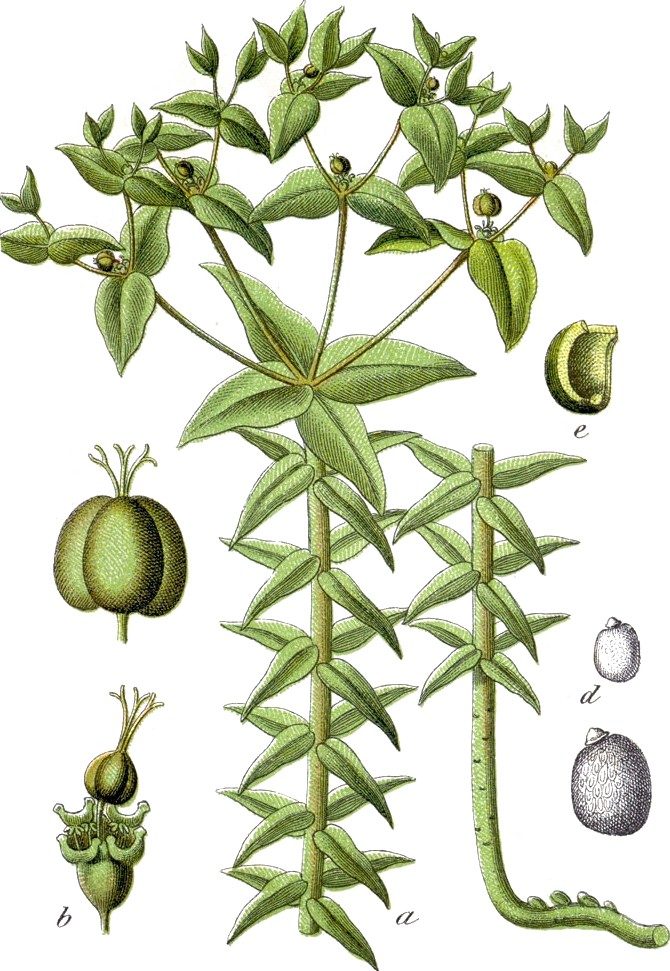
Caper spurge
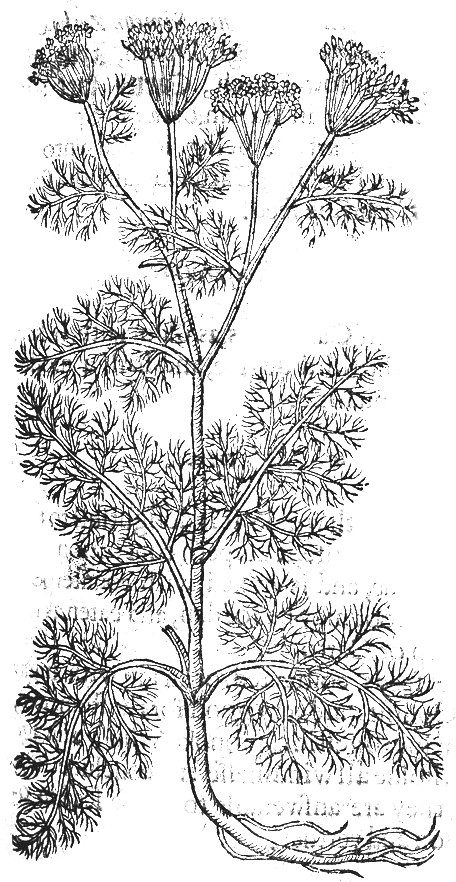
Latiri; cataputia minore
- Known today as
- Euphorbia lathyris.
- Kind
- Plant, in 1 older authority
- Constituents
- ingenol, phorbol esters
- Poisoning
- Gastrointestinal irritants
- Earliest authority here
- Pliny (AD 23/24–79)
- In other databases
- Plants of the World Online search · GBIF search · Wikidata search
- In the Canale glossary
- On the Manner of Discerning and Healing the Bewitched, Appendix A: Part Three, Chapter 5: Vomitory Medicines
Revised October 1, 2026: An older authority added from a text read in full. Lore added from texts read in full. Version 1, first published September 25, 2026.
Caution. Hazardous in some form or dose; see the modern assessment below.
Caper spurge: what did Canale use it for?
Eight or ten seeds whole in an egg, or leaves in broth, as a vomit; its milky sap only with great care (ch. 5; note XXXVII).
Caper spurge: what does modern science say?
The seeds are purgative, the root purgative and emetic, the milky juice acrid, and the leaves blister. Canale’s warning about the sap is sound.
Caper spurge: is it poisonous?
Yes, in some form or dose. Its poisoning is gastrointestinal irritants: Thirty minutes to three hours: the short latency is reassuring, since the deadly syndromes come later. Historical description, not medical advice; in a poisoning, call a poison centre.
Pharmacognosy & Toxicology
- Constituents
- Mechanism
- The diterpene esters activate protein kinase C and inflame skin and gut.
- Checked against ChEMBL
- ingenol: No measurement in ChEMBL for “activate protein kinase C” (23 activities recorded, none against the target named); the line rests on its references.
- Toxic dose
- A few seeds purge violently; the latex blisters and blinds.
- Syndrome
- Gastrointestinal irritants
- Standing
- Ingenol mebutate, from a related spurge, was licensed for actinic keratosis in 2012 and withdrawn in Europe in 2020.
- Nelson, L. S., et al. (2007). Handbook of Poisonous and Injurious Plants. Verified against its record · doi:10.1007/978-1-4939-8926-3
Constituent names open the compound’s record at PubChem, and “ChEMBL” beside a name opens its record at ChEMBL, the European Bioinformatics Institute’s database of bioactive molecules. Where a mechanism line was checked against ChEMBL (ChEMBL 37, read 1 October 2026), the check is shown with the measured value and its source paper, or says plainly that nothing has been measured. Doses are as the references give them, for description only; this is not medical advice. Each source carries the result of its check against Crossref, PubMed, or the authority’s page: see Verification.
Caper spurge: what lore surrounds it?
Thiselton-Dyer has the spurges among the devil's plants, “the spurge having long been named ‘devil's milk,’” the sun-spurge nicknamed cat's-milk “from its milky juice oozing in drops, as milk from the small teats of a cat,” and in Scotland “a popular cure for ringworm” being a decoction of sun-spurge, “or, as it is locally termed, ‘mare's milk.’”
Caper spurge: what did the older authorities say?
- Pliny
- Describes the lathyris, with leaves like the lettuce and buds whose seed is enclosed “in envelopes like that of the caper”: the seeds, about the size of a peppercorn, “white, sweet, and easily cleansed from the husk,” twenty of them taken in water or hydromel “are curative of dropsy, and carry off bile,” and those who need a stronger purgative take more.
Sources
- [54] Grieve, M. (1931). A Modern Herbal. Online edition, botanical.com, cited under the plant concerned. Read in part · the text read
- Pliny the Elder, Natural History 27.71, trans. J. Bostock & H. T. Riley (1855), Perseus Digital Library. Primary text
- Thiselton-Dyer, T. F. (1889). The Folk-lore of Plants. Project Gutenberg #10118. Read in part · the text read
Verification
- Checked
- October 1, 2026
- Passes
- Every sentence read against its sources, in the pass over the remaining 343 entries
- The Standing line checked against the authority it names (EMA, WHO, FDA, CITES, Commission E)
- Every dated or regulatory claim checked by category across the database
- The mechanism read against ChEMBL (ChEMBL 37): curated mechanisms and measured activity
- Each quotation from the older authorities checked word for word against the text, read in full
- Sources
- 4 cited: 2 read in part, 1 verified against its record, 1 primary text.
- Corrections
- None were needed.
What was checked, how, and what was found is set out on the Verification page. A checked source is one whose record was found; it does not make the entry medical advice.
Cite This Entry
Version 1 · first published September 25, 2026 · last revised October 1, 2026
- Chicago
“Caper spurge.” In Materia Medica, edited by B. C. P. Statema. Version 1. The Thinking Press, 2026–. Last modified October 1, 2026. https://thethinkingpress.org/materia-medica/caper-spurge.
- MLA
“Caper spurge.” Materia Medica, edited by B. C. P. Statema, version 1, The Thinking Press, 1 Oct. 2026, thethinkingpress.org/materia-medica/caper-spurge. Accessed 8 Oct. 2026.
- APA
Caper spurge. (2026, October 1). In B. C. P. Statema (Ed.), Materia medica (Version 1). The Thinking Press. Retrieved October 8, 2026, from https://thethinkingpress.org/materia-medica/caper-spurge
Club members keep entries on a shelf with private notes, print the plates as cards, and receive an entry by email each week. Create a free account before January 1, 2027 and all of it is yours for good. About the Club
See Also
Poisoned alike: gastrointestinal irritants
Castor-oil plant, seeds of · Bryony · Colocynth · Yellow stainer · Common earthball · The sickener · Cyclamen, greater · Scammony · the syndrome, with all of them →
Also in Pliny the Elder
Cassia wood in Pliny the Elder · Castoreum in Pliny the Elder · Broom in Pliny the Elder · everything Pliny the Elder names →
Drawing on the same sources: Thiselton-Dyer, Nelson
Nearby in the alphabet
The Caravaca cross · Cantharides (The dried blister beetle Lytta vesicatoria) · Caraway broth (Carum carvi) · Camphor (The crystalline gum of Cinnamomum camphora) · Cardamom · Calamine (Zinc carbonate and zinc oxide) · Carmelite water (with lemon peel, nutmeg, coriander, and angelica, distilled in spirit) · Caesar’s mushroom (egg-like when young and seated in a white cup)
Historical description, not medical advice.