
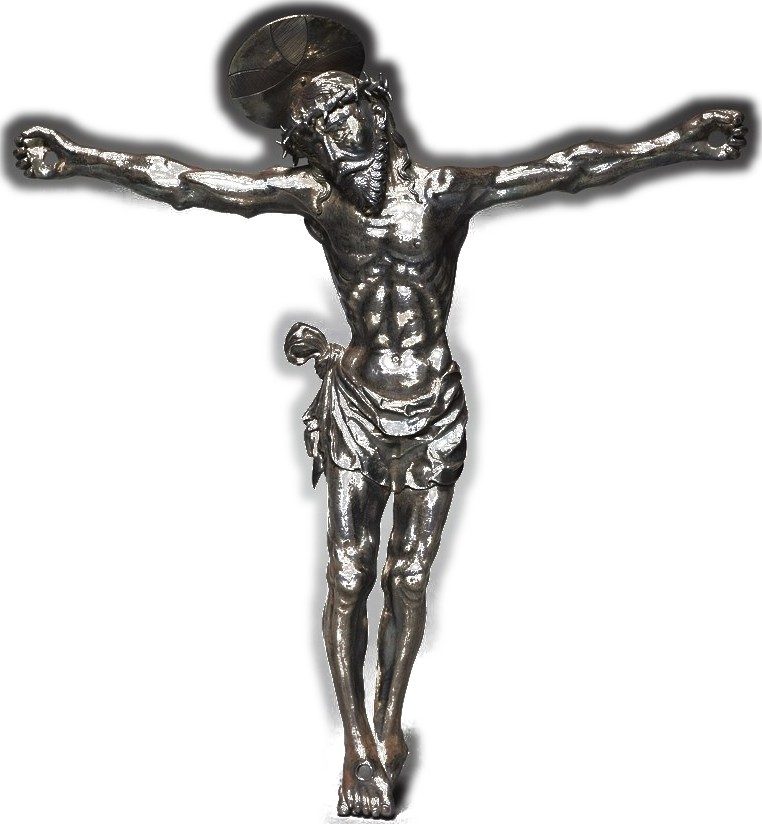
Crucifix
Crocifisso
- Known today as
- The image of Christ on the Cross.
- Kind
- Sacramental, in 1 older authority
- Earliest authority here
- The Catholic Encyclopedia (New York, 1907–1914)
- In the Canale glossary
- On the Manner of Discerning and Healing the Bewitched, Appendix A: Treatise Two: Blessed Objects and Materials
Revised October 1, 2026: An authority added from a text read in full. Version 1, first published September 25, 2026.
Crucifix: what did Canale use it for?
The display of “images of the Crucified” drives off demons (Treatise Two; note LXV).
Crucifix: what does modern science say?
In universal Christian use.
What Medicine Makes of It
- The Rite as TherapyWhy exorcism works when it works: persuasion, community, and the ending.
- Gassner and MesmerThe exorcist and the magnetiser, 1775: how exorcism became psychotherapy.
Crucifix: what lore surrounds it?
The crucifix’s power over vampires, which most readers now bring to it, is a literary invention of the nineteenth century, fixed by Stoker in 1897, rather than older folk belief; its long, documented history is against demons and hexes, as in Canale.
Crucifix: what did the older authorities say?
- The Catholic Encyclopedia
- The Catholic Encyclopedia reads the Palatine graffito of the crucified man with an ass's head as proof “that the Christians used the crucifix in their private devotions at least as early as the third century.” The Rituale Romanum supplies for a cross a blessing that “consists only of a short prayer, with a second prayer whose use is optional, and only holy water is used,” with the rubric directing the priest to kneel and “devoutly adore and kiss the cross.” In the ancient ceremony “the cross was first washed with holy water and then anointed with chrism precisely as in the form for the blessing of bells,” and St. Louis of France “regarded it as unseemly that crosses and statues should be set up for veneration without being previously blessed.”
Sources
- The Catholic Encyclopedia (New York, 1907–1914), “Cross and Crucifix in Archæology.” newadvent.org/cathen/04517a.htm Standard reference work
- The Catholic Encyclopedia (New York, 1907–1914), “Cross and Crucifix in Liturgy.” newadvent.org/cathen/04533a.htm Standard reference work
Verification
- Checked
- October 1, 2026
- Passes
- Every dated or regulatory claim checked by category across the database
- Each quotation from the older authorities checked word for word against the text, read in full
- Sources
- 2 cited: 2 standard reference work.
- Corrections
- None were needed.
What was checked, how, and what was found is set out on the Verification page. A checked source is one whose record was found; it does not make the entry medical advice.
Cite This Entry
Version 1 · first published September 25, 2026 · last revised October 1, 2026
- Chicago
“Crucifix.” In Materia Medica, edited by B. C. P. Statema. Version 1. The Thinking Press, 2026–. Last modified October 1, 2026. https://thethinkingpress.org/materia-medica/crucifix.
- MLA
“Crucifix.” Materia Medica, edited by B. C. P. Statema, version 1, The Thinking Press, 1 Oct. 2026, thethinkingpress.org/materia-medica/crucifix. Accessed 8 Oct. 2026.
- APA
Crucifix. (2026, October 1). In B. C. P. Statema (Ed.), Materia medica (Version 1). The Thinking Press. Retrieved October 8, 2026, from https://thethinkingpress.org/materia-medica/crucifix
Club members keep entries on a shelf with private notes, print the plates as cards, and receive an entry by email each week. Create a free account before January 1, 2027 and all of it is yours for good. About the Club
See Also
Also in The Catholic Encyclopedia
Earth of the Holy Land in The Catholic Encyclopedia · Cornicello in The Catholic Encyclopedia · Epiphany chalk in The Catholic Encyclopedia · Contact relics in The Catholic Encyclopedia · everything The Catholic Encyclopedia names →
Nearby in the alphabet
Cubeb (a Javanese pepper whose berries keep a little stalk, like a tail) · Crow’s gall (The bile of a crow) · Cumin (Cuminum cyminum) · Cramp rings (made from gold and silver offered at the cross) · Cuttlefish bone (washed up on beaches) · Crabs’ eyes (Chalky stones from the stomachs of crayfish) · Cyclamen, greater (Cyclamen purpurascens or C) · Cowslip (Primula veris)


Historical description, not medical advice.