
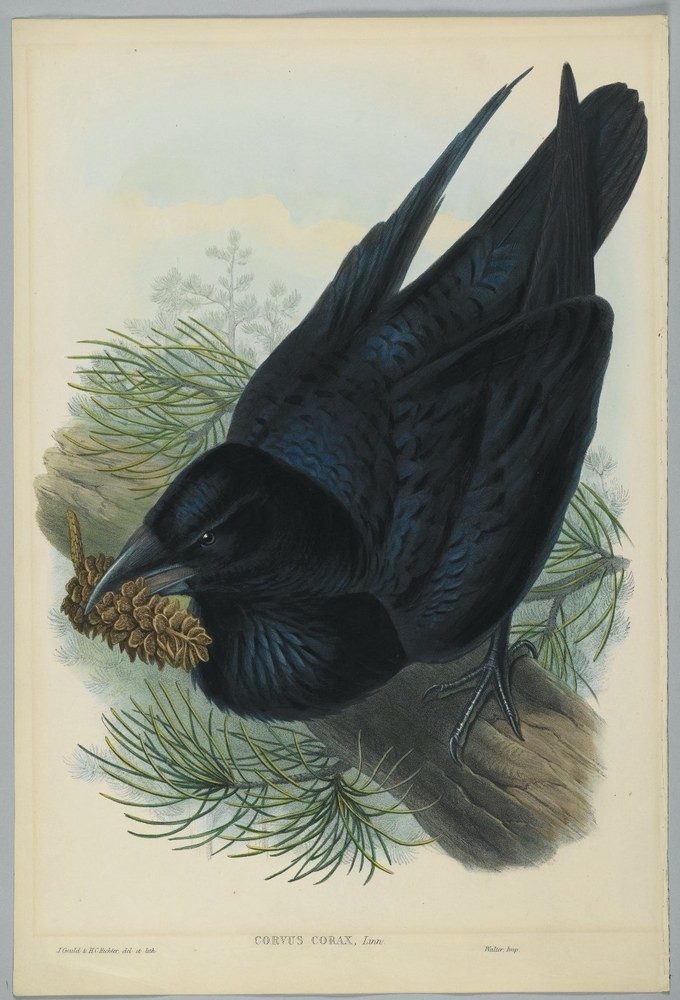
Crow’s gall
Fiel di corvo
- Known today as
- The bile of a crow.
- Kind
- Animal, in 2 older authorities
- Constituents
- bile acids, biliverdin
- In the Canale glossary
- On the Manner of Discerning and Healing the Bewitched, Appendix A: Part Three, Chapter 9: Anointings
Revised October 1, 2026: Tradition, lore, modern assessment, and sources extended. Version 1, first published September 25, 2026.
Crow’s gall: what did Canale use it for?
With jasmine oil for anointing (ch. 9).
Crow’s gall: what does modern science say?
Animal galls were used in ancient eye medicine. Bile salts are detergents and can thin mucus, which may be why galls seemed to clear the eyes; the practice is abandoned.
The toxic dose and the poisoning
- Toxic dose
- None.
The references for these lines are listed under Pharmacognosy, in Science. Doses are as the references give them, for description only; this is not medical advice. In a poisoning, call a poison centre.
Crow’s gall: what did the older authorities say?
- Dioscorides and Galenc. AD 40–90
- Give the galls of many animals, the hyena, the ox, the goat, the partridge, for dimness of the eyes; the crow’s bile belongs to this long tradition of gall as a medicine for sight.
- The Book of Tobit
- Tobias cures his father’s blindness with the gall of a fish, by the angel’s instruction, the scriptural warrant for every later gall.
Crow’s gall: what lore surrounds it?
The crow, as a bird of omen and of the gallows, lent its parts to the magical pharmacy; the choice of a crow’s gall for anointing the bewitched is sympathy of the darkest bird against the dark.
Pharmacognosy
- Constituents
- bile acidscholic and chenodeoxycholic
- biliverdin ChEMBLthe green of bird bile
- Mechanism
- Bird bile, applied in oil: bile acids are detergents that would irritate the skin and nothing more. The Chinese bear bile of the same tradition has a real drug in it, ursodeoxycholic acid, now synthesised; crow’s bile has not been studied and there is no reason it should be.
- Standing
- A sympathetic ingredient; nothing in modern use.
- Hagey, L. R., et al. (1993). “Ursodeoxycholic acid in the Ursidae: biliary bile acids of bears, pandas, and related carnivores.” Journal of Lipid Research 34. Verified against its record · doi:10.1016/s0022-2275(20)35109-9
The abstract of each source, beneath its citation. For Club members. About the Club or sign in.
Constituent names open the compound’s record at PubChem, and “ChEMBL” beside a name opens its record at ChEMBL, the European Bioinformatics Institute’s database of bioactive molecules. Where a mechanism line was checked against ChEMBL (ChEMBL 37, read 1 October 2026), the check is shown with the measured value and its source paper, or says plainly that nothing has been measured. Doses are as the references give them, for description only; this is not medical advice. Each source carries the result of its check against Crossref, PubMed, or the authority’s page: see Verification.
Sources
- [107] Retief, F., Stulting, A., & Cilliers, L. (2008). The eye in antiquity. South African Medical Journal 98(9): 697–700. Verified against its record · PMID 19115749
- Tobit 6:4–9; 11:10–13. Book, seen in reviews
- Dioscorides, De materia medica II. Read in part · the text read
Verification
- Checked
- October 1, 2026
- Passes
- Read against its sources in the pass over the remaining 343 entries
- Every dated or regulatory claim checked by category across the database
- Sources
- 4 cited: 1 read in part, 2 verified against its record, 1 book, seen in reviews. 1 with the abstract on file.
- Corrections
- None recorded.
What was checked, how, and what was found is set out on the Verification page. A checked source is one whose record was found; it does not make the entry medical advice.
Club members can point at a technical term in this entry, such as a constituent, an action, or a word of Jung’s, to read its definition from the source. The Club.
Cite This Entry
Version 1 · first published September 25, 2026 · last revised October 1, 2026
- Chicago
“Crow’s gall.” In Materia Medica, edited by B. C. P. Statema. Version 1. The Thinking Press, 2026–. Last modified October 1, 2026. https://thethinkingpress.org/materia-medica/crows-gall.
- MLA
“Crow’s gall.” Materia Medica, edited by B. C. P. Statema, version 1, The Thinking Press, 1 Oct. 2026, thethinkingpress.org/materia-medica/crows-gall. Accessed 22 Nov. 2026.
- APA
Crow’s gall. (2026, October 1). In B. C. P. Statema (Ed.), Materia medica (Version 1). The Thinking Press. Retrieved November 22, 2026, from https://thethinkingpress.org/materia-medica/crows-gall
See Also
Also in Dioscorides
Cuttlefish bone in Dioscorides · Comfrey in Dioscorides · Fenugreek in Dioscorides · Coltsfoot in Dioscorides · everything Dioscorides names →
Drawing on the same sources: Dioscorides
Nearby in the alphabet
Crucifix (The image of Christ on the Cross) · Cranberry · Cubeb (a Javanese pepper whose berries keep a little stalk, like a tail) · Cramp rings (made from gold and silver offered at the cross) · Cumin (Cuminum cyminum) · Crabs’ eyes (Chalky stones from the stomachs of crayfish) · Cowslip (Primula veris)

Historical description, not medical advice.
