
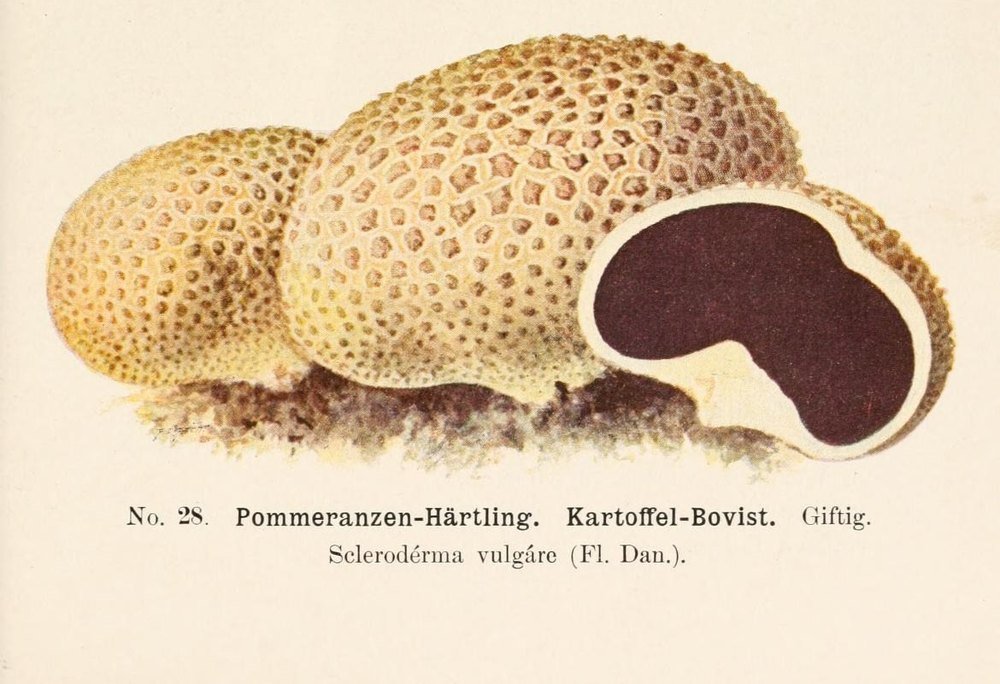
Common earthball
Scleroderma citrinum
- Known today as
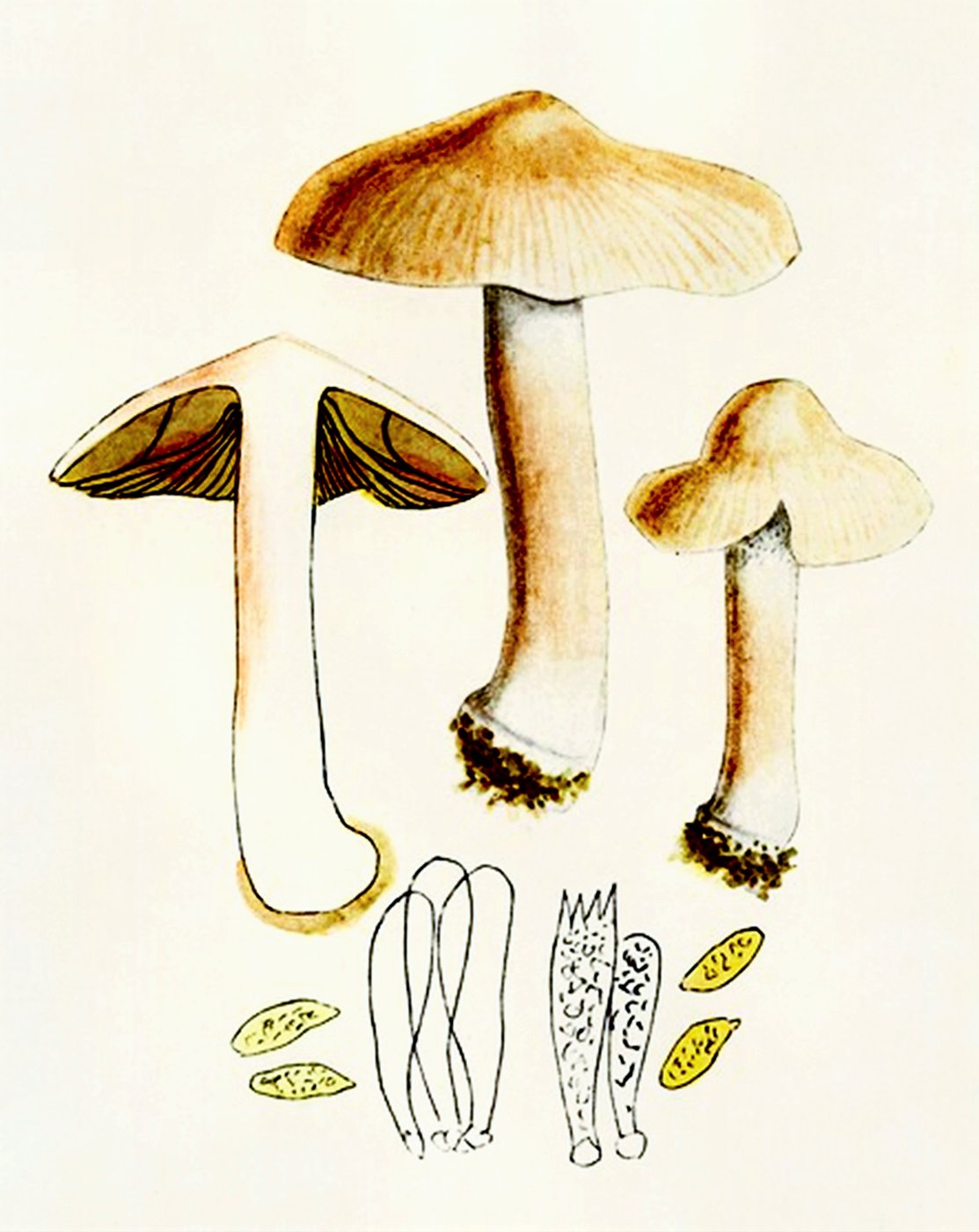
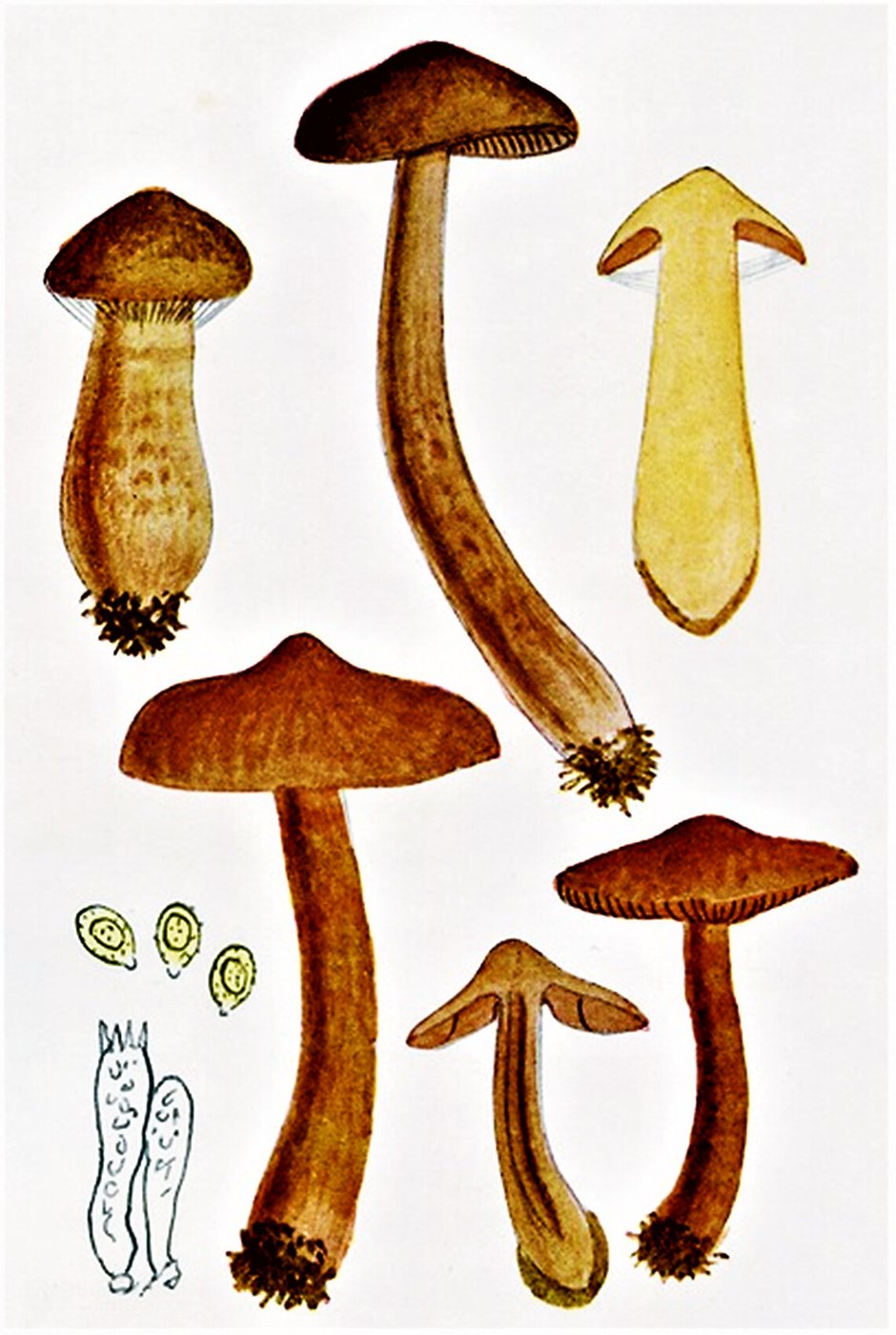
- A hard, yellow-brown ball with a black interior, of acid woodland.
- Kind
- Fungus
- Constituents
- sclerocitrin, unidentified gastrointestinal irritant
- Poisoning
- Gastrointestinal irritants
- In other databases
- GBIF search · Wikidata search
Revised October 3, 2026: Tradition, lore, modern assessment, and sources extended. Checked against its sources, each read in full, in part, or in its abstract. Version 1, first published September 25, 2026.
Caution. Poisonous.
Common earthball: what was it used for?
Put into foie gras, dishonestly, to pass for truffle.
Common earthball: what does modern science say?
Eaten, it brings vomiting, stomach pain, sweating, and faintness, sometimes within half an hour; its spores can inflame the eyes and nose.
Common earthball: is it poisonous?
Yes, in some form or dose. Poisonous. Its poisoning is gastrointestinal irritants: Thirty minutes to three hours: the short latency is reassuring, since the deadly syndromes come later. Historical description, not medical advice; in a poisoning, call a poison centre.
Pharmacognosy & Toxicology
- Constituents
- Mechanism
- Eaten in quantity it gives vomiting and diarrhoea, and its spores can inflame the eyes and nose; the toxin is not identified.
- Toxic dose
- Toxic in large amounts, harmless in small, by one account.
- Syndrome
- Gastrointestinal irritants
- Standing
- Poisonous; once used in truffle fraud.
Constituent names open the compound’s record at PubChem, and “ChEMBL” beside a name opens its record at ChEMBL, the European Bioinformatics Institute’s database of bioactive molecules. Where a mechanism line was checked against ChEMBL (ChEMBL 37, read 1 October 2026), the check is shown with the measured value and its source paper, or says plainly that nothing has been measured. Doses are as the references give them, for description only; this is not medical advice. Each source carries the result of its check against Crossref, PubMed, or the authority’s page: see Verification.
Common earthball: what lore surrounds it?
Once an adulterant of truffle.
Sliced across, the young earthball is black marbled with white, a little like truffle, and smells of metal; dishonest dealers passed it off as truffle in foie gras, and the beginner mistakes it for a puffball, which is softer.
In Their Own Words
The 1911 Britannica says Scleroderma vulgare is very common in woods and was gathered in Epping Forest for the cheaper London dining-rooms serving continental dishes, and calls it worthless, offensive and possibly dangerous.
“…is extremely common on the surface of the ground in woods, and is gathered by Italians and Frenchmen in Epping Forest for the inferior dining-rooms of London where continental dishes are served. It is a worthless, offensive, and possibly dangerous fungus.”
Encyclopædia Britannica, eleventh edition: Truffle, “Truffle”, vol. 27. The 1911 Encyclopædia Britannica, as transcribed on Wikisource. The text, read in full
Each passage is quoted from the text named, which the press fetched and read, and was checked word for word against a fresh copy of it; the link opens that copy. Passages are given as printed, without the editors’ footnote numbers, and with words broken across lines joined.
Sources
- Wikipedia (de), “Dickschaliger Kartoffelbovist,” de.wikipedia.org (read 2 October 2026). Read in full · the text read
- Wikipédia, “Scléroderme commun,” fr.wikipedia.org (read 2 October 2026). Read in full · the text read
Verification
- Checked
- October 1, 2026, and October 3, 2026
- Passes
- Every sentence read against its sources, in the pass over the remaining 343 entries
- The Standing line checked against the authority it names (EMA, WHO, FDA, CITES, Commission E)
- Every dated or regulatory claim checked by category across the database
- Every source read, in full, in part, or in its abstract, and every sentence checked against what was read (October 3, 2026)
- Sources
- 2 cited: 2 read in full.
- Corrections
- None were needed.
What was checked, how, and what was found is set out on the Verification page. A checked source is one whose record was found; it does not make the entry medical advice.
Cite This Entry
Version 1 · first published September 25, 2026 · last revised October 3, 2026
- Chicago
“Common earthball.” In Materia Medica, edited by B. C. P. Statema. Version 1. The Thinking Press, 2026–. Last modified October 3, 2026. https://thethinkingpress.org/materia-medica/common-earthball.
- MLA
“Common earthball.” Materia Medica, edited by B. C. P. Statema, version 1, The Thinking Press, 3 Oct. 2026, thethinkingpress.org/materia-medica/common-earthball. Accessed 8 Oct. 2026.
- APA
Common earthball. (2026, October 3). In B. C. P. Statema (Ed.), Materia medica (Version 1). The Thinking Press. Retrieved October 8, 2026, from https://thethinkingpress.org/materia-medica/common-earthball
Club members keep entries on a shelf with private notes, print the plates as cards, and receive an entry by email each week. Create a free account before January 1, 2027 and all of it is yours for good. About the Club
See Also
Poisoned alike: gastrointestinal irritants
Cyclamen, greater · Colocynth · Honey fungus · Castor-oil plant, seeds of · Jack-o’-lantern · Caper spurge · Jalap · Bryony · the syndrome, with all of them →
Nearby in the alphabet
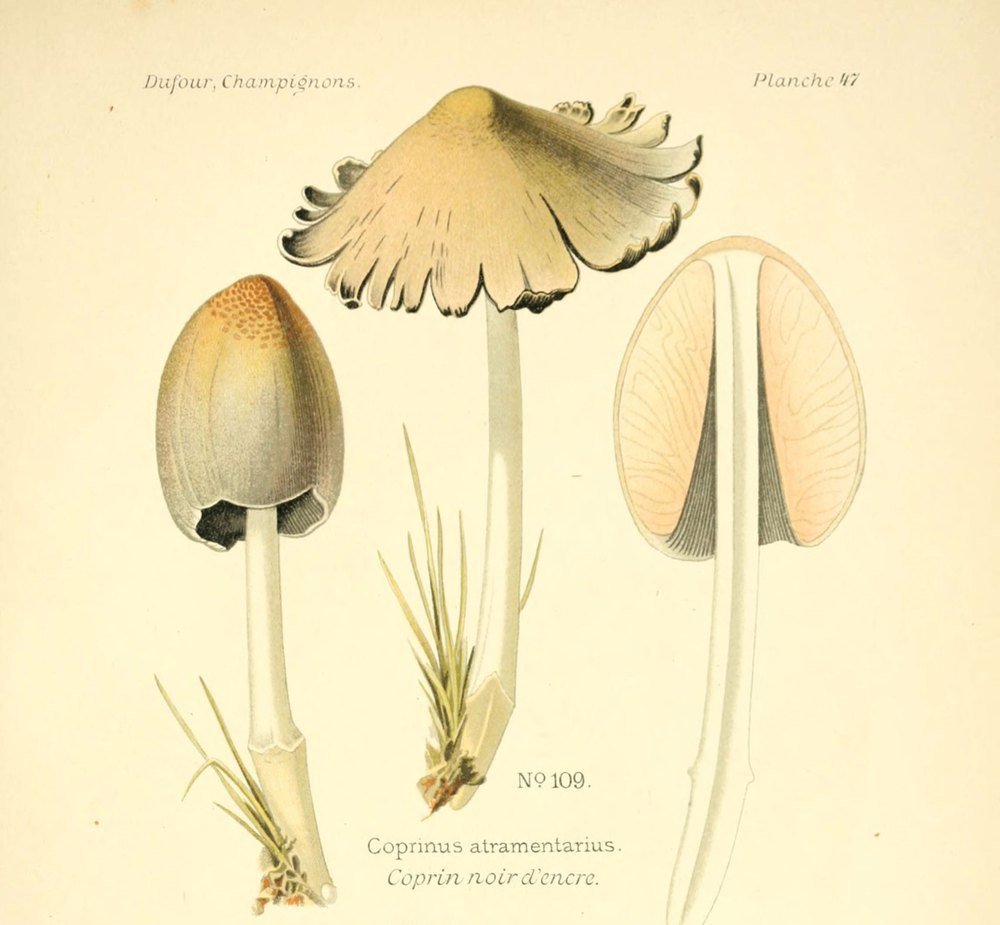
Common ink cap (A grey mushroom that dissolves into black ink as it ages) · Comfrey (Symphytum officinale) · Compound fumitory (Fumaria officinalis, with other herbs) · Coltsfoot (Tussilago farfara) · Concealed shoes · Confection of alkermes (with apple juice, rose water, sugar, ambergris, and gold) · Coffee (The roasted seeds of Coffea arabica)
_(8510517348).jpg)
Historical description, not medical advice.