
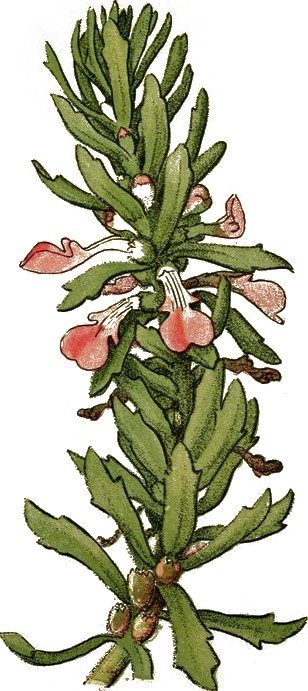
Arthritica
Artetico; iva artetica
- Known today as
- Ajuga iva, named for its use against gout (note XLIX).
- Kind
- Plant, in 1 older authority
- Constituents
- ajugarin I, ecdysterone, iridoid glycosides
- Earliest authority here
- Pliny (AD 23/24–79)
- In other databases
- Plants of the World Online search · GBIF search · Wikidata search
- In the Canale glossary
- On the Manner of Discerning and Healing the Bewitched, Appendix A: Part Three, Chapter 10: Amulets
Revised October 1, 2026: An older authority added from a text read in full. Version 1, first published September 25, 2026.
Arthritica: what did Canale use it for?
Among the amulet herbs: hung about the neck, and used in fumigations and decoctions against hexes (ch. 10; see the amulet herbs).
Arthritica: what does modern science say?
Some anti-inflammatory activity is reported in animals; no established effect.
Pharmacognosy & Toxicology
- Constituents
- ajugarin I ChEMBLa clerodane diterpene
- ecdysterone ChEMBLan insect-moulting hormone, in the Ajuga species
- iridoid glycosidesharpagide, 8-O-acetylharpagide
- Mechanism
- Canale’s iva artetica is a ground pine or bugle, Ajuga chamaepitys or A. iva: its iridoids and diterpenes have anti-inflammatory and antinociceptive action in rodents, and the ecdysteroids are anabolic in insects, not in people.
- Toxic dose
- No human toxicity recorded; the plant is bitter enough to limit the dose.
- Standing
- No monograph; Ajuga iva remains in North African folk medicine for diabetes and rheumatism, with animal data only.
- Bouyahya, A., et al. (2020). “Ethnomedicinal use, phytochemistry, pharmacology, and toxicology of Ajuga iva.” Journal of Ethnopharmacology 258. Verified against its record · doi:10.1016/j.jep.2020.112875
- Israili, Z. H., and Lyoussi, B. (2009). “Ethnopharmacology of the plants of genus Ajuga.” Pakistan Journal of Pharmaceutical Sciences 22. Verified against its record · PMID 19783524
The abstract of each source, beneath its citation. For Club members. About the Club or sign in.
Constituent names open the compound’s record at PubChem, and “ChEMBL” beside a name opens its record at ChEMBL, the European Bioinformatics Institute’s database of bioactive molecules. Where a mechanism line was checked against ChEMBL (ChEMBL 37, read 1 October 2026), the check is shown with the measured value and its source paper, or says plainly that nothing has been measured. Doses are as the references give them, for description only; this is not medical advice. Each source carries the result of its check against Crossref, PubMed, or the authority’s page: see Verification.
Arthritica: what did the older authorities say?
- Pliny
- Of the chamaepitys, “called in Latin abiga, because it promotes abortion, and known to some as incense of the earth,” with the odour and blossoms of the pine, he gives three kinds, the third “altogether smaller, with a stem the thickness of one’s finger,” though with the same smell and so the same name.
Sources
- [12] Boutora, Y., Boussekine, S., Benslama, O., et al. (2026). Bioactive potential and COX-2 interaction of Ajuga iva (L.) Schreb. hydroalcoholic extract. Molecules 31(3): 496. doi:10.3390/molecules31030496 Verified against its record · doi:10.3390/molecules31030496
- Pliny the Elder, Natural History 24.20, trans. J. Bostock & H. T. Riley (1855), Perseus Digital Library. Primary text
Verification
- Checked
- October 1, 2026
- Passes
- Every sentence read against its sources, in the pass over the remaining 343 entries
- The Standing line checked against the authority it names (EMA, WHO, FDA, CITES, Commission E)
- Every dated or regulatory claim checked by category across the database
- Each quotation from the older authorities checked word for word against the text, read in full
- Sources
- 4 cited: 3 verified against its record, 1 primary text. 3 with the abstract on file.
- Corrections
- None were needed.
What was checked, how, and what was found is set out on the Verification page. A checked source is one whose record was found; it does not make the entry medical advice.
Cite This Entry
Version 1 · first published September 25, 2026 · last revised October 1, 2026
- Chicago
“Arthritica.” In Materia Medica, edited by B. C. P. Statema. Version 1. The Thinking Press, 2026–. Last modified October 1, 2026. https://thethinkingpress.org/materia-medica/arthritica.
- MLA
“Arthritica.” Materia Medica, edited by B. C. P. Statema, version 1, The Thinking Press, 1 Oct. 2026, thethinkingpress.org/materia-medica/arthritica. Accessed 8 Oct. 2026.
- APA
Arthritica. (2026, October 1). In B. C. P. Statema (Ed.), Materia medica (Version 1). The Thinking Press. Retrieved October 8, 2026, from https://thethinkingpress.org/materia-medica/arthritica
Club members keep entries on a shelf with private notes, print the plates as cards, and receive an entry by email each week. Create a free account before January 1, 2027 and all of it is yours for good. About the Club
See Also
Sharing iridoid glycosides
Also in Pliny the Elder
Asarabacca in Pliny the Elder · Armenian stone, pills of in Pliny the Elder · Balm of Gilead in Pliny the Elder · Aniseed in Pliny the Elder · everything Pliny the Elder names →
Nearby in the alphabet
Asafoetida (“devil’s dung) · Armenian bole (colored by iron oxide) · The aspergillum (or perforated ball on a handle, with which holy water is sprinkled) · Apples, syrup of (A syrup of sweet apples) · Aster (Aster amellus) · Antimony (The metallic element and its compounds)
Historical description, not medical advice.