
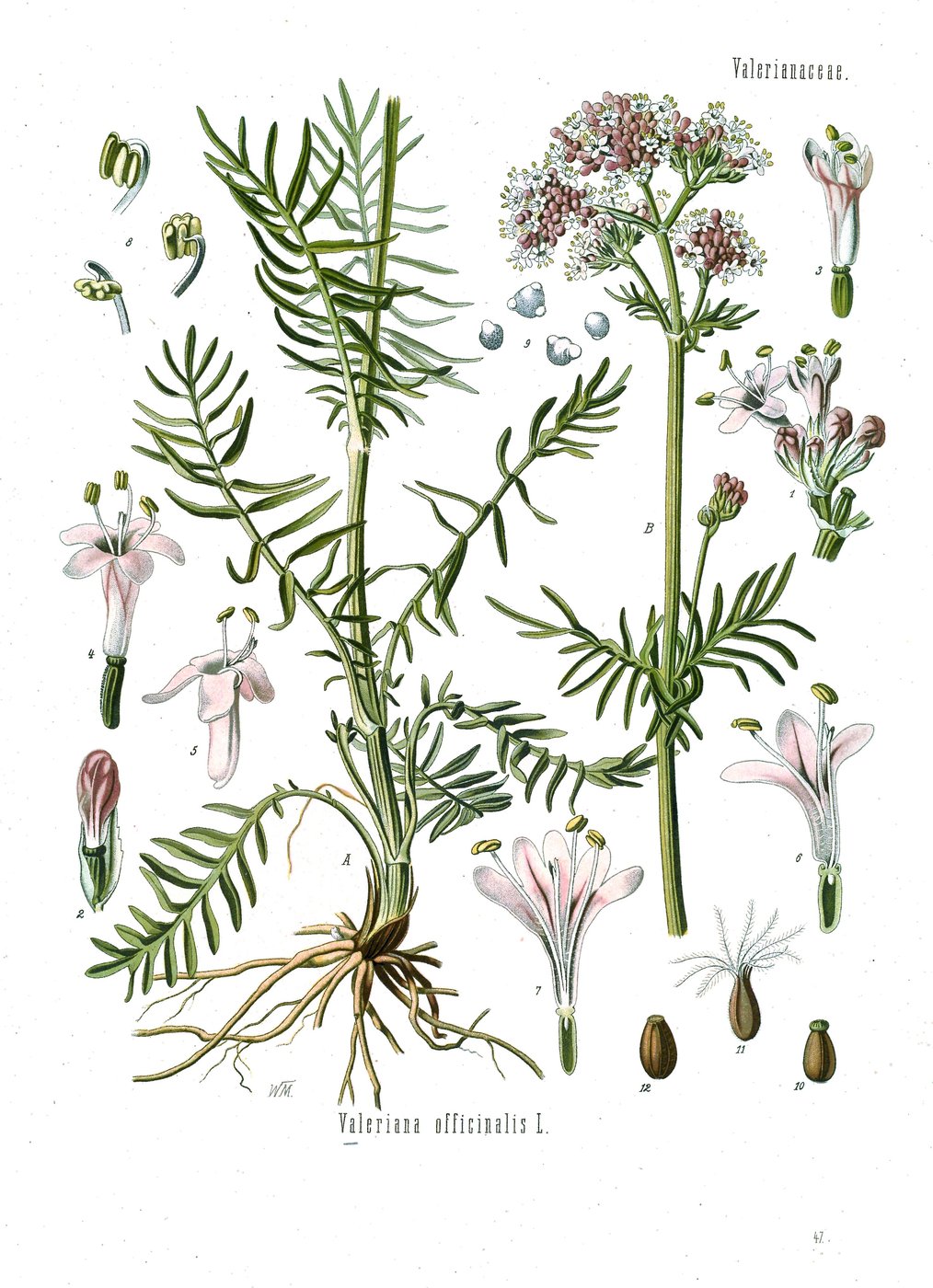
Valerian
Phu (Dioscorides); Latin valeriana
- Known today as
- Valeriana officinalis; the root is used.
- Kind
- Plant, in 4 older authorities
- Constituents
- valerenic acid, isovaleric acid, valepotriates
- Earliest authority here
- Dioscorides (c. AD 40–90)
- In other databases
- Plants of the World Online search · GBIF search · Wikidata search
Revised October 1, 2026: Tradition, lore, modern assessment, and sources extended. Version 1, first published September 25, 2026.
Valerian: what does modern science say?
Widely taken for sleep and nervous unrest; controlled trials give mixed and modest results. Spikenard, in Canale, is a Himalayan relative (see Spikenard). Valerenic acid and its relatives act on the GABA receptors, and two meta-analyses have found it improves the sense of having slept well without much changing the measures of sleep itself; it is approved in Europe as a traditional remedy for mild nervous tension and sleep. It is not a sedative in the way of the drugs, and it does not impair driving.
Pharmacognosy & Toxicology
- Constituents
- valerenic acid ChEMBL
- isovaleric acid ChEMBLthe smell
- valepotriatesunstable; absent from most extracts
- Mechanism
- Valerenic acid modulates the GABA-A receptor at a site distinct from the benzodiazepines.
- Checked against ChEMBL
- valerenic acid: Measured, as the entry says (“modulates the GABA-A receptor”): GABA-A receptor; alpha-1/beta-2/gamma-2 (human), EC50 13 µM, CHEMBL5143681; GABA-A receptor; alpha-1/beta-3/gamma-2 (human), EC50 19 µM, CHEMBL4308853.
- Toxic dose
- No serious toxicity recorded; drowsiness.
- Standing
- Approved in Europe as a traditional remedy for mild nervous tension and sleep.
- Bent, S., et al. (2006). American Journal of Medicine 119. Book, not indexed
Constituent names open the compound’s record at PubChem, and “ChEMBL” beside a name opens its record at ChEMBL, the European Bioinformatics Institute’s database of bioactive molecules. Where a mechanism line was checked against ChEMBL (ChEMBL 37, read 1 October 2026), the check is shown with the measured value and its source paper, or says plainly that nothing has been measured. Doses are as the references give them, for description only; this is not medical advice. Each source carries the result of its check against Crossref, PubMed, or the authority’s page: see Verification.
Valerian: what lore surrounds it?
Cats are drawn to the root as to catmint; legend makes it the lure the Pied Piper carried.
In Sweden the root was sewn into the bridegroom’s clothes to keep off the envy of the elves. During the air raids of both World Wars valerian was given in Britain for the strain of the bombing, and “shell shock” was treated with it in 1914. The smell of the dried root, like old socks, is from isovaleric acid, and the cat that rolls in it is answering the same compound that is in catmint.
Valerian: what did the older authorities say?
- Dioscorides
- Describes the root of phu, warming and diuretic.
- Its name
- Medieval Latin valeriana, often derived from valere, to be strong or well.
- Hippocrates and Galen
- Hippocrates names phu among the remedies, and Galen prescribes it for sleeplessness: the oldest medical use of the root is the one it still has.
- Gerard and Culpeper
- Gerard says the country people of the north so esteem it that no broth or pottage is worth anything without it; Culpeper gives it for coughs, the plague, and to drive away the phantoms of the night.
Sources
- Dioscorides, De materia medica. Read in part · the text read
- Gerard, J. (1597). The Herball. Verified against its record · doi:10.5962/bhl.title.99400
- Bent, S., et al. (2006). “Valerian for sleep: a systematic review and meta-analysis.” American Journal of Medicine 119. Verified against its record · doi:10.1016/j.amjmed.2006.02.026
Verification
- Checked
- October 1, 2026
- Passes
- Every sentence read against its sources, in the pass over the remaining 343 entries
- The Standing line checked against the authority it names (EMA, WHO, FDA, CITES, Commission E)
- Every dated or regulatory claim checked by category across the database
- The mechanism read against ChEMBL (ChEMBL 37): curated mechanisms and measured activity
- Sources
- 4 cited: 1 read in part, 2 verified against its record, 1 book, not indexed. 1 with the abstract on file.
- Corrections
- None were needed.
What was checked, how, and what was found is set out on the Verification page. A checked source is one whose record was found; it does not make the entry medical advice.
Cite This Entry
Version 1 · first published September 25, 2026 · last revised October 1, 2026
- Chicago
“Valerian.” In Materia Medica, edited by B. C. P. Statema. Version 1. The Thinking Press, 2026–. Last modified October 1, 2026. https://thethinkingpress.org/materia-medica/valerian.
- MLA
“Valerian.” Materia Medica, edited by B. C. P. Statema, version 1, The Thinking Press, 1 Oct. 2026, thethinkingpress.org/materia-medica/valerian. Accessed 8 Oct. 2026.
- APA
Valerian. (2026, October 1). In B. C. P. Statema (Ed.), Materia medica (Version 1). The Thinking Press. Retrieved October 8, 2026, from https://thethinkingpress.org/materia-medica/valerian
Club members keep entries on a shelf with private notes, print the plates as cards, and receive an entry by email each week. Create a free account before January 1, 2027 and all of it is yours for good. About the Club
See Also
Also in Dioscorides
Verdigris in Dioscorides · St. John’s wort in Dioscorides · Vine ash in Dioscorides · Squill in Dioscorides · everything Dioscorides names →
Also in Hippocrates and the Hippocratic Writers
Black hellebore in Hippocrates and the Hippocratic Writers · Hyssop in Hippocrates and the Hippocratic Writers · Honey in Hippocrates and the Hippocratic Writers · Honeyed wine and honeyed water in Hippocrates and the Hippocratic Writers · everything Hippocrates and the Hippocratic Writers names →
Also in Nicholas Culpeper
Woad in Nicholas Culpeper · Tormentil in Nicholas Culpeper · Wood sorrel in Nicholas Culpeper · Toadflax in Nicholas Culpeper · everything Nicholas Culpeper names →
Drawing on the same sources: Dioscorides, Gerard
Nearby in the alphabet
Verbena (Verbena officinalis) · Unicorn’s horn (Monodon monoceros) · Turpentine · The vernicle (leaving his image) · Turmeric (of the ginger family, whose root is deep yellow within) · Turkey tail (banded bracket of dead wood, common worldwide)

Historical description, not medical advice.