
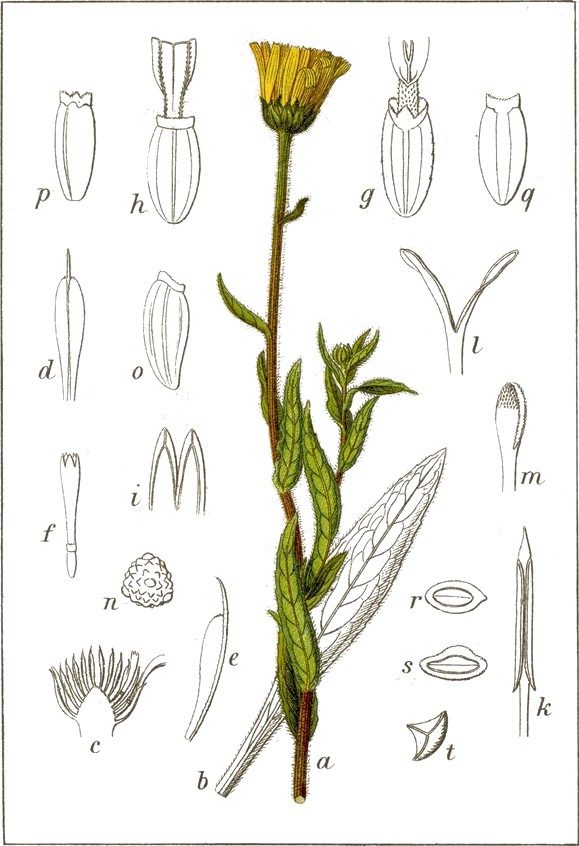
Ox eye
Buftalmo
- Known today as
- Probably Buphthalmum salicifolium, yellow ox-eye; some read it as the ox-eye daisy, Leucanthemum vulgare.
- Kind
- Plant, in 2 older authorities
- Constituents
- sesquiterpene lactones, flavonoids, polyacetylenes
- Earliest authority here
- Dioscorides (c. AD 40–90)
- In other databases
- Plants of the World Online search · GBIF search · Wikidata search
- In the Canale glossary
- On the Manner of Discerning and Healing the Bewitched, Appendix A: Part Three, Chapter 10: Amulets
Revised October 1, 2026: Tradition, lore, modern assessment, and sources extended. Version 1, first published September 25, 2026.
Ox eye: what did Canale use it for?
As an amulet and in fumigations (ch. 10).
Ox eye: what does modern science say?
No established effect. Both candidates are harmless composites with a little volatile oil; the daisy was once used, like chamomile, for coughs and the chest.
Pharmacognosy & Toxicology
- Constituents
- Mechanism
- Buphthalmum, or the ox-eye daisy: a Compositae of no particular pharmacology, whose lactones sensitise the skin. In a fumigation it is smoke.
- Toxic dose
- Safe; contact dermatitis in the sensitised.
- Standing
- No monograph.
- Paulsen, E. (2002). “Contact sensitization from Compositae-containing herbal remedies and cosmetics.” Contact Dermatitis 47. Verified against its record · doi:10.1034/j.1600-0536.2002.470401.x
The abstract of each source, beneath its citation. For Club members. About the Club or sign in.
Constituent names open the compound’s record at PubChem, and “ChEMBL” beside a name opens its record at ChEMBL, the European Bioinformatics Institute’s database of bioactive molecules. Where a mechanism line was checked against ChEMBL (ChEMBL 37, read 1 October 2026), the check is shown with the measured value and its source paper, or says plainly that nothing has been measured. Doses are as the references give them, for description only; this is not medical advice. Each source carries the result of its check against Crossref, PubMed, or the authority’s page: see Verification.
Ox eye: what lore surrounds it?
The ox-eye daisy of the English meadows, Leucanthemum, is the “moon daisy” and the midsummer flower of Saint John, worn against lightning and the devil; if Canale meant that plant, the amulet joins the midsummer herbs.
Ox eye: what did the older authorities say?
- Dioscorides
- Gives bouphthalmon, the ox-eye, a yellow flower like chamomile, in a cerate to dissolve hard swellings, and says that those who drink it after the bath are rid of the jaundice.
- The amulet herbs
- Canale strings it with the other strong-smelling composites, the chamomile and the feverfew, which the folk medicine of Italy hung at the neck and burned against the spells of the fascinators.
Sources
- Dioscorides, De materia medica III. Read in part · the text read
Verification
- Checked
- October 1, 2026
- Passes
- Every sentence read against its sources, in the pass over the remaining 343 entries
- The Standing line checked against the authority it names (EMA, WHO, FDA, CITES, Commission E)
- Every dated or regulatory claim checked by category across the database
- Sources
- 2 cited: 1 read in part, 1 verified against its record. 1 with the abstract on file.
- Corrections
- None were needed.
What was checked, how, and what was found is set out on the Verification page. A checked source is one whose record was found; it does not make the entry medical advice.
Cite This Entry
Version 1 · first published September 25, 2026 · last revised October 1, 2026
- Chicago
“Ox eye.” In Materia Medica, edited by B. C. P. Statema. Version 1. The Thinking Press, 2026–. Last modified October 1, 2026. https://thethinkingpress.org/materia-medica/ox-eye.
- MLA
“Ox eye.” Materia Medica, edited by B. C. P. Statema, version 1, The Thinking Press, 1 Oct. 2026, thethinkingpress.org/materia-medica/ox-eye. Accessed 8 Oct. 2026.
- APA
Ox eye. (2026, October 1). In B. C. P. Statema (Ed.), Materia medica (Version 1). The Thinking Press. Retrieved October 8, 2026, from https://thethinkingpress.org/materia-medica/ox-eye
Club members keep entries on a shelf with private notes, print the plates as cards, and receive an entry by email each week. Create a free account before January 1, 2027 and all of it is yours for good. About the Club
See Also
Sharing flavonoids, polyacetylenes
Capsella bursa-pastoris · Botrychium lunaria · Oxalis acetosella · Hepatica nobilis · Burdock · Eryngium maritimum
Also in Dioscorides
Rhubarb in Dioscorides · Orris in Dioscorides · Rocket in Dioscorides · Oregano and squinanth in Dioscorides · everything Dioscorides names →
Drawing on the same sources: Dioscorides, Paulsen
Nearby in the alphabet
Oxymel, and oxymel of squill (Honey boiled with vinegar) · Oyster mushroom (A shell-shaped mushroom of dead hardwood) · Orpiment and realgar (Yellow and red arsenic sulfides) · Palm and olive branches (Branches blessed on Palm Sunday) · Palm of Christ (Ricinus communis (note XLII)) · Orache (garden orache, a spinach-like plant)
Historical description, not medical advice.