
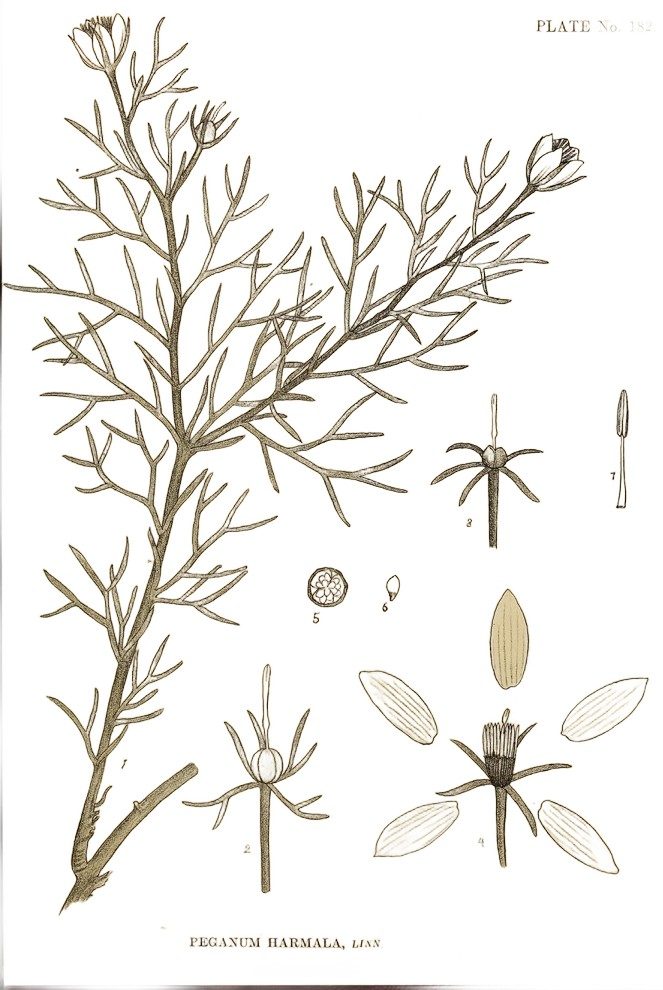
Wild rue
Ruta silvestre
- Known today as
- Either the wild form of Ruta graveolens or Syrian rue, Peganum harmala.
- Kind
- Plant, in 1 older authority
- Constituents
- harmine, harmaline, vasicine
- Earliest authority here
- Pliny (AD 23/24–79)
- In other databases
- Plants of the World Online search · GBIF search · Wikidata search
- In the Canale glossary
- On the Manner of Discerning and Healing the Bewitched, Appendix A: Part Three, Chapter 10: Amulets
Revised October 1, 2026: An older authority added from a text read in full. Lore added from texts read in full. Version 1, first published September 25, 2026.
Caution. Hazardous in some form or dose; see the modern assessment below.
Wild rue: what did Canale use it for?
Among the amulet herbs: hung about the neck, and used in fumigations and decoctions against hexes (ch. 10; see the amulet herbs).
Wild rue: what does modern science say?
If Peganum, its seeds contain harmaline and related alkaloids used in hallucinogenic preparations, and they have long been burnt against the evil eye in Iran and neighboring lands.
Wild rue: is it poisonous?
Yes, in some form or dose. Its poisoning is harmala alkaloids and the serotonin syndrome: One to two hours. Historical description, not medical advice; in a poisoning, call a poison centre.
Pharmacognosy & Toxicology
- Constituents
- Mechanism
- Harmine and harmaline inhibit monoamine oxidase A reversibly, raising serotonin and dopamine, and bind the serotonin receptors; they are the same alkaloids as the ayahuasca vine’s.
- Checked against ChEMBL
- harmine: Measured, as the entry says (“inhibit monoamine oxidase A”): Amine oxidase [flavin-containing] A (human), IC50 1 nM, CHEMBL5233266.
- harmaline: Measured, as the entry says (“inhibit monoamine oxidase A”): Amine oxidase [flavin-containing] A (human), IC50 2.5 nM, CHEMBL5233266; Amine oxidase [flavin-containing] A (rat), IC50 12 nM, CHEMBL1128201.
- Toxic dose
- Seed extracts of a few grams have brought convulsions and coma; fatalities are recorded.
- Syndrome
- Harmala alkaloids and the serotonin syndrome
- Standing
- No approved use; harmine is studied for its action on pancreatic beta cells and in depression.
- Moloudizargari, M., et al. (2013). Pharmacognosy Reviews 7. Book, not indexed
The abstract of each source, beneath its citation. For Club members. About the Club or sign in.
Constituent names open the compound’s record at PubChem, and “ChEMBL” beside a name opens its record at ChEMBL, the European Bioinformatics Institute’s database of bioactive molecules. Where a mechanism line was checked against ChEMBL (ChEMBL 37, read 1 October 2026), the check is shown with the measured value and its source paper, or says plainly that nothing has been measured. Doses are as the references give them, for description only; this is not medical advice. Each source carries the result of its check against Crossref, PubMed, or the authority’s page: see Verification.
Wild rue: what lore surrounds it?
Folkard opens with the conjecture “that the Moly, which, according to Homer, Mercury gave to Ulysses as an antidote to the enchantress Circe's beverage, was the root of the wild Rue.” Rue was Herb of Grace “from the fact that the word rue means also ‘repentance,’” and Turner held that “it preserves chastity, being eaten; it quickeneth the sight, stirs up the spirits, and sharpeneth the wit.” Gerarde reports that the weasel, before fighting the serpent, “armeth her selfe by eating Rue.” Rue entered Mithridates' counter-poison and the “vinegar of the four thieves,” Piperno in 1625 had the epileptic hang it round the neck “renouncing at the time, in a stated formula, the devil and all his works,” and “in Venice, Rue is kept as a charm in a house, to maintain its good fortune.”
Thiselton-Dyer names the vervain and the rue as “two of those most frequently used as ingredients in the mystic cauldron,” rue having “entered so largely into magic rites” that it “was once much in request as an antidote against such practices; and nowadays, when worn on the person in conjunction with agrimony, maiden-hair, broom-straw, and ground ivy, it is said in the Tyrol to confer fine vision, and to point out the presence of witches.” Maury supposed its repute with witches came from “its being a narcotic and causing hallucinations.”
Wild rue: what did the older authorities say?
- Pliny
- Gives polium “beaten up with wild rue in rain water” to assuage the pain of the sting of the asp.
Sources
- [18] Calderoni, M., Altare, M., Mastracci, L., Grillo, F., Cornara, L., & Pagano, A. (2021). Potential risks of plant constituents in dietary supplements: qualitative and quantitative analysis of Peganum harmala seeds. Molecules 26(5): 1368. doi:10.3390/molecules26051368 Verified against its record · doi:10.3390/molecules26051368
- [95] Omidsalar, M. (1998). Esfand. Encyclopaedia Iranica VIII(6): 583–584. Book, seen in reviews
- Pliny the Elder, Natural History 21.84, trans. J. Bostock & H. T. Riley (1855), Perseus Digital Library. Primary text
- Folkard, R. (1884). Plant Lore, Legends, and Lyrics, “Rue.” Project Gutenberg #44638. Primary text
- Thiselton-Dyer, T. F. (1889). The Folk-lore of Plants. Project Gutenberg #10118. Read in part · the text read
Verification
- Checked
- October 1, 2026
- Passes
- Every sentence read against its sources, in the pass over the remaining 343 entries
- The Standing line checked against the authority it names (EMA, WHO, FDA, CITES, Commission E)
- Every dated or regulatory claim checked by category across the database
- The mechanism read against ChEMBL (ChEMBL 37): curated mechanisms and measured activity
- Each quotation from the older authorities checked word for word against the text, read in full
- Sources
- 6 cited: 1 read in part, 1 verified against its record, 2 primary text, 1 book, seen in reviews, 1 book, not indexed. 1 with the abstract on file.
- Corrections
- None were needed.
What was checked, how, and what was found is set out on the Verification page. A checked source is one whose record was found; it does not make the entry medical advice.
Cite This Entry
Version 1 · first published September 25, 2026 · last revised October 1, 2026
- Chicago
“Wild rue.” In Materia Medica, edited by B. C. P. Statema. Version 1. The Thinking Press, 2026–. Last modified October 1, 2026. https://thethinkingpress.org/materia-medica/wild-rue.
- MLA
“Wild rue.” Materia Medica, edited by B. C. P. Statema, version 1, The Thinking Press, 1 Oct. 2026, thethinkingpress.org/materia-medica/wild-rue. Accessed 8 Oct. 2026.
- APA
Wild rue. (2026, October 1). In B. C. P. Statema (Ed.), Materia medica (Version 1). The Thinking Press. Retrieved October 8, 2026, from https://thethinkingpress.org/materia-medica/wild-rue
Club members keep entries on a shelf with private notes, print the plates as cards, and receive an entry by email each week. Create a free account before January 1, 2027 and all of it is yours for good. About the Club
See Also
Also in Pliny the Elder
Woad in Pliny the Elder · Wild garlic in Pliny the Elder · Wood sorrel in Pliny the Elder · Wild carrot, seed of in Pliny the Elder · everything Pliny the Elder names →
Drawing on the same sources: Folkard, Thiselton-Dyer
Aloe · White hellebore · The amulet herbs · Water germander · Borage · the bibliography →
Nearby in the alphabet
Winter-grain mould (Pink and white moulds of grain left in the field over winter) · Wild ginger · Witch ball (often silvered or colored, hung in the window) · Witch bottle · Witch marks (Symbols scratched or burned near doors and fireplaces) · Wild bergamot
Historical description, not medical advice.