
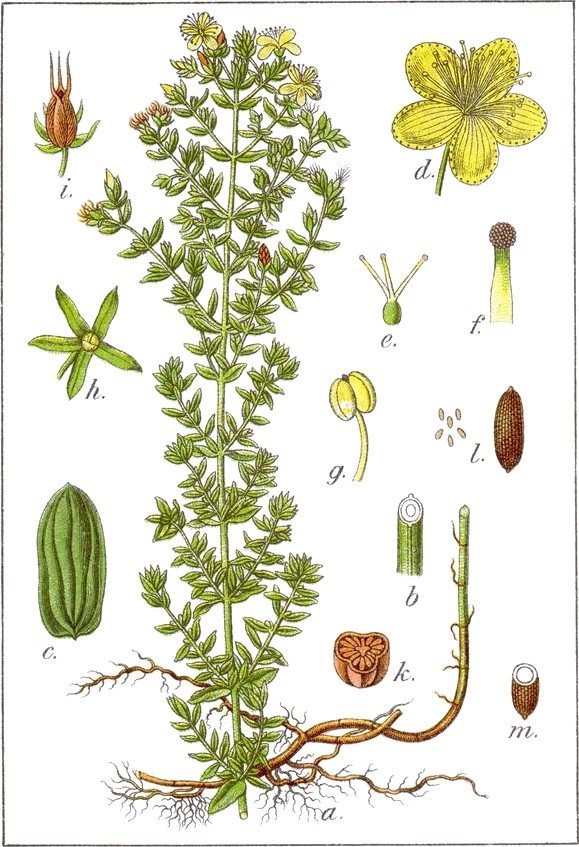
St. John’s wort
Hiperico; perforata
- Known today as
- Hypericum perforatum.
- Kind
- Plant, in 2 older authorities
- Constituents
- hypericin, hyperforin
- Earliest authority quoted here
- Dioscorides (c. AD 40–90)
- Qualities
- Hot and dry (Galenic tradition). What the degrees mean
- In other databases
- Plants of the World Online · GBIF · Wikidata
- In the Canale glossary
- On the Manner of Discerning and Healing the Bewitched, Appendix A: Part Three, Chapter 6: Remedies Given by Mouth After the Purge
Revised November 1, 2026: Checked against its sources, each read in full, in part, or in its abstract. Corrected from the press's evidence dossier on the entry, every change checked in the sources read. Version 1, first published September 25, 2026.
Caution. Hazardous in some form or dose; see Safety, below.
St. John’s wort: what did Canale use it for?
Canale’s chief plant: seed, juice, flowers, and oil in the powders, electuary, conserve, bath, fumigations, and oils; worn on the person against every hex, “and from its effect called Fuga Daemonum” (chs. 6–10; notes XLVI–XLVII).
Before anyone takes it
- Not for
- Do not take it with coumarin anticoagulants, cyclosporine, everolimus, sirolimus, tacrolimus, HIV protease inhibitors and similar drugs, irinotecan, imatinib and other cancer drugs handled by the same liver enzymes. EMA, 2022
St. John’s wort: what does modern science say?
The most striking case in the glossary of an old herb with modern trial support, though the EMA notes that the old use was to ‘strengthen the nerves’ rather than to treat depression as such. The Cochrane review of 29 trials (Linde, Berner and Kriston, 2008) found the hypericum extracts tested superior to placebo in patients with major depression, as effective as standard antidepressants, and with fewer side effects, while noting that trials from German-speaking countries reported findings more favourable to hypericum, which complicates the interpretation. Depression is the condition a modern reader might recognize in many of Canale’s “melancholic” bewitched. The herb also weakens many prescription medicines by speeding their breakdown.
St. John’s wort: how is it taken as a tea?
An infusion given before bed for children who wet the bed, and for chronic catarrh of the lungs, bowels, or urinary passages, Grieve says. The EMA did not accept these uses and does not recommend the herb by mouth under 18.
All the herbal teas of the database. Historical directions, not medical advice.
St. John’s wort: is it poisonous?
Yes, in some form or dose. Historical description, not medical advice; in a poisoning, call a poison centre.
Before anyone takes it
- Not for
- Do not take it with coumarin anticoagulants, cyclosporine, everolimus, sirolimus, tacrolimus, HIV protease inhibitors and similar drugs, irinotecan, imatinib and other cancer drugs handled by the same liver enzymes. EMA, 2022
- The WHO contraindicates it in known allergy to plants of its family, the Clusiaceae. WHO
- Warnings
- Before planned surgery, tell the anaesthetist; the EMA advises stopping it if needed, since the enzyme effect takes about a week to wear off. EMA, 2022
- Avoid intense sun or ultraviolet light while taking it. EMA, 2022
- With other medicines
- It lowers the blood levels of many medicines, including the contraceptive pill, so that bleeding between periods and pregnancy can follow; women on the pill should use other contraception too. EMA, 2022
- NCCIH also lists seizure medicines such as phenytoin and carbamazepine, heart drugs such as digoxin and ivabradine, some statins, warfarin and some HIV and cancer drugs. NCCIH, 2025
- With SSRIs and other serotonin drugs it can, rarely, cause serotonin syndrome: sweating, fast heart, diarrhoea, fever, agitation, tremor. EMA, 2022
- Pregnancy and breast-feeding
- Safety in pregnancy and breastfeeding is not established; animal studies showed reproductive toxicity, and the EMA does not recommend it. EMA, 2022
- NCCIH warns it may raise the risk of birth defects, and that breastfed babies of mothers taking it can have colic, drowsiness and lethargy. NCCIH, 2025
- Children
- Not recommended by mouth under 18, for lack of data. EMA, 2022
- On the skin, not recommended under 12. EMA, 2022
- Side effects
- Stomach upset (nausea, pain, diarrhoea), allergic skin reactions, tiredness and restlessness may occur. EMA, 2022
- Fair skin may tingle, burn or sunburn more easily in strong sun. EMA, 2022
- Case reports suggest it may trigger mania in vulnerable people (EMA’s account of a systematic review). EMA
- Toxic dose
- After up to 4.5 g of dry extract a day for two weeks and a further 15 g at once, seizures and confusion were reported; after a massive overdose, keep out of sunlight for one to two weeks. EMA, 2022
- Driving
- No adequate studies on driving or using machines exist. EMA, 2022
- With the regulators
- The EU herbal monograph (2022) accepts two well-established uses for depression, for named dry extracts only, and four traditional uses. EMA
The toxic dose and the poisoning
- Toxic dose
- Photosensitivity in fair skins; the interactions are the danger. Seizures and confusion have been reported after up to 4.5 g of dry extract a day for two weeks and a further 15 g just before admission to hospital (EMA).
The references for these lines are listed under Pharmacognosy, in Science. Doses are as the references give them, for description only; this is not medical advice. In a poisoning, call a poison centre.
St. John’s wort: what did the older authorities say?
- Dioscoridesc. AD 40–90
- Describes hyperikon as a diuretic; put in as a pessary it brings on the menses; drunk in wine it removes tertian and quartan fevers; its seed, drunk for forty days, heals sciatica; and its leaves with the seed are laid on burns.
- Paracelsus1493/94–1541
- Wrote that his oil heals all wounds and stabs above all other medicine: an oil of the seed with turpentine and red wine, then olive oil and the flowers, set in the sun for a month. A red oil of the fresh flowers in olive oil, sunned for about six weeks, was still in the German pharmacopoeia’s supplement of 1941.
St. John’s wort: what lore surrounds it?
Its name, Grieve explains, means “over an apparition” (a botanical review reads hyper eikon as “above the image”), from the belief “that the herb was so obnoxious to evil spirits that a whiff of it would cause them to fly”; it blooms, NCCIH notes, around the feast of St. John the Baptist in late June.
Its history and lore, checked
The evidence beneath each verdict here, in the words of the sources read, is for members. Join free
History and names12 claims
Partly confirmedCanale used the seed, juice, flowers and oil of St. John’s wort in his powders, electuary, conserve, bath, fumigations and oils.
The juice and the oil found in the 1622 text; the other preparations not found in its garbled OCR.
ConfirmedFrom its effect the herb was called Fuga Daemonum (Canale).
Partly confirmedThe name fuga daemonum, ‘flight of demons’, was common to the exorcists’ manuals of Canale’s century.
Canale uses it and lists a book called Fuga Daemonum among his sources; other manuals not checked.
ConfirmedThe herb was gathered on St. John’s Eve and hung over doors and windows.
Partly confirmedThe red juice of the crushed flowers was read as the blood of the Baptist.
Paracelsus’s ‘Johannes-blut’ is known only through Crockett and Robson; Folkard and Thiselton-Dyer put the Baptist’s blood in spots on the leaves.
UncertainThe name Hypericum means ‘over an apparition’ (Grieve).
Grieve gives ‘over an apparition’; Crockett and Robson give hyper eikon, ‘above the image’.
ConfirmedIts qualities are hot and dry (Galenic tradition).
Partly confirmedDioscorides describes hyperikon as a diuretic and emmenagogue, taken in wine against tertian and quartan fevers and for sciatica, and laid on burns.
All five uses are his, but the menses are brought on by a pessary and the sciatica cure is the seed drunk for forty days; the plant’s identity is disputed.
ConfirmedParacelsus praised St. John’s wort above other remedies as a wound-healer.
Partly confirmedIts red oil, the flowers steeped in olive oil in the sun, became a fixture of the apothecary.
Paracelsus’s own oil adds seed oil, turpentine and red wine; the plain red olive-oil maceration is documented in the 1941 German pharmacopoeia supplement.
UncertainSt. John’s wort for depression is the most striking case in the glossary of a traditional use borne out.
The EMA says ‘depression’ is unknown in traditional medicine; NCCIH and Grieve record old use for depression.
UncertainDepression is the condition a modern reader might recognize in many of Canale’s melancholic bewitched.
An interpretation; Paracelsus, a century before Canale, denied that such fantasies were melancholy.
Belief2 claims
Not testable, but explainedWorn on the person, St. John’s wort protects against every hex (Canale).
Why it was believed: The red stain that crushed flowers leave on the fingers gave the plant its reputation for protective magic, by Crockett and Robson’s account. Paracelsus, whom Canale seems to cite as Theofratto, taught that the herb drove out phantasms that come from nature, not from the devil (the press’s reading of his German; interpretation of ‘Theofratto’ is the press’s).
Not testable, but explainedThe herb was so hateful to evil spirits that a whiff of it would make them fly (Grieve).
Why it was believed: Crushed flowers stain the fingers red, which tradition took as a sign of protective power (Crockett and Robson). Paracelsus read the see-through dots of the leaves as a signature that it drives out phantasms, and told readers to smell it often and keep it under the pillow; this reading of his German is the press’s interpretation.
Each verdict is on the press’s scale, from confirmed to never documented, and rests on the sources read, in full, in part or in their abstracts. How the press checks. A summary of what was read, not medical advice.
St. John’s wort: what does the evidence say?
The press read 25 sources for this entry and checked 32 of its claims against them (November 1, 2026). The claims are given as they stood when checked; where the reading found the entry wrong, the entry was corrected that day. Of the verdicts in this entry, 5 confirmed, 7 partly confirmed, 9 plausible but untested, 4 uncertain and 2 beliefs explained rather than tested. The verdicts on 5 medical and safety claims wait until a named pharmacologist or physician has read them.
What the European Medicines Agency accepts
Well-established use
- “Herbal medicinal product for the treatment of mild to moderate depressive episodes.”
- “Herbal medicinal product for the short-term treatment of symptoms in mild depressive disorders.”
Traditional use
- “Traditional herbal medicinal product for the relief of temporary mental exhaustion.”
- “Traditional herbal medicinal product for the symptomatic treatment of minor inflammations of the skin (such as sunburn) and as an aid in healing of minor wounds.”
- “Traditional herbal medicinal product for the ... symptomatic relief of mild gastrointestinal discomfort.”
- “Traditional herbal medicinal product for the supportive treatment of nervous restlessness and associated with difficulties in falling asleep.”
Of each of these uses the agency says: “The product is a traditional herbal medicinal product for use in specified indications exclusively based upon long-standing use.”
From EMA, 2022
The evidence beneath each verdict here, in the words of the sources read, is for members. One verdict’s is open, as a sample. Join free
Medicine12 claims
Plausible, untestedSt. John’s wort is a diuretic.
No trial found; the WHO lists it among folk uses not supported by data.
The evidence: one source read
Also used as a diuretic, an emmenagogue and an antimalarial agent (5, 8).
World Health Organization. WHO monographs on selected medicinal plants, vol. 2: Herba Hyperici. Geneva: WHO. Read in part · the text read
This verdict’s evidence is open to every reader, as a sample of what members read under each.
Plausible, untestedSt. John’s wort brings on the menses.
No trial found; the WHO lists it among folk uses not supported by data.
Plausible, untestedTaken in wine, St. John’s wort cures tertian and quartan fevers (malaria).
No trial found; the WHO lists ‘antimalarial’ among folk uses not supported by data.
Plausible, untestedSt. John’s wort cures sciatica.
No trial of the herb found; one trial of a homeopathic dilution found no significant effect on pain.
Plausible, untestedSt. John’s wort laid on burns heals them.
Traditional use accepted by EMA, for minor skin inflammation such as sunburn and minor wounds only; burn studies are in rats.
UncertainSt. John’s wort heals wounds.
Small trials disagree; the EMA accepts minor wounds as traditional use only.
Plausible, untestedA tea given before bed cures bed-wetting in children (Grieve).
Only rat bladder strips; the EMA judged this folk use not plausible and does not recommend the herb by mouth under 18.
Plausible, untestedThe tea helps chronic catarrh of the lungs (Grieve).
No trial found; the WHO calls bronchial use a folk use not supported by data; the EMA judged it not plausible.
Plausible, untestedThe tea helps chronic catarrh of the bowels (Grieve).
No trial of catarrh found; the EMA accepts only ‘mild gastrointestinal discomfort’ as traditional use, and one bowel trial, in irritable bowel syndrome, was negative.
Plausible, untestedThe tea helps chronic catarrh of the urinary passages (Grieve).
No trial found; the WHO calls urogenital use a folk use not supported by data.
Partly confirmedHypericum extracts have fewer side effects than standard antidepressants (Cochrane, 2008).
Fewer side effects and drop-outs in short trials, which were not designed to find rare harms; interactions are the main danger.
It weakens many medicines, among them the contraceptive pill, warfarin, cyclosporine, digoxin, some HIV, cancer and seizure drugs, and can cause serotonin syndrome with other antidepressants; the EMA does not recommend it in pregnancy, while breastfeeding or under 18.
Partly confirmedHyperforin induces the liver’s CYP3A4.
Hyperforin induces CYP3A4 and other enzymes, dose-dependently; one 2024 dose study found the effect mainly in the gut rather than the liver.
The plant1 claim
ConfirmedSt. John’s wort blooms around the feast of St. John the Baptist in late June (NCCIH).
The verdicts on its history and lore under History.
What no one yet knows
- Does it help severe depression, or for longer than 12 weeks? The trials were mostly in mild to moderate depression and lasted 4 to 12 weeks; NCCIH and the reviews call these questions uncertain.
- Do teas, tinctures and oils share the effect of the dry extracts that were tested? The evidence is for named dry extracts; the EMA found the clinical evidence for every other preparation insufficient, and products differ in their active compounds.
- Why did trials from German-speaking countries find larger benefits? The Cochrane review reports the pattern and says it complicates interpretation; the abstract read gives no explanation.
- Is it safe in pregnancy? The EMA says safety is not established and cites animal reproductive toxicity; the human data it reviews are small (one cohort of 54 women, one national cohort with 38 users).
- Is it safe and useful for children and teenagers? The EMA found no controlled data on efficacy and safety in this group; the one controlled trial it reports, in ADHD, found no benefit.
- Which constituent carries the antidepressant effect? The EMA says several groups of compounds contribute; a 2025 review of a low-hyperforin extract proposes a further mechanism in cell membranes.
- Do any of the old uses hold up in people: bed-wetting, catarrh, diuresis, the menses, malarial fevers, sciatica, burns? No human trial of any of them was found; the WHO files most of them as folk uses not supported by data, and the EMA declined the tea’s further uses.
- Is Dioscorides’ hyperikon our Hypericum perforatum? Sprengel found no species that matches it exactly except Hypericum barbatum, and thought Dioscorides’ ascyron might be H. perforatum.
- Did Paracelsus call the red sap ‘St. John’s blood’? Crockett and Robson say so, citing works not read; the phrase is not in his Herbarius chapter on the herb.
- Was fuga daemonum a common name in the other exorcists’ manuals of the period? Canale uses it and cites a book of that title; Menghi’s manual could not be read in the Internet Archive’s OCR.
- What is the true meaning of the name Hypericum? Grieve reads ‘over an apparition’, Crockett and Robson ‘above the image’; no etymological dictionary was read.
Each verdict is on the press’s scale, from confirmed to never documented, and rests on the sources read, in full, in part or in their abstracts. How the press checks. A summary of what was read, not medical advice.
Pharmacognosy
- Constituents
- Mechanism
- It weakens the effects of many medicines, NCCIH warns: among them the contraceptive pill, cyclosporine, warfarin, digoxin, some seizure medicines (phenytoin, carbamazepine), some HIV and cancer drugs, some statins, and some antidepressants.
- Checked against ChEMBL
- hyperforin: No measurement in ChEMBL for “inhibits the reuptake of serotonin, noradrenaline, and dopamine” (2 activities recorded, none against the target named); the line rests on its references.
- hyperforin: No measurement in ChEMBL for “induces the liver's CYP3A4” (2 activities recorded, none against the target named); the line rests on its references.
- Standing
- A Cochrane review of 29 trials found the extracts tested better than placebo in major depression, similarly effective as standard antidepressants, and with fewer side effects, though trials from German-speaking countries reported results more favourable to it.
- Linde, K., et al. (2008). “St John’s wort for major depression.” Cochrane Database of Systematic Reviews. Abstract read · the text read
- European Medicines Agency, HMPC (2022). European Union herbal monograph on Hypericum perforatum L., herba. Final, Revision 1. EMA/HMPC/7695/2021, adopted 23 November 2022. Read in full · the text read
The abstract of each source, beneath its citation. For Club members. About the Club or sign in.
Constituent names open the compound’s record at PubChem, and “ChEMBL” beside a name opens its record at ChEMBL, the European Bioinformatics Institute’s database of bioactive molecules. Where a mechanism line was checked against ChEMBL (ChEMBL 37, read 1 October 2026), the check is shown with the measured value and its source paper, or says plainly that nothing has been measured. Doses are as the references give them, for description only; this is not medical advice. Each source carries the result of its check against Crossref, PubMed, or the authority’s page: see Verification.
What Medicine Makes of It
- The Nightmare and the HagThe incubus that sits on the chest, and sleep paralysis.
- Melancholy and the DemonThe black bile, the devil’s bath, and depression.
- The IncubusThe demon lover of the night, and the sleep that cannot move.
Sources
- [91] National Center for Complementary and Integrative Health, NIH. Usefulness and Safety pages: Boswellia (April 2025); Chamomile (November 2024); St. John’s Wort (May 2025). nccih.nih.gov. Read in part · the text read
- Linde, K., Berner, M. M., & Kriston, L. (2008). “St John’s wort for major depression.” Cochrane Database of Systematic Reviews. PMID 18843608. Abstract read 15 October 2026.
- Grieve, M. A Modern Herbal, “St. John’s Wort.” As published on botanical.com. Read in full · the text read
- Dioscorides. De materia medica, ed. and Latin trans. C. Sprengel, Pedanii Dioscoridis Anazarbei De materia medica libri quinque, vol. 1. Leipzig: Cnobloch, 1829. Read in part · the text read
- European Medicines Agency, HMPC. Assessment report on Hypericum perforatum L., herba. Final, Revision 1. EMA/HMPC/244315/2016. Read in part · the text read
- Paracelsus. Herbarius, ch. 5, “Von dem sanct Johanns kraut,” in K. Sudhoff (ed.), Sämtliche Werke, 1. Abteilung, vol. 2. München and Berlin: R. Oldenbourg, 1930. Read in part · the text read
- Crockett, S. L., & Robson, N. K. B. (2011). Taxonomy and chemotaxonomy of the genus Hypericum. Medicinal and Aromatic Plant Science and Biotechnology 5 (special issue 1): 1–13. Read in part · the text read
Verification
- Checked
- October 1, 2026, October 17, 2026
- Passes
- Read against its sources in the pass over the remaining 343 entries
- Every dated or regulatory claim checked by category across the database
- The mechanism read against ChEMBL (ChEMBL 37): curated mechanisms and measured activity
- Every source read, in full, in part, or in its abstract, and every sentence checked against what was read (October 17, 2026)
- Sources
- 9 cited: 2 read in full, 5 read in part, 1 abstract read, 1 not yet checked. 1 with the abstract on file.
- Corrections
- None recorded.
What was checked, how, and what was found is set out on the Verification page. A checked source is one whose record was found; it does not make the entry medical advice.
Club members can point at a technical term in this entry, such as a constituent, an action, or a word of Jung’s, to read its definition from the source. The Club.
Cite This Entry
Version 1 · first published September 25, 2026 · last revised November 1, 2026
- Chicago
“St. John’s wort.” In Materia Medica, edited by B. C. P. Statema. Version 1. The Thinking Press, 2026–. Last modified November 1, 2026. https://thethinkingpress.org/materia-medica/st-johns-wort.
- MLA
“St. John’s wort.” Materia Medica, edited by B. C. P. Statema, version 1, The Thinking Press, 1 Nov. 2026, thethinkingpress.org/materia-medica/st-johns-wort. Accessed 22 Nov. 2026.
- APA
St. John’s wort. (2026, November 1). In B. C. P. Statema (Ed.), Materia medica (Version 1). The Thinking Press. Retrieved November 22, 2026, from https://thethinkingpress.org/materia-medica/st-johns-wort
See Also
Sharing hypericin
Also in Dioscorides
Valerian in Dioscorides · Squill in Dioscorides · Verdigris in Dioscorides · Southernwood in Dioscorides · everything Dioscorides names →
Also in Paracelsus
Sulfur in Paracelsus · Salt in Paracelsus · Weapon-salve in Paracelsus · Quicksilver in Paracelsus · everything Paracelsus names →
Drawing on the same sources: Grieve
Of the same qualities: hot and dry
Saffron · Theriac · Rue · Thyme · Rosemary · what the degrees mean →
Nearby in the alphabet
St. Walburga’s oil (A clear liquid that gathers on the stone slab over the relics of St) · St. John’s fires (The bonfires lit across Europe on the eve of the Nativity of St) · St. Zacharias cross (each standing for a Latin invocation against the plague) · St. Ignatius water (Water blessed with a relic or medal of St) · Stinkhorn · St. Hubert’s key (blessed at the shrine of St) · The stole (the sign of his sacred office) · St. Christopher medal (An image of St)
Historical description, not medical advice.
