
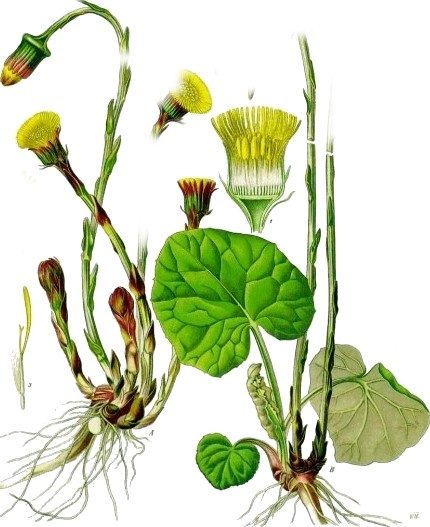
Coltsfoot
Tussilagine
- Known today as
- Tussilago farfara.
- Kind
- Plant, in 2 older authorities
- Constituents
- senkirkine, tussilagone, mucilage
- Earliest authority here
- Dioscorides and Pliny (c. AD 40–90)
- In other databases
- Plants of the World Online search · GBIF search · Wikidata search
- In the Canale glossary
- On the Manner of Discerning and Healing the Bewitched, Appendix A: Part Three, Chapter 10: Amulets
Revised October 1, 2026: Tradition, lore, modern assessment, and sources extended. Version 1, first published September 25, 2026.
Coltsfoot: what did Canale use it for?
Among the amulet herbs: hung about the neck, and used in fumigations and decoctions against hexes (ch. 10; see the amulet herbs).
Coltsfoot: how is it taken as a tea?
A decoction of an ounce of leaves, or coltsfoot tea made for the same purpose, for coughs; coltsfoot rock has long been a domestic remedy.
All the herbal teas of the database. Historical directions, not medical advice.
Coltsfoot: what does modern science say?
A classic cough remedy; its liver-toxic pyrrolizidine alkaloids, which cause cancer in animals, now limit internal use. Senkirkine and the other pyrrolizidine alkaloids of the plant caused liver tumours in rats and a fatal case of veno-occlusive disease in an infant whose mother drank the tea; Germany forbade its sale, and an alkaloid-free cultivar, ‘Wien,’ was bred in Austria to keep the herb in use.
Pharmacognosy & Toxicology
- Constituents
- senkirkine ChEMBLa pyrrolizidine alkaloid
- tussilagone ChEMBL
- mucilagethe soothing part
- Mechanism
- As comfrey.
- Toxic dose
- Cumulative; an infant died of veno-occlusive disease from the mother’s tea.
- Syndrome
- Pyrrolizidine alkaloids (veno-occlusive disease)
- Standing
- Forbidden in Germany; an alkaloid-free cultivar is permitted.
- European Medicines Agency (2014). Public statement on pyrrolizidine alkaloids. Verified against its record · doi:10.1016/b978-0-12-386454-3.00054-3
Constituent names open the compound’s record at PubChem, and “ChEMBL” beside a name opens its record at ChEMBL, the European Bioinformatics Institute’s database of bioactive molecules. Where a mechanism line was checked against ChEMBL (ChEMBL 37, read 1 October 2026), the check is shown with the measured value and its source paper, or says plainly that nothing has been measured. Doses are as the references give them, for description only; this is not medical advice. Each source carries the result of its check against Crossref, PubMed, or the authority’s page: see Verification.
Coltsfoot: what lore surrounds it?
The flower was painted on the signs of apothecaries in Paris as the badge of the trade, and coltsfoot rock, the sweet of Lancashire, is still made from its extract.
Coltsfoot: what did the older authorities say?
- Dioscorides and Pliny
- Both prescribe the smoke of the dried leaf, drawn through a reed, for the cough and the tightness of the chest: the oldest medicinal smoking in the Western record.
- Its name
- Tussilago, from tussis, the cough, and agere, to drive away; the English name is for the hoof-shaped leaf, which appears only after the flowers have gone, so that the old herbalists called it filius ante patrem, the son before the father.
Sources
- [41] European Medicines Agency, Committee on Herbal Medicinal Products (HMPC). Herbal monographs, assessment reports and public statements, ema.europa.eu, cited under the herb concerned: aniseed (summary, EMA/305345/2016); Aristolochia (public statement, EMEA/HMPC/138381/2005); asarone (public statement, EMEA/HMPC/139215/2005); caraway (EMA/HMPC/715092/2013); centaury (EMA/HMPC/277493/2015); chicory root (assessment report, EMA/HMPC/113041/2010); cinnamon (EMA/HMPC/246774/2009); clove (assessment report, EMA/HMPC/534946/2010); ethanol in herbal products (reflection paper, EMA/HMPC/85114/2008); fennel (EMEA/HMPC/372839/2016, Rev. 1, 2024); fumitory (draft assessment report, EMA/HMPC/367013/2021); greater celandine (public statement, EMA/HMPC/743927/2010); hops (EMA/HMPC/682384/2013); horehound (EMA/HMPC/604271/2012); mallow (assessment report, EMA/HMPC/749518/2016); marshmallow root (Althaeae radix); melissa (summary, EMA/HMPC/310761/2013); myrrh (assessment report and monograph, EMA/HMPC/96910/2010 and 96911/2010); peppermint oil (assessment report, EMEA/HMPC/349465/2006); pyrrolizidine alkaloids (public statement, EMA/HMPC/893108/2011); rhubarb (EMA/HMPC/113700/2019); sage (Salviae officinalis folium); wormwood (EMA/HMPC/751490/2016). Read in full · the text read
- [100] Quan, N. V., Xuan, T. D., & Teschke, R. (2020). Potential hepatotoxins found in herbal medicinal products: a systematic review. International Journal of Molecular Sciences 21(14): 5011. doi:10.3390/ijms21145011 Verified against its record · doi:10.3390/ijms21145011
- Grieve, M. A Modern Herbal, “Coltsfoot.” As published on botanical.com.
- Pliny, Natural History XXVI. Primary text
- Grieve, M. (1931). A Modern Herbal, “Coltsfoot.” Book, seen in reviews
Verification
- Checked
- October 1, 2026
- Passes
- Every sentence read against its sources, in the pass over the remaining 343 entries
- The Standing line checked against the authority it names (EMA, WHO, FDA, CITES, Commission E)
- Every dated or regulatory claim checked by category across the database
- Sources
- 6 cited: 1 read in full, 2 verified against its record, 1 primary text, 1 book, seen in reviews, 1 not yet checked.
- Corrections
- None were needed.
What was checked, how, and what was found is set out on the Verification page. A checked source is one whose record was found; it does not make the entry medical advice.
Cite This Entry
Version 1 · first published September 25, 2026 · last revised October 1, 2026
- Chicago
“Coltsfoot.” In Materia Medica, edited by B. C. P. Statema. Version 1. The Thinking Press, 2026–. Last modified October 1, 2026. https://thethinkingpress.org/materia-medica/coltsfoot.
- MLA
“Coltsfoot.” Materia Medica, edited by B. C. P. Statema, version 1, The Thinking Press, 1 Oct. 2026, thethinkingpress.org/materia-medica/coltsfoot. Accessed 8 Oct. 2026.
- APA
Coltsfoot. (2026, October 1). In B. C. P. Statema (Ed.), Materia medica (Version 1). The Thinking Press. Retrieved October 8, 2026, from https://thethinkingpress.org/materia-medica/coltsfoot
Club members keep entries on a shelf with private notes, print the plates as cards, and receive an entry by email each week. Create a free account before January 1, 2027 and all of it is yours for good. About the Club
See Also
Poisoned alike: pyrrolizidine alkaloids (veno-occlusive disease)
Comfrey · Butterbur · Houndstongue · Borage · Ragwort · Alkanet · the syndrome, with all of them →
Sharing mucilage
Also in Dioscorides
Chaste tree in Dioscorides · Crow’s gall in Dioscorides · Chamomile in Dioscorides · everything Dioscorides names →
Drawing on the same sources: Grieve, Pliny
Compound fumitory · Clove · Cubeb · Cumin · Cinnamon · Eagle-stone · the bibliography →
Nearby in the alphabet
Colocynth (The dried pulp of Citrullus colocynthis) · Common earthball (yellow-brown ball with a black interior, of acid woodland) · Coffee (The roasted seeds of Coffea arabica) · Common ink cap (A grey mushroom that dissolves into black ink as it ages) · Cochineal (a parasite of the prickly-pear cactus of Mexico and South America) · Cochia pills
Historical description, not medical advice.