
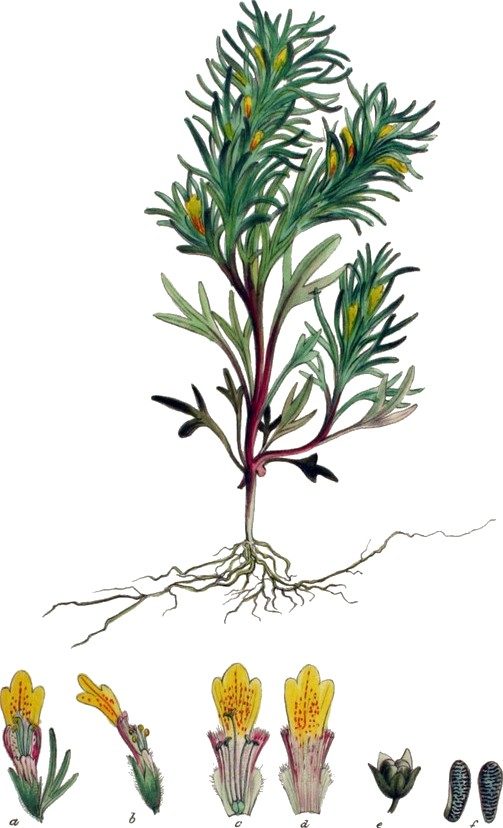
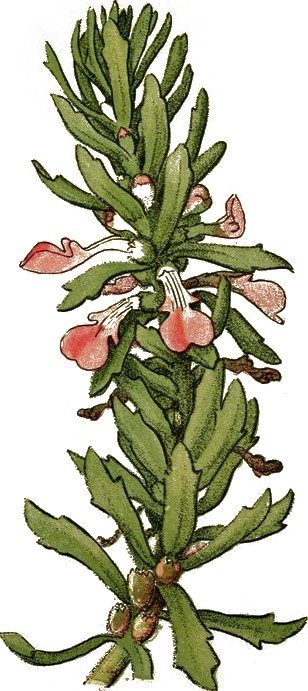
Ground pine
Camepitio
- Known today as
- Ajuga chamaepitys, yellow bugle, distinct from arthritica (note XLIX).
- Kind
- Plant, in 2 older authorities
- Constituents
- ajugarin, iridoid glycosides, the resinous oil
- Earliest authority here
- Pliny (AD 23/24–79)
- In other databases
- Plants of the World Online search · GBIF search · Wikidata search
- In the Canale glossary
- On the Manner of Discerning and Healing the Bewitched, Appendix A: Part Three, Chapter 10: Amulets
Revised October 1, 2026: An older authority added from a text read in full. Lore added from texts read in full. Version 1, first published September 25, 2026.
Ground pine: what did Canale use it for?
Among the amulet herbs: hung about the neck, and used in fumigations and decoctions against hexes (ch. 10; see the amulet herbs).
Ground pine: what does modern science say?
No established effect.
Pharmacognosy & Toxicology
- Constituents
- ajugarin ChEMBLclerodane diterpenes
- iridoid glycosides
- the resinous oilwhich gives the pine scent
- Mechanism
- Ajuga chamaepitys, sister to Canale’s iva artetica: anti-inflammatory diterpenes in animals, nothing established in people; its old use for gout rests on a diuretic bitterness.
- Toxic dose
- Safe at the tea doses of the herbals.
- Standing
- No monograph.
- Israili, Z. H., and Lyoussi, B. (2009). “Ethnopharmacology of the plants of genus Ajuga.” Pakistan Journal of Pharmaceutical Sciences 22. Verified against its record · PMID 19783524
The abstract of each source, beneath its citation. For Club members. About the Club or sign in.
Constituent names open the compound’s record at PubChem, and “ChEMBL” beside a name opens its record at ChEMBL, the European Bioinformatics Institute’s database of bioactive molecules. Where a mechanism line was checked against ChEMBL (ChEMBL 37, read 1 October 2026), the check is shown with the measured value and its source paper, or says plainly that nothing has been measured. Doses are as the references give them, for description only; this is not medical advice. Each source carries the result of its check against Crossref, PubMed, or the authority’s page: see Verification.
Ground pine: what lore surrounds it?
Grieve records that ground pine “was formerly regarded almost as a specific in gouty and rheumatic affections, the young tops, dried and reduced to powder being employed. It formed an ingredient of the once famous Portland Powder.”
Ground pine: what did the older authorities say?
- Pliny
- Calls the chamaepitys “abiga” in Latin, “because it promotes abortion,” and says some know it as “incense of the earth”: its branches are a cubit long and have the odour and blossoms of the pine; and a wine was made by boiling its wood, or germander’s, in must, with ten drachms of the flower to a congius.
- Culpeper
- Mars owns the herb: the decoction prevails against the strangury and the obstructions of the liver and spleen, and pills were made of its powder with the pulp of figs; it is “so powerful upon those feminine parts, that it is utterly forbidden for women with child”; and it is “a special remedy for the poison of the aconites.”
Sources
- Pliny the Elder, Natural History 24.20, 14.19, trans. J. Bostock & H. T. Riley (1855), Perseus Digital Library. Primary text
- Culpeper, N. (1653). The Complete Herbal, “Ground Pine, Or Chamepitys.” Project Gutenberg #49513. Primary text
- Grieve, M. (1931). A Modern Herbal, “Bugle, Yellow.” botanical.com/botanical/mgmh/b/bugley83.html Standard reference work
Verification
- Checked
- October 1, 2026
- Passes
- Every sentence read against its sources, in the pass over the remaining 343 entries
- The Standing line checked against the authority it names (EMA, WHO, FDA, CITES, Commission E)
- Every dated or regulatory claim checked by category across the database
- Each quotation from the older authorities checked word for word against the text, read in full
- Sources
- 4 cited: 1 verified against its record, 2 primary text, 1 standard reference work. 1 with the abstract on file.
- Corrections
- None were needed.
What was checked, how, and what was found is set out on the Verification page. A checked source is one whose record was found; it does not make the entry medical advice.
Cite This Entry
Version 1 · first published September 25, 2026 · last revised October 1, 2026
- Chicago
“Ground pine.” In Materia Medica, edited by B. C. P. Statema. Version 1. The Thinking Press, 2026–. Last modified October 1, 2026. https://thethinkingpress.org/materia-medica/ground-pine.
- MLA
“Ground pine.” Materia Medica, edited by B. C. P. Statema, version 1, The Thinking Press, 1 Oct. 2026, thethinkingpress.org/materia-medica/ground-pine. Accessed 8 Oct. 2026.
- APA
Ground pine. (2026, October 1). In B. C. P. Statema (Ed.), Materia medica (Version 1). The Thinking Press. Retrieved October 8, 2026, from https://thethinkingpress.org/materia-medica/ground-pine
Club members keep entries on a shelf with private notes, print the plates as cards, and receive an entry by email each week. Create a free account before January 1, 2027 and all of it is yours for good. About the Club
See Also
Sharing iridoid glycosides
Also in Pliny the Elder
Gum arabic in Pliny the Elder · Ground ivy in Pliny the Elder · Hawthorn in Pliny the Elder · Greater celandine in Pliny the Elder · everything Pliny the Elder names →
Also in Nicholas Culpeper
Herb Paris in Nicholas Culpeper · Ground cherry in Nicholas Culpeper · everything Nicholas Culpeper names →
Drawing on the same sources: Culpeper, Grieve, Israili
Hamech, confection of · Hartshorn · Heartsease · the bibliography →
Historical description, not medical advice.