
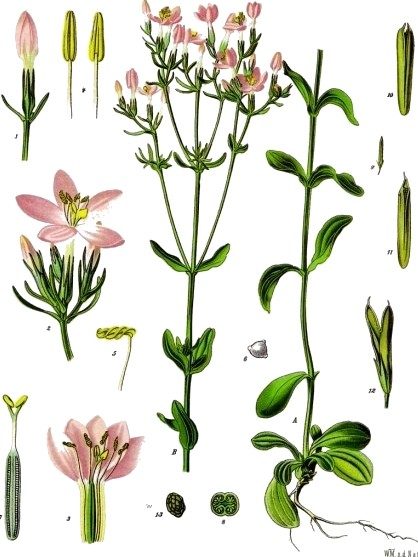
Centaury
Centaurea
- Known today as
- Common centaury, Centaurium erythraea.
- Kind
- Plant, in 2 older authorities
- Constituents
- swertiamarin, gentiopicroside, sweroside, and 1 more
- Earliest authority here
- Pliny (AD 23/24–79)
- In other databases
- Plants of the World Online search · GBIF search · Wikidata search
- In the Canale glossary
- On the Manner of Discerning and Healing the Bewitched, Appendix A: Part Three, Chapter 10: Amulets
Revised October 1, 2026: An older authority added from a text read in full. Version 1, first published September 25, 2026.
Centaury: what did Canale use it for?
Among the amulet herbs: hung about the neck, and used in fumigations and decoctions against hexes (ch. 10; see the amulet herbs).
Centaury: what does modern science say?
Intensely bitter, and still used for loss of appetite and indigestion.
Pharmacognosy & Toxicology
- Constituents
- swertiamarin ChEMBLthe secoiridoid bitter
- gentiopicroside ChEMBL
- sweroside ChEMBL
- xanthones
- Mechanism
- A gentian-family bitter: the secoiridoids provoke saliva and gastric secretion by reflex and increase appetite; no central action.
- Toxic dose
- Safe; nothing is recorded against it beyond its bitterness.
- Standing
- EMA monograph (2016) for loss of appetite and mild dyspepsia; it is also in a licensed German combination for urinary complaints (Canephron).
- EMA/HMPC (2016). European Union herbal monograph on Centaurium erythraea Rafn, herba (EMA/HMPC/277493/2015). Verified against its record
Constituent names open the compound’s record at PubChem, and “ChEMBL” beside a name opens its record at ChEMBL, the European Bioinformatics Institute’s database of bioactive molecules. Where a mechanism line was checked against ChEMBL (ChEMBL 37, read 1 October 2026), the check is shown with the measured value and its source paper, or says plainly that nothing has been measured. Doses are as the references give them, for description only; this is not medical advice. Each source carries the result of its check against Crossref, PubMed, or the authority’s page: see Verification.
Centaury: what lore surrounds it?
By tradition going back to the Greek herbal writers, the plant is named for Chiron, wisest of the centaurs, who used it to heal a wound, in some versions the poisoned wound from Hercules’ arrow that never fully healed, and taught its use to other healers. The genus names Centaurea and Centaurium both preserve the story.
Centaury: what did the older authorities say?
- Pliny
- “Centaury, it is said, effected a cure for Chiron, on the occasion when, while handling the arms of Hercules, his guest, he let one of the arrows fall upon his foot: hence it is that by some it is called chironion.” The lesser centaury, lepton or libadion from growing by fountains, has a root never used, its virtue being in the juice drawn in autumn; “in Italy this kind of centaury is known as gall of the earth, from its extreme bitterness,” and the Gauls call it exacum because it purges off noxious matter; the root of the greater centaury is given in white wine for snakebite.
- Culpeper
- Under the Sun, “as appears in that their flowers open and shut as the Sun, either shews or hides his face”: boiled and drunk it purges choleric humours, opens obstructions of the liver, gall, and spleen, and is given with good effect in agues; “much used by the Italians in powder” for the dropsy and green-sickness; a dram of the powder in wine against the biting of an adder.
Sources
- [41] European Medicines Agency, Committee on Herbal Medicinal Products (HMPC). Herbal monographs, assessment reports and public statements, ema.europa.eu, cited under the herb concerned: aniseed (summary, EMA/305345/2016); Aristolochia (public statement, EMEA/HMPC/138381/2005); asarone (public statement, EMEA/HMPC/139215/2005); caraway (EMA/HMPC/715092/2013); centaury (EMA/HMPC/277493/2015); chicory root (assessment report, EMA/HMPC/113041/2010); cinnamon (EMA/HMPC/246774/2009); clove (assessment report, EMA/HMPC/534946/2010); ethanol in herbal products (reflection paper, EMA/HMPC/85114/2008); fennel (EMEA/HMPC/372839/2016, Rev. 1, 2024); fumitory (draft assessment report, EMA/HMPC/367013/2021); greater celandine (public statement, EMA/HMPC/743927/2010); hops (EMA/HMPC/682384/2013); horehound (EMA/HMPC/604271/2012); mallow (assessment report, EMA/HMPC/749518/2016); marshmallow root (Althaeae radix); melissa (summary, EMA/HMPC/310761/2013); myrrh (assessment report and monograph, EMA/HMPC/96910/2010 and 96911/2010); peppermint oil (assessment report, EMEA/HMPC/349465/2006); pyrrolizidine alkaloids (public statement, EMA/HMPC/893108/2011); rhubarb (EMA/HMPC/113700/2019); sage (Salviae officinalis folium); wormwood (EMA/HMPC/751490/2016). Read in full · the text read
- [54] Grieve, M. (1931). A Modern Herbal. Online edition, botanical.com, cited under the plant concerned. Read in part · the text read
- Theoi Project, “Chiron.” Book, not indexed
- Pliny the Elder, Natural History 25.30–31, 25.55, trans. J. Bostock & H. T. Riley (1855), Perseus Digital Library. Primary text
- Culpeper, N. (1653). The Complete Herbal, “The Ordinary Small Centaury.” Project Gutenberg #49513. Primary text
Verification
- Checked
- October 1, 2026
- Passes
- Every sentence read against its sources, in the pass over the remaining 343 entries
- The Standing line checked against the authority it names (EMA, WHO, FDA, CITES, Commission E)
- Every dated or regulatory claim checked by category across the database
- Each quotation from the older authorities checked word for word against the text, read in full
- Sources
- 6 cited: 1 read in full, 1 read in part, 1 verified against its record, 2 primary text, 1 book, not indexed.
- Corrections
- None were needed.
What was checked, how, and what was found is set out on the Verification page. A checked source is one whose record was found; it does not make the entry medical advice.
Cite This Entry
Version 1 · first published September 25, 2026 · last revised October 1, 2026
- Chicago
“Centaury.” In Materia Medica, edited by B. C. P. Statema. Version 1. The Thinking Press, 2026–. Last modified October 1, 2026. https://thethinkingpress.org/materia-medica/centaury.
- MLA
“Centaury.” Materia Medica, edited by B. C. P. Statema, version 1, The Thinking Press, 1 Oct. 2026, thethinkingpress.org/materia-medica/centaury. Accessed 8 Oct. 2026.
- APA
Centaury. (2026, October 1). In B. C. P. Statema (Ed.), Materia medica (Version 1). The Thinking Press. Retrieved October 8, 2026, from https://thethinkingpress.org/materia-medica/centaury
Club members keep entries on a shelf with private notes, print the plates as cards, and receive an entry by email each week. Create a free account before January 1, 2027 and all of it is yours for good. About the Club
See Also
Sharing sweroside
Also in Pliny the Elder
Chaste tree in Pliny the Elder · Catmint in Pliny the Elder · Chicory in Pliny the Elder · Castoreum in Pliny the Elder · everything Pliny the Elder names →
Also in Nicholas Culpeper
Chamomile in Nicholas Culpeper · Burdock in Nicholas Culpeper · everything Nicholas Culpeper names →
Drawing on the same sources: Culpeper
Nearby in the alphabet
Chaga (cracked, charcoal-like growth on living birch) · Cattail · Chanterelle (apricot-scented mushroom with blunt ridges for gills) · Caterpillar fungus (sending up a slender stalk)
Historical description, not medical advice.