
Boldo
Boldu, boldus; Boldoa fragrans; Peumus boldus Molina; in pharmacy Boldi folium
- Known today as
- Peumus boldus, an evergreen shrub of the fields of the Chilean Andes, whose yellowish-green fruit is eaten, whose bark tanned leather, and whose wood made charcoal, by Grieve’s account. The leaves, the part used, are opposite, stalkless, about two inches long, leathery and red-brown when dried, dotted with small glands, with a smell that when crushed is “very strongly disagreeable, not unlike oil of Chenopodium (wormseed).”
- Kind
- Plant
- Constituents
- boldine, ascaridole, 1,8-cineole, and 1 more
- In other databases
- Plants of the World Online · GBIF · Wikidata
Caution. Not for people with obstruction of the bile duct, cholangitis, liver disease, gallstones, or other biliary disorders, nor for anyone under eighteen, nor in pregnancy or breast-feeding, which the European agency does not recommend in view of the preclinical safety data. Anaphylaxis has been reported. Grieve recorded that boldine in toxic doses causes great excitement, cramps, and convulsions ending in death from paralysis of the breathing.
Boldo: what was it used for?
A remedy of the liver and the urinary passages. Grieve calls it tonic, antiseptic, and stimulant, “Useful in chronic hepatic torpor,” the oil useful in genito-urinary inflammation, and the plant “long been recognized in South America as a valuable cure for gonorrhoea”; its alkaloid boldine was used in veterinary practice for jaundice, and the tincture as a diuretic.
Boldo: what does modern science say?
The European Medicines Agency’s herbal committee accepts the leaf as a traditional herbal medicine, “exclusively based upon long-standing use,” for the symptomatic relief of dyspepsia and mild spasmodic disorders of the gut (monograph of 2016). Its assessment report finds 0.25 to 0.7 per cent isoquinoline alkaloids, boldine usually chief among them, and 2 to 2.6 per cent volatile oil whose major constituents include ascaridole, 1,8-cineole, and p-cymene.
Boldo: is it poisonous?
Yes, in some form or dose. Not for people with obstruction of the bile duct, cholangitis, liver disease, gallstones, or other biliary disorders, nor for anyone under eighteen, nor in pregnancy or breast-feeding, which the European agency does not recommend in view of the preclinical safety data. Anaphylaxis has been reported. Grieve recorded that boldine in toxic doses causes great excitement, cramps, and convulsions ending in death from paralysis of the breathing. Historical description, not medical advice; in a poisoning, call a poison centre.
Pharmacognosy & Toxicology
- Constituents
- boldineusually chief of the isoquinoline alkaloids, 0.25 to 0.7 per cent
- ascaridolein the volatile oil
- 1,8-cineole ChEMBLin the volatile oil
- p-cymenein the volatile oil
- Mechanism
- Not established in the sources read for this entry.
- Standing
- European Union herbal monograph (2016): traditional use, “exclusively based upon long-standing use,” for dyspepsia and mild spasmodic disorders of the gut.
- European Medicines Agency, Committee on Herbal Medicinal Products. European Union herbal monograph on Boldi folium (Boldo Leaf). EMA/HMPC/453725/2016, 22 November 2016. Read in full · the text read
- European Medicines Agency, Committee on Herbal Medicinal Products. Assessment report on Boldi folium. EMA/HMPC/453726/2016, 22 November 2016. Read in part · the text read
- Grieve, M. A Modern Herbal, “Boldo.” As published on botanical.com. Read in full · the text read
Constituent names open the compound’s record at PubChem, and “ChEMBL” beside a name opens its record at ChEMBL, the European Bioinformatics Institute’s database of bioactive molecules. Where a mechanism line was checked against ChEMBL (ChEMBL 37, read 1 October 2026), the check is shown with the measured value and its source paper, or says plainly that nothing has been measured. Doses are as the references give them, for description only; this is not medical advice. Each source carries the result of its check against Crossref, PubMed, or the authority’s page: see Verification.
Boldo: what lore surrounds it?
The leaves’ oil, Grieve notes, is chemically related to the oil of wormseed, and the Australian Monimia rotundifolia yields one similar enough to be substituted for it.
Sources
- Grieve, M. A Modern Herbal, “Boldo.” As published on botanical.com. Read in full · the text read
- European Medicines Agency, Committee on Herbal Medicinal Products. European Union herbal monograph on Boldi folium (Boldo Leaf). EMA/HMPC/453725/2016, 22 November 2016. Read in full · the text read
- European Medicines Agency, Committee on Herbal Medicinal Products. Assessment report on Boldi folium. EMA/HMPC/453726/2016, 22 November 2016. Read in part · the text read
Verification
- Checked
- October 1, 2026
- Passes
- Every sentence read against its sources, in the pass over the remaining 343 entries
- The Standing line checked against the authority it names (EMA, WHO, FDA, CITES, Commission E)
- Every dated or regulatory claim checked by category across the database
- Sources
- 3 cited: 2 read in full, 1 read in part.
- Corrections
- None were needed.
What was checked, how, and what was found is set out on the Verification page. A checked source is one whose record was found; it does not make the entry medical advice.
Club members can point at a technical term in this entry, such as a constituent, an action, or a word of Jung’s, to read its definition from the source. The Club.
Cite This Entry
Version 1 · first published October 16, 2026
- Chicago
“Boldo.” In Materia Medica, edited by B. C. P. Statema. Version 1. The Thinking Press, 2026–. Last modified October 16, 2026. https://thethinkingpress.org/materia-medica/boldo.
- MLA
“Boldo.” Materia Medica, edited by B. C. P. Statema, version 1, The Thinking Press, 16 Oct. 2026, thethinkingpress.org/materia-medica/boldo. Accessed 17 Oct. 2026.
- APA
Boldo. (2026, October 16). In B. C. P. Statema (Ed.), Materia medica (Version 1). The Thinking Press. Retrieved October 17, 2026, from https://thethinkingpress.org/materia-medica/boldo
Club members keep entries on a shelf with private notes, print the plates as cards, and receive an entry by email each week. Create a free account before January 1, 2027 and all of it is yours for good. About the Club
See Also
Sharing 1,8-cineole
Elettaria cardamomum · Melaleuca alternifolia · Eucalyptus globulus · Artemisia abrotanum
Drawing on the same sources: Grieve
Nearby in the alphabet
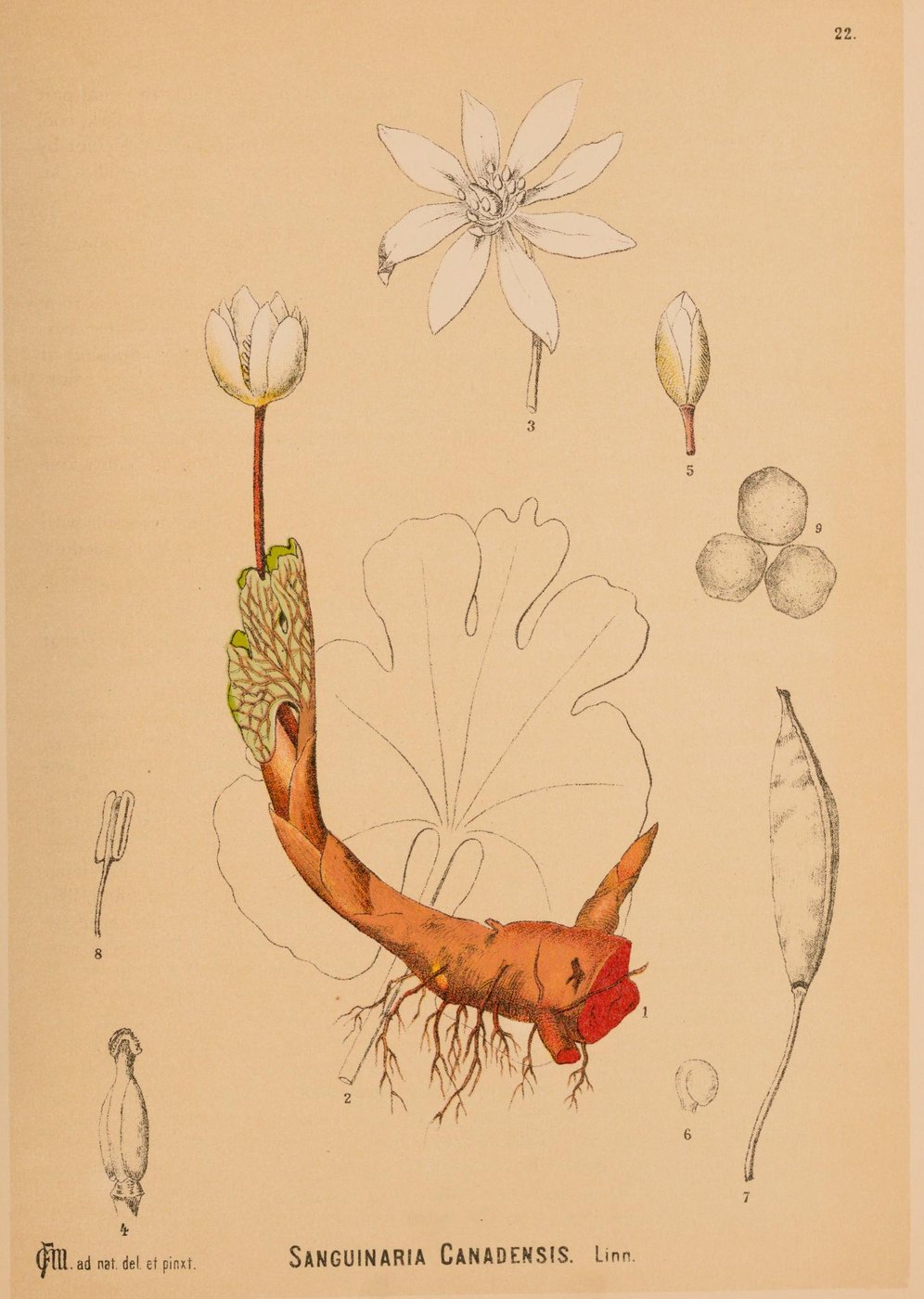
Blue cohosh · Borax (brought as the crude salt tincal from the lakes of Tibet) · Bloodstone (iron oxide, which streaks blood-red) · Breve (A written prayer or holy names folded and worn on the body) · Bloodroot (the first flower of the spring woods from Canada to the South)
Historical description, not medical advice.
