
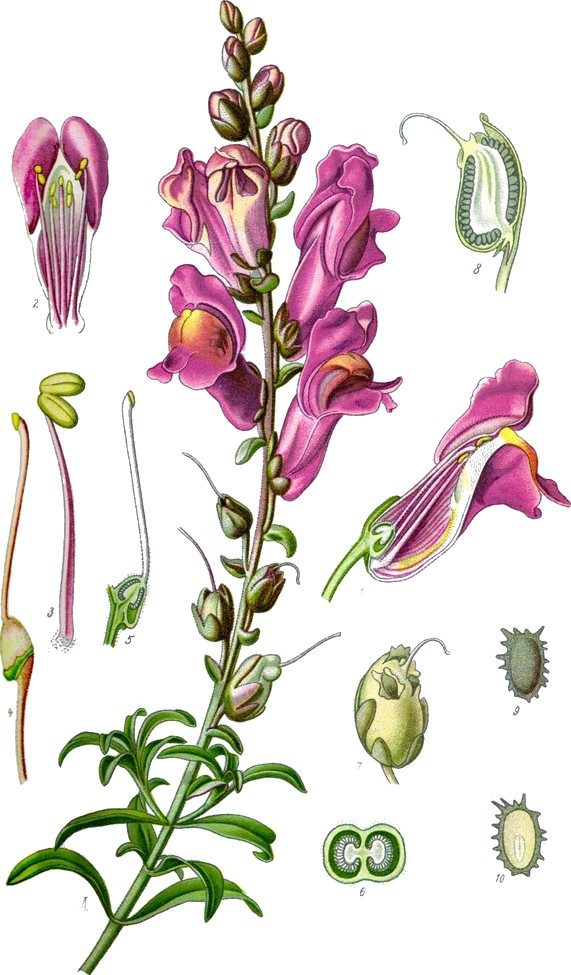
Snapdragon
Antirrino
- Known today as
- Antirrhinum majus.
- Kind
- Plant, in 1 older authority
- Constituents
- aureusidin and bracteatin, antirrhinoside, cyanidin and pelargonidin glycosides
- Earliest authority here
- Pliny (AD 23/24–79)
- In other databases
- Plants of the World Online search · GBIF search · Wikidata search
- In the Canale glossary
- On the Manner of Discerning and Healing the Bewitched, Appendix A: Part Three, Chapter 10: Amulets
Revised October 1, 2026: An older authority added from a text read in full. Lore added from texts read in full. Version 1, first published September 25, 2026.
Snapdragon: what did Canale use it for?
Hung about the neck, “of great benefit for preserving oneself from every harm done by way of hexes” (ch. 10).
Snapdragon: what does modern science say?
Grieve records it as a preservative against witchcraft. No effect is known.
Pharmacognosy & Toxicology
- Constituents
- aureusidin and bracteatinaurone pigments
- antirrhinoside ChEMBLan iridoid glycoside
- cyanidin and pelargonidin glycosides
- Mechanism
- Hung about the neck it delivers nothing; eaten, it is a mild bitter of no account. Its modern distinction is as the plant in which Erwin Baur worked out Mendelian inheritance after 1900 and in which transposable elements were later found, and as the source of the flower-colour genes of molecular genetics.
- Toxic dose
- Safe.
- Standing
- No monograph.
- Schwarz-Sommer, Z., et al. (2003). “Antirrhinum majus: a model plant for molecular genetics.” Nature Reviews Genetics 4. Matched to its record and reviewed
The abstract of each source, beneath its citation. For Club members. About the Club or sign in.
Constituent names open the compound’s record at PubChem, and “ChEMBL” beside a name opens its record at ChEMBL, the European Bioinformatics Institute’s database of bioactive molecules. Where a mechanism line was checked against ChEMBL (ChEMBL 37, read 1 October 2026), the check is shown with the measured value and its source paper, or says plainly that nothing has been measured. Doses are as the references give them, for description only; this is not medical advice. Each source carries the result of its check against Crossref, PubMed, or the authority’s page: see Verification.
Snapdragon: what lore surrounds it?
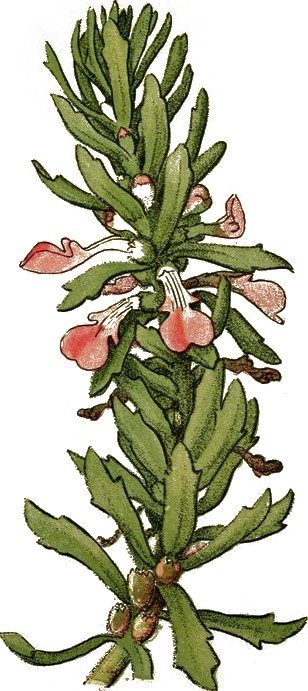
“The snapdragon and the herb-betony had the reputation of averting the most subtle forms of witchcraft,” Thiselton-Dyer writes; the plant “was said to have a supernatural influence, and amongst other qualities to possess the power of destroying charms.” Its country name is calf's-snout, from the snouts of animals, and its gaping corolla gave the names “dog's-mouth, rabbit's-mouth, and lion's-snap.”
Grieve: “It was valued in olden times like the Toadflax as a preservative against witchcraft,” and the small snapdragon is the Calf's Snout, Orontium, which Dodonaeus took from “an old mediaeval generic name” for the plant.
Snapdragon: what did the older authorities say?
- Pliny
- Gives the antirrhinum or anarrhinon, the lychnis agria, as a plant like flax, without a root, with a flower like the hyacinth and “a seed similar in form to the muzzle of a calf”; “according to what the magicians say, persons who rub themselves with this plant improve their personal appearance thereby; and they may ensure themselves against all noxious substances and poisons, by wearing it as a bracelet.”
Sources
- [54] Grieve, M. (1931). A Modern Herbal. Online edition, botanical.com, cited under the plant concerned. Read in part · the text read
- Pliny the Elder, Natural History 25.80, trans. J. Bostock & H. T. Riley (1855), Perseus Digital Library. Primary text
- Thiselton-Dyer, T. F. (1889). The Folk-lore of Plants. Project Gutenberg #10118. Read in part · the text read
- Grieve, M. (1931). A Modern Herbal, “Snapdragon.” botanical.com/botanical/mgmh/s/snapdr58.html Standard reference work
Verification
- Checked
- October 1, 2026
- Passes
- Every sentence read against its sources, in the pass over the remaining 343 entries
- The Standing line checked against the authority it names (EMA, WHO, FDA, CITES, Commission E)
- Every dated or regulatory claim checked by category across the database
- Each quotation from the older authorities checked word for word against the text, read in full
- Sources
- 5 cited: 2 read in part, 1 matched to its record and reviewed, 1 primary text, 1 standard reference work. 1 with the abstract on file.
- Corrections
- Mendel worked on peas; Antirrhinum was Erwin Baur's Mendelian plant after 1900. Reworded.
What was checked, how, and what was found is set out on the Verification page. A checked source is one whose record was found; it does not make the entry medical advice.
Cite This Entry
Version 1 · first published September 25, 2026 · last revised October 1, 2026
- Chicago
“Snapdragon.” In Materia Medica, edited by B. C. P. Statema. Version 1. The Thinking Press, 2026–. Last modified October 1, 2026. https://thethinkingpress.org/materia-medica/snapdragon.
- MLA
“Snapdragon.” Materia Medica, edited by B. C. P. Statema, version 1, The Thinking Press, 1 Oct. 2026, thethinkingpress.org/materia-medica/snapdragon. Accessed 8 Oct. 2026.
- APA
Snapdragon. (2026, October 1). In B. C. P. Statema (Ed.), Materia medica (Version 1). The Thinking Press. Retrieved October 8, 2026, from https://thethinkingpress.org/materia-medica/snapdragon
Club members keep entries on a shelf with private notes, print the plates as cards, and receive an entry by email each week. Create a free account before January 1, 2027 and all of it is yours for good. About the Club
See Also
Sharing antirrhinoside
Also in Pliny the Elder
Sugar in Pliny the Elder · Snail in Pliny the Elder · Sweet almond, oil of in Pliny the Elder · Silphium in Pliny the Elder · everything Pliny the Elder names →
Drawing on the same sources: Thiselton-Dyer, Grieve
Violet, lettuce, sow-thistle · Water germander · Southernwood · Shepherd’s purse · St. John’s wort · the bibliography →
Nearby in the alphabet
Solomon’s seal (Polygonatum multiflorum and its relatives) · Sorrel, syrup of · Silver · Species Pleris Archonticon · The sickener (brittle mushroom of wet pine woods)
Historical description, not medical advice.