
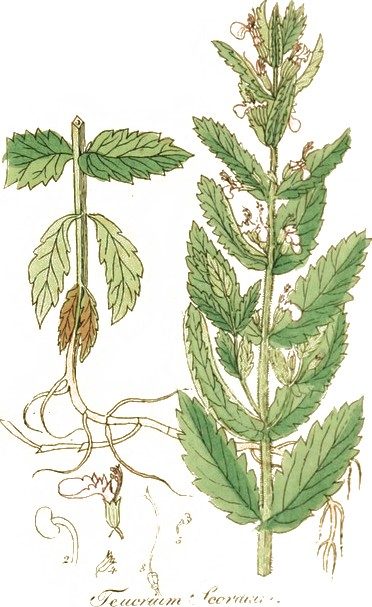
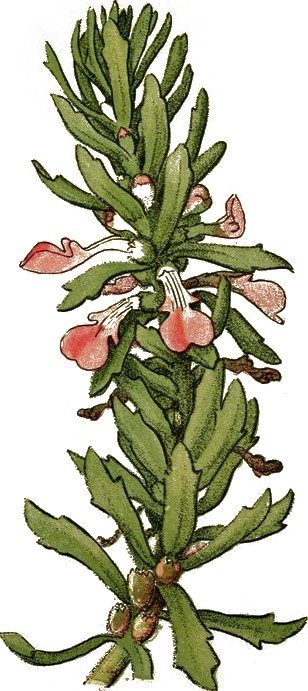
Water germander
Scordeo
- Known today as
- Teucrium scordium, of the same genus as wall germander, which has caused liver failure in modern herbal preparations.
- Kind
- Plant, in 1 older authority
- Constituents
- neo-clerodane diterpenes, scordein, the garlic-scented oil
- Poisoning
- Hepatotoxic monoterpenes (pulegone)
- Earliest authority here
- Pliny (AD 23/24–79)
- In other databases
- Plants of the World Online search · GBIF search · Wikidata search
- In the Canale glossary
- On the Manner of Discerning and Healing the Bewitched, Appendix A: Part Three, Chapter 10: Amulets
Revised October 1, 2026: An older authority added from a text read in full. Lore added from texts read in full. Version 1, first published September 25, 2026.
Caution. Hazardous in some form or dose; see the modern assessment below.
Water germander: what did Canale use it for?
Among the amulet herbs: hung about the neck, and used in fumigations and decoctions against hexes (ch. 10; see the amulet herbs).
Water germander: what does modern science say?
Scordium was an ingredient of theriac and was esteemed as an antidote to poisons. Several Teucrium species have caused liver injury, so the genus is treated with caution.
Water germander: is it poisonous?
Yes, in some form or dose. Its poisoning is hepatotoxic monoterpenes (pulegone): Hours. Historical description, not medical advice; in a poisoning, call a poison centre.
Pharmacognosy & Toxicology
- Constituents
- Mechanism
- Teucrium scordium: its relative the wall germander (T. chamaedrys) caused an epidemic of liver damage in France in 1992 when sold for weight loss, the teucrin diterpenes being activated by the liver into hepatotoxic epoxides; the water germander carries the same class and should be assumed to share the risk. Its old fame against the plague rested on its scent.
- Toxic dose
- No safe internal dose can be stated; the wall germander was banned in France in 1992.
- Syndrome
- Hepatotoxic monoterpenes (pulegone)
- Standing
- Not approved; Teucrium species are restricted across Europe after the French cases.
- Larrey, D., et al. (1992). “Hepatitis after germander (Teucrium chamaedrys) administration: another instance of herbal medicine hepatotoxicity.” Annals of Internal Medicine 117. Verified against its record · doi:10.7326/0003-4819-117-2-129
- Kouzi, S. A., et al. (1994). “Hepatotoxicity of germander (Teucrium chamaedrys L.) and one of its constituent neoclerodane diterpenes teucrin A in the mouse.” Chemical Research in Toxicology 7. Matched to its record and reviewed
The abstract of each source, beneath its citation. For Club members. About the Club or sign in.
Constituent names open the compound’s record at PubChem, and “ChEMBL” beside a name opens its record at ChEMBL, the European Bioinformatics Institute’s database of bioactive molecules. Where a mechanism line was checked against ChEMBL (ChEMBL 37, read 1 October 2026), the check is shown with the measured value and its source paper, or says plainly that nothing has been measured. Doses are as the references give them, for description only; this is not medical advice. Each source carries the result of its check against Crossref, PubMed, or the authority’s page: see Verification.
Water germander: what lore surrounds it?
Thiselton-Dyer records that “the germander is known as horse-chere, from its growing after horse-droppings.”
Used in These Compounds
Water germander is an ingredient of 1 compound medicine in the database. For Club members. Create a free account or sign in.
Water germander: what did the older authorities say?
- Pliny
- Lennaeus, he says, “attributes to Mithridates the discovery of another plant, the scordotis or scordion, which has been described, he tells us, by the hand even of that prince”: a cubit high, with a square branchy stem and downy leaves like the oak’s, growing in Pontus in rich, humid soils, and bitter; it reduces swellings of the testes, is taken in vinegar for gout, its juice is recommended “for all painful affections of the body,” and it is drunk for ruptures and convulsions.
Sources
- [3] Ahnfelt, N.-O., Fors, H., & Wendin, K. (2022). Making and taking theriac: an experimental and sensory approach to the history of medicine. BJHS Themes 7: 39–62. doi:10.1017/bjt.2022.6 Verified against its record · doi:10.1017/bjt.2022.6
- [54] Grieve, M. (1931). A Modern Herbal. Online edition, botanical.com, cited under the plant concerned. Read in part · the text read
- [80] LiverTox: Clinical and Research Information on Drug-Induced Liver Injury. Bethesda (MD): National Institute of Diabetes and Digestive and Kidney Diseases. Entries: Germander (updated 12 March 2018); Pennyroyal Oil (updated 28 March 2020); Senna (updated 1 April 2020). Abstract read · the text read
- Pliny the Elder, Natural History 25.27, 26.58, 26.64, 26.67, 26.85, trans. J. Bostock & H. T. Riley (1855), Perseus Digital Library. Primary text
- Thiselton-Dyer, T. F. (1889). The Folk-lore of Plants. Project Gutenberg #10118. Read in part · the text read
Verification
- Checked
- October 1, 2026
- Passes
- Every sentence read against its sources, in the pass over the remaining 343 entries
- The Standing line checked against the authority it names (EMA, WHO, FDA, CITES, Commission E)
- Every dated or regulatory claim checked by category across the database
- Each quotation from the older authorities checked word for word against the text, read in full
- Sources
- 7 cited: 2 read in part, 1 abstract read, 2 verified against its record, 1 matched to its record and reviewed, 1 primary text. 2 with the abstract on file.
- Corrections
- None were needed.
What was checked, how, and what was found is set out on the Verification page. A checked source is one whose record was found; it does not make the entry medical advice.
Cite This Entry
Version 1 · first published September 25, 2026 · last revised October 1, 2026
- Chicago
“Water germander.” In Materia Medica, edited by B. C. P. Statema. Version 1. The Thinking Press, 2026–. Last modified October 1, 2026. https://thethinkingpress.org/materia-medica/water-germander.
- MLA
“Water germander.” Materia Medica, edited by B. C. P. Statema, version 1, The Thinking Press, 1 Oct. 2026, thethinkingpress.org/materia-medica/water-germander. Accessed 8 Oct. 2026.
- APA
Water germander. (2026, October 1). In B. C. P. Statema (Ed.), Materia medica (Version 1). The Thinking Press. Retrieved October 8, 2026, from https://thethinkingpress.org/materia-medica/water-germander
Club members keep entries on a shelf with private notes, print the plates as cards, and receive an entry by email each week. Create a free account before January 1, 2027 and all of it is yours for good. About the Club
See Also
Poisoned alike: hepatotoxic monoterpenes (pulegone)
Parsley · Savin · Pennyroyal · Rue · the syndrome, with all of them →
Also in Pliny the Elder
Wax in Pliny the Elder · Walnut, middle bark of in Pliny the Elder · Wild carrot, seed of in Pliny the Elder · Violet, lettuce, sow-thistle in Pliny the Elder · everything Pliny the Elder names →
Drawing on the same sources: Thiselton-Dyer
Nearby in the alphabet
Wax ex-votos · Vitriol (blue vitriol (copper sulfate), and white vitriol (zinc sulfate)) · Weapon-salve · Viper (Vipera species, dried into troches) · White arsenic (Arsenic trioxide)
Historical description, not medical advice.