
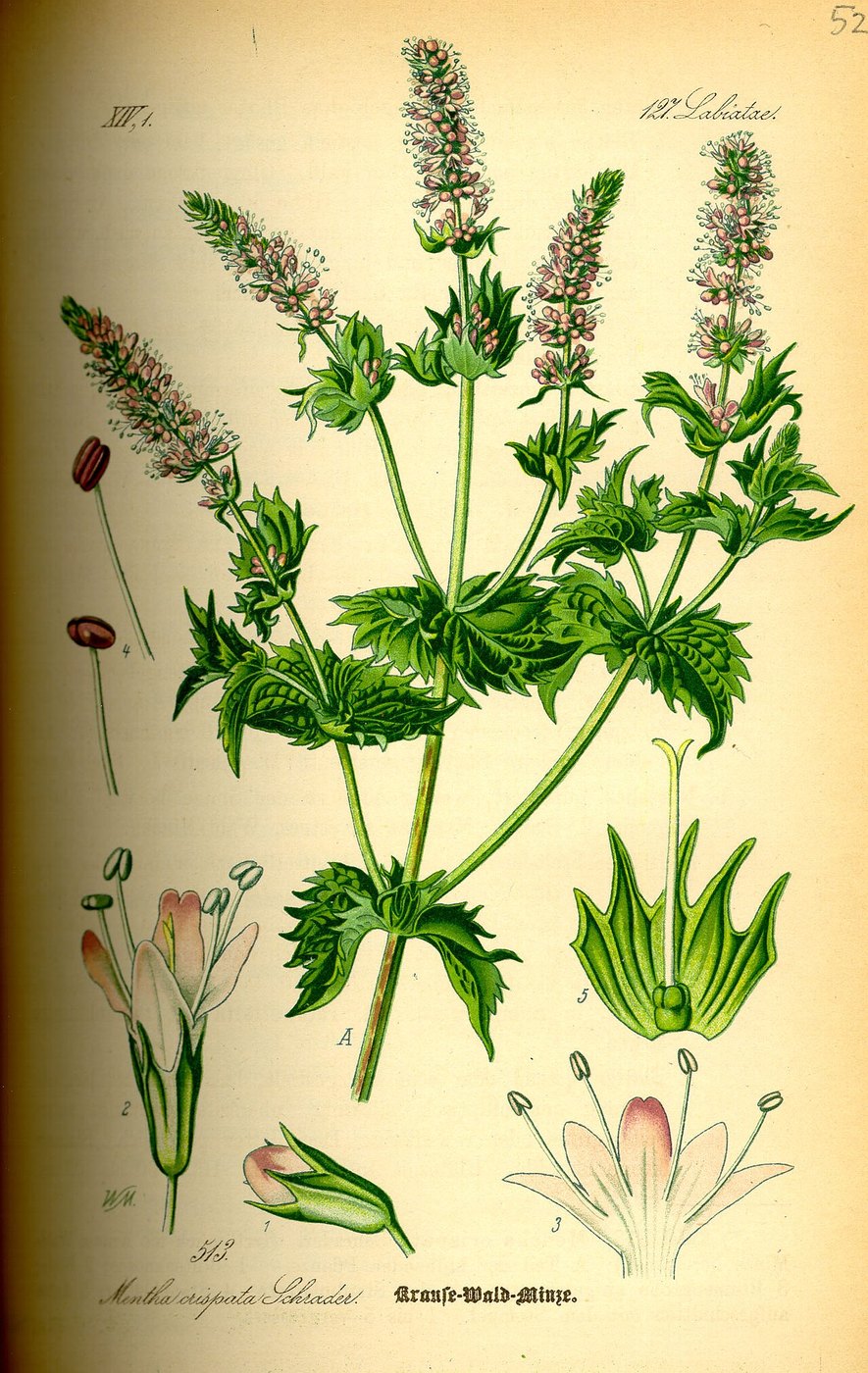
Spearmint
Mentha spicata, printed by Grieve as Mentha viridis; Garden Mint, Mackerel Mint, Our Lady’s Mint, Green Mint, Spire Mint, Sage of Bethlehem, Fish Mint, Lamb Mint; French Menthe de Notre Dame, Italian Erba Santa Maria, German Frauen Munze; Turner’s “Spere Mynte” (1568)
- Known today as
- The common garden mint, Mentha spicata: erect square stems about two feet high from creeping root-stocks, with very short-stalked, pointed, wrinkled, bright green leaves. A native of the Mediterranean, brought to Britain by the Romans; Grieve finds it wild in nearly all the countries to which civilization has extended.
- Kind
- Plant, in 3 older authorities
- Earliest authority here
- Pliny, as Gerard quotes him (AD 23/24–79)
- In other databases
- Plants of the World Online search · GBIF search · Wikidata search
Caution. The hormone studies were small and short. Spearmint tea is not a treatment for polycystic ovary syndrome, and anyone with the condition should be under a physician’s care.
Spearmint: what was it used for?
Chiefly a kitchen herb, Grieve says, but its oil is stimulant, carminative and antispasmodic, like peppermint’s though weaker, and better suited to children’s complaints: two to five drops on sugar. A distilled water of spearmint was given for hiccough, flatulence and the giddiness of indigestion; the sweetened infusion, an ounce of the dried herb to a pint of boiling water, a wineglassful or less at a dose, for the troubles of infants and as a drink in fevers; and it was held a specific against nausea and vomiting and the pain of colic. Parkinson used the mints in baths with balm “to comfort and strengthen the nerves and sinews,” and inwardly to strengthen weak stomachs.
Spearmint: how is it taken as a tea?
An ounce of the dried herb to a pint of boiling water, strained and taken a wineglassful or less at a time: for the troubles of infants, sweetened, and as a drink in fevers and inflammatory diseases; held a specific against nausea and vomiting, and to ease colic.
All the herbal teas of the database. Historical directions, not medical advice.
Spearmint and polycystic ovary syndrome: what do the studies show?
Lowers androgens in two small studies; hair growth not yet shown to improve
- Androgens
- Free testosterone down (5 days; 30 days); total testosterone down at 30 days
- Insulin and glucose
- Not studied
- Cycles
- Not studied
- Hirsutism and skin
- Self-rated better; doctors’ score not significantly changed
The story begins in Isparta in south-western Turkey, where the local doctors suspected that the mint tea of the district lowered the libido. Akdoğan and colleagues gave 21 hirsute women, 12 of them with PCOS, a cup of spearmint tea twice a day for five days of the follicular phase: free testosterone fell and LH, FSH and estradiol rose, while total testosterone and DHEA-S did not change significantly. Grant then randomised 42 women with PCOS to spearmint tea or a placebo herbal tea twice a day for a month. Free and total testosterone fell and LH and FSH rose on the spearmint; the women rated their own hirsutism better, but the doctors’ Ferriman–Gallwey score did not differ significantly between the groups (p = 0.12), which Grant put down to a trial too short for hair. A 2026 review of plants said to alter androgens judged these human studies small and short, and found that an objective improvement in hirsutism has not been shown.
All seven herbs side by side. The studies are listed among the sources below, each with its abstract. A summary of research, not medical advice.
Spearmint: what does modern science say?
Spearmint tea is the one herb of this group with a story of its own in hormone research: in two small studies, in Turkey and England, it lowered free testosterone in women with hirsutism or polycystic ovary syndrome within days or weeks, though the hair itself has not yet been shown to change. The evidence is set out below.
Spearmint: what lore surrounds it?
Its generic name, Mentha, comes from the nymph Menthe, whom Proserpine, jealous of Pluto’s love for her, turned into the plant; Theophrastus first gave the name to the mint. Ovid has the old couple Baucis and Philemon scour their table with green mint before laying it for their divine guests, and the Pharisees paid tithes of mint, anise and cumin. In Athens, where every part of the body had its own scent, mint was the scent for the arms. The fourteenth century whitened its teeth with it; mice, Grieve adds, so dislike its smell that they will leave untouched any food it is scattered on.
Spearmint: what did the older authorities say?
- Pliny, as Gerard quotes him
- “The smell of Mint does stir up the minde and the taste to a greedy desire of meate”; and “it will not suffer milk to cruddle in the stomach, and therefore it is put in milk that is drunke, lest those that drinke thereof should be strangled.”
- John Gerard
- “The smelle rejoiceth the heart of man, for which cause they used to strew it in chambers and places of recreation, pleasure and repose, where feasts and banquets are made”; it is good against watering eyes and sores of the head, applied with salt to the bites of mad dogs, and laid on the stings of wasps and bees “with good success.”
- Nicholas Culpeper, as Grieve gives him
- Names nearly forty maladies for which mint is “singularly good”: smelled, “it is comfortable for the head and memory,” a decoction gargled cures sore mouths and gums, and rose leaves and mint, heated and laid on, “cause rest and sleep.”
Sources
- Grieve, M. A Modern Herbal, “Mints” (Spearmint). As published on botanical.com. Read in part · the text read
- Akdoğan, M., Tamer, M. N., Cüre, E., et al. (2007). “Effect of spearmint (Mentha spicata Labiatae) teas on androgen levels in women with hirsutism.” Phytotherapy Research 21: 444–447. doi:10.1002/ptr.2074. Abstract read · the text read
- Grant, P. (2010). “Spearmint herbal tea has significant anti-androgen effects in polycystic ovarian syndrome. A randomized controlled trial.” Phytotherapy Research 24: 186–188. doi:10.1002/ptr.2900. Abstract read · the text read
- Sharma, K., Yakubu, J., and Pandey, A. V. (2026). “Analysis of androgen modulation by natural products.” Pharmacological Research 231: 108377. doi:10.1016/j.phrs.2026.108377. Abstract read · the text read
Verification
- Checked
- October 1, 2026
- Passes
- Every dated or regulatory claim checked by category across the database
- Sources
- 4 cited: 1 read in part, 3 abstract read. 3 with the abstract on file.
- Corrections
- None were needed.
What was checked, how, and what was found is set out on the Verification page. A checked source is one whose record was found; it does not make the entry medical advice.
Cite This Entry
Version 1 · first published October 10, 2026
- Chicago
“Spearmint.” In Materia Medica, edited by B. C. P. Statema. Version 1. The Thinking Press, 2026–. Last modified October 10, 2026. https://thethinkingpress.org/materia-medica/spearmint.
- MLA
“Spearmint.” Materia Medica, edited by B. C. P. Statema, version 1, The Thinking Press, 10 Oct. 2026, thethinkingpress.org/materia-medica/spearmint. Accessed 10 Oct. 2026.
- APA
Spearmint. (2026, October 10). In B. C. P. Statema (Ed.), Materia medica (Version 1). The Thinking Press. Retrieved October 10, 2026, from https://thethinkingpress.org/materia-medica/spearmint
Club members keep entries on a shelf with private notes, print the plates as cards, and receive an entry by email each week. Create a free account before January 1, 2027 and all of it is yours for good. About the Club
See Also
Also in Pliny the Elder
Sugar in Pliny the Elder · Snapdragon in Pliny the Elder · Sweet almond, oil of in Pliny the Elder · Snail in Pliny the Elder · everything Pliny the Elder names →
Also in Nicholas Culpeper
Tansy in Nicholas Culpeper · Southernwood in Nicholas Culpeper · Toadflax in Nicholas Culpeper · Solomon’s seal in Nicholas Culpeper · everything Nicholas Culpeper names →
Drawing on the same sources: Grieve
Nearby in the alphabet
Species Pleris Archonticon · Speedwell (Veronica chamaedrys and its relatives) · Sorrel, syrup of · Spermaceti (A white wax from the head of the sperm whale) · Spikenard (a Himalayan valerian)
Historical description, not medical advice.

