
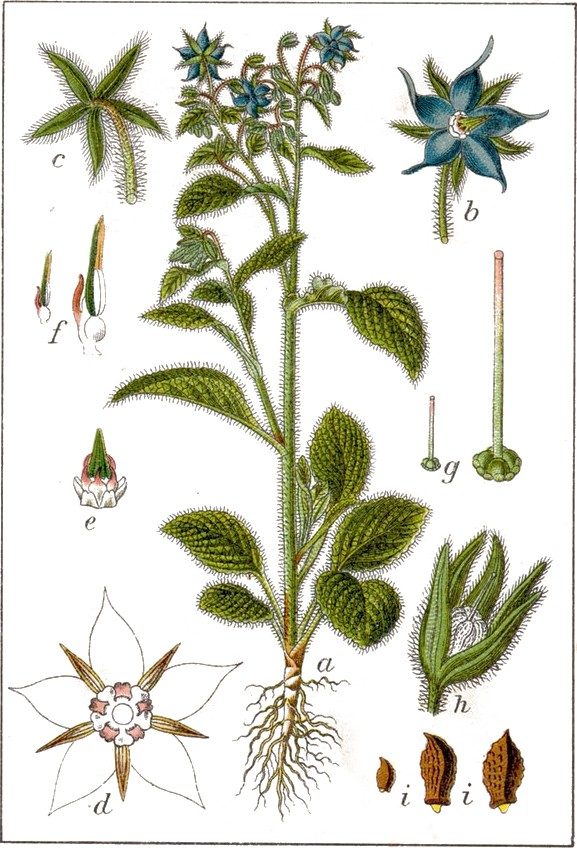
Borage
Boragine
- Known today as
- Borago officinalis.
- Kind
- Plant, in 1 older authority
- Constituents
- gamma-linolenic acid, amabiline, thesinine, and 1 more
- Earliest authority here
- The medieval herbalists
- Qualities
- Hot and moist (Galenic tradition). What the degrees mean
- In other databases
- Plants of the World Online search · GBIF search · Wikidata search
- In the Canale glossary
- On the Manner of Discerning and Healing the Bewitched, Appendix A: Treatise One, Part Three, Chapters 2–3: Purgative and Preparative Medicines
Revised October 1, 2026: Lore added from texts read in full. Version 1, first published September 25, 2026.
Caution. Hazardous in some form or dose; see the modern assessment below.
Borage: what did Canale use it for?
Juice, water, syrup, and flowers in the preparatives, a “cordial” to cheer the melancholic (chs. 3–4, 7).
Borage: how is it taken as a tea?
An ounce of leaves to a pint of boiling water, taken in wineglassful doses.
All the herbal teas of the database. Historical directions, not medical advice.
Borage: what does modern science say?
The plant contains liver-toxic pyrrolizidine alkaloids, and products made from it are best avoided.
Borage: is it poisonous?
Yes, in some form or dose. Its poisoning is pyrrolizidine alkaloids (veno-occlusive disease): Weeks to months of use. Historical description, not medical advice; in a poisoning, call a poison centre.
Pharmacognosy & Toxicology
- Constituents
- gamma-linolenic acid ChEMBL20–25 per cent of the seed oil
- amabilinea pyrrolizidine alkaloid of the leaf and flower
- thesinine
- mucilage
- Mechanism
- The leaf is cooling by its mucilage and potassium salts and nothing else; the cheer it gave the melancholic was the wine it was floated in. The seed oil’s gamma-linolenic acid feeds anti-inflammatory prostaglandins and is given for eczema, with meta-analyses finding no benefit. The leaf’s pyrrolizidine alkaloids are low but real.
- Toxic dose
- The leaf and flower should not be taken daily on account of the alkaloids; the seed oil is free of them.
- Syndrome
- Pyrrolizidine alkaloids (veno-occlusive disease)
- Standing
- No EMA monograph for the leaf; the seed oil is sold as a supplement, and a Cochrane review (2013) found it no better than placebo for eczema.
- Bamford, J. T. M., et al. (2013). “Oral evening primrose oil and borage oil for eczema.” Cochrane Database of Systematic Reviews 4. Verified against its record · doi:10.1002/14651858.cd004416.pub2
- Dodson, C. D., and Stermitz, F. R. (1986). “Pyrrolizidine alkaloids from borage.” Journal of Natural Products 49. Verified against its record · doi:10.1021/np50046a045
The abstract of each source, beneath its citation. For Club members. About the Club or sign in.
Constituent names open the compound’s record at PubChem, and “ChEMBL” beside a name opens its record at ChEMBL, the European Bioinformatics Institute’s database of bioactive molecules. Where a mechanism line was checked against ChEMBL (ChEMBL 37, read 1 October 2026), the check is shown with the measured value and its source paper, or says plainly that nothing has been measured. Doses are as the references give them, for description only; this is not medical advice. Each source carries the result of its check against Crossref, PubMed, or the authority’s page: see Verification.
What Medicine Makes of It
- Melancholy and the DemonThe black bile, the devil’s bath, and depression.
Borage: what lore surrounds it?
“In former days, Borage (Borago officinalis) was noted as one of the four ‘cordial flowers’ most deserving of esteem for cheering the spirits—the other three being the Rose, Violet, and Alkanet.” Folkard gives the old Latin rhyme “Ego Borago gaudia semper ago,” and says all the old herbalists agree with Pliny “that when put into wine the leaves and flowers of Borage make men and women glad and merry, driving away all sadness, dulness, and melancholy.” The “cool tankard” of our forefathers was “young shoots and blossoms of Borage mingled with wine, water, lemon, and sugar,” and astrologers made it “one of Jupiter's cordials.”
Thiselton-Dyer records the Cingalese notion “that the vervain and borage will only thrive near man's dwellings,” and Burton's frontispiece verse, “Borage and hellebore fill two scenes, Sovereign plants to purge the veins Of melancholy, and cheer the heart Of those black fumes which make it smart.”
Grieve gives the derivations: Borago as a corruption of “corago, from cor, the heart, and ago, I bring, because of its cordial effect,” or from the Low Latin burra, a flock of wool, for its hairy coat, or Henslow's Celtic barrach, “a man of courage.” She quotes Gerarde's old verse, “Ego Borago” … “Gaudia semper ago,” and the syrup of the flowers that “comforteth the heart, purgeth melancholy and quieteth the phrenticke and lunaticke person,” adds that “according to Dioscorides and Pliny, Borage was the famous Nepenthe of Homer,” and Evelyn's “Sprigs of Borage are of known virtue to revive the hypochrondriac and cheer the hard student.”
Used in These Compounds
Borage is an ingredient of 1 compound medicine in the database. For Club members. Create a free account or sign in.
Borage: what did the older authorities say?
- The medieval herbalists
- “Ego borago gaudia semper ago”: “I, borage, always bring gladness.” Some identified it with the gladdening herb of Pliny.
Sources
- [28] Culpeper, N. (1653). Pharmacopœia Londinensis, or, The London Dispensatory [the Royal College of Physicians’ pharmacopoeia in English, with Culpeper’s commentary]. London: Peter Cole. Text Creation Partnership edition A35381. Read in part · the text read
- [33] Drugs and Lactation Database (LactMed). Borage. Bethesda (MD): National Institute of Child Health and Human Development; updated 15 February 2021. ncbi.nlm.nih.gov/books/NBK501790. Book, seen in reviews
- Grieve, M. A Modern Herbal, “Borage.” As published on botanical.com.
- Folkard, R. (1884). Plant Lore, Legends, and Lyrics, “Borage.” Project Gutenberg #44638. Primary text
- Thiselton-Dyer, T. F. (1889). The Folk-lore of Plants. Project Gutenberg #10118. Read in part · the text read
- Grieve, M. (1931). A Modern Herbal, “Borage.” botanical.com/botanical/mgmh/b/borage66.html Standard reference work
Verification
- Checked
- October 1, 2026
- Passes
- Every sentence read against its sources, in the pass over the remaining 343 entries
- The Standing line checked against the authority it names (EMA, WHO, FDA, CITES, Commission E)
- Every dated or regulatory claim checked by category across the database
- Each quotation from the older authorities checked word for word against the text, read in full
- Sources
- 8 cited: 2 read in part, 2 verified against its record, 1 primary text, 1 standard reference work, 1 book, seen in reviews, 1 not yet checked. 1 with the abstract on file.
- Corrections
- None were needed.
What was checked, how, and what was found is set out on the Verification page. A checked source is one whose record was found; it does not make the entry medical advice.
Cite This Entry
Version 1 · first published September 25, 2026 · last revised October 1, 2026
- Chicago
“Borage.” In Materia Medica, edited by B. C. P. Statema. Version 1. The Thinking Press, 2026–. Last modified October 1, 2026. https://thethinkingpress.org/materia-medica/borage.
- MLA
“Borage.” Materia Medica, edited by B. C. P. Statema, version 1, The Thinking Press, 1 Oct. 2026, thethinkingpress.org/materia-medica/borage. Accessed 8 Oct. 2026.
- APA
Borage. (2026, October 1). In B. C. P. Statema (Ed.), Materia medica (Version 1). The Thinking Press. Retrieved October 8, 2026, from https://thethinkingpress.org/materia-medica/borage
Club members keep entries on a shelf with private notes, print the plates as cards, and receive an entry by email each week. Create a free account before January 1, 2027 and all of it is yours for good. About the Club
See Also
Poisoned alike: pyrrolizidine alkaloids (veno-occlusive disease)
Butterbur · Alkanet · Coltsfoot · Ragwort · Comfrey · Houndstongue · the syndrome, with all of them →
Sharing mucilage
Drawing on the same sources: Grieve, Folkard, Thiselton-Dyer
Burdock · Bogbean · Cassia wood · Apples, syrup of · Cassia, flower of · Caper spurge · The amulet herbs · the bibliography →
Of the same qualities: hot and moist
Nearby in the alphabet
Borax (brought as the crude salt tincal from the lakes of Tibet) · Breve (A written prayer or holy names folded and worn on the body) · Bloodstone (iron oxide, which streaks blood-red) · Brewer’s yeast (beer, and wine) · Bloodroot (the first flower of the spring woods from Canada to the South) · Broom (Spartium junceum, or common broom, Cytisus scoparius) · Blessed paper (Paper blessed so that what is written on it may take effect)
Historical description, not medical advice.