
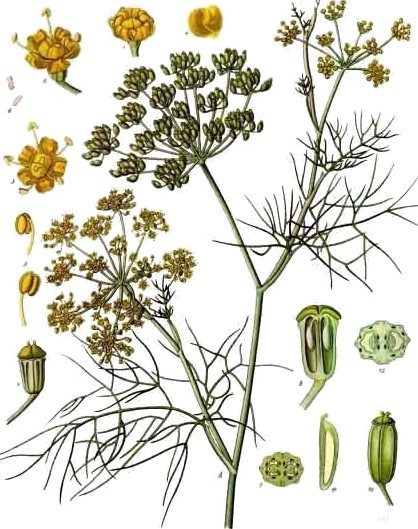
Fennel
Finocchio
- Known today as
- Foeniculum vulgare, seed and water.
- Kind
- Plant, in 1 older authority
- Constituents
- trans-anethole, fenchone, estragole
- Earliest authority here
- Pliny (AD 23/24–79)
- In other databases
- Plants of the World Online search · GBIF search · Wikidata search
- In the Canale glossary
- On the Manner of Discerning and Healing the Bewitched, Appendix A: Part Three, Chapter 5: Vomitory Medicines
Revised October 1, 2026: Lore added from texts read in full. Version 1, first published September 25, 2026.
Fennel: what did Canale use it for?
To temper the vomits of broom and ben-nut; in a julep; among the amulets (chs. 5–6, 10).
Fennel: how is it taken as a tea?
Half a pint of boiling water on a teaspoonful of bruised seeds, formerly taken as a carminative.
All the herbal teas of the database. Historical directions, not medical advice.
Fennel: what does modern science say?
An established traditional carminative, which is exactly its role in these recipes.
Pharmacognosy & Toxicology
- Constituents
- Mechanism
- Anethole relaxes gut smooth muscle, which tempered Canale’s vomits, and is secreted in milk; fenchone is expectorant. The oestrogenic action is through anethole polymers in animals.
- Toxic dose
- Safe as food; estragole limits the oil in infants, and the EMA advises against fennel tea for children under four.
- Standing
- EMA monographs (2007) for bitter and sweet fennel fruit for dyspepsia, wind, and as an expectorant; a Cochrane review found no reliable evidence for infant colic.
- EMA/HMPC (2007). Community herbal monograph on Foeniculum vulgare Miller subsp. vulgare var. vulgare, fructus (EMEA/HMPC/263293/2006; Revision 1, 2024). Verified against its record
- Badgujar, S. B., et al. (2014). “Foeniculum vulgare Mill: a review of its botany, phytochemistry, pharmacology, contemporary application, and toxicology.” BioMed Research International. Verified against its record · doi:10.1155/2014/842674
The abstract of each source, beneath its citation. For Club members. About the Club or sign in.
Constituent names open the compound’s record at PubChem, and “ChEMBL” beside a name opens its record at ChEMBL, the European Bioinformatics Institute’s database of bioactive molecules. Where a mechanism line was checked against ChEMBL (ChEMBL 37, read 1 October 2026), the check is shown with the measured value and its source paper, or says plainly that nothing has been measured. Doses are as the references give them, for description only; this is not medical advice. Each source carries the result of its check against Crossref, PubMed, or the authority’s page: see Verification.
Fennel: what lore surrounds it?
Folkard has fennel in the wreaths “worn by victors after the games in the arena,” mixed by gladiators with their food “to increase their strength,” crowning the god Sylvanus, and strewn “across the pathway of newly-married couples.” He repeats Pliny that “serpents are wonderfully fond of this plant, inasmuch as it restores them to youth by causing them to cast their old skin,” and Gerarde's distich on the water of “Fennell, Roses, Vervain, Rue, and Celandine” that is “good to cheere the sight of eine.” The ancients believed it “made fat people grow lean,” and it was hung over doors and windows on the vigil of St. John.
Thiselton-Dyer has fennel among the plants Stowe says were placed over doors on St. John's Eve “together with green birch, fennel, orpine, and white lilies,” and sets against its honours the proverb “Sowing fennel is sowing sorrow,” adding that in Hampshire “the peasants dislike giving any away for fear of some ill-luck befalling them.” The garden fennel or love-in-a-mist is one of the devil's plants, “devil-in-a-bush.”
Grieve quotes a very old English rhyming herbal preserved at Stockholm on the adder that is hurt in the eye, for whom “Ye red fenel is hys prey,” and Pliny's twenty-two remedies, with the serpents that “sharpen their sight with the juice by rubbing against the plant.” In mediæval times fennel “was employed, together with St. John's Wort and other herbs, as a preventative of witchcraft and other evil influences, being hung over doors on Midsummer's Eve.” Charlemagne “enjoined its cultivation on the imperial farms,” and Coles in 1650 has it in drinks “for those that are grown fat, to abate their unwieldiness and cause them to grow more gaunt and lank,” the Greek Marathron coming “from maraino, to grow thin.”
Fennel: what did the older authorities say?
- Pliny
- Tells that serpents eat fennel when they cast their skins, to sharpen their sight, whence its long use for the eyes.
Sources
- [16] The British Pharmaceutical Codex (1911). London: Pharmaceutical Society of Great Britain. Monographs as transcribed at Henriette’s Herbal Homepage, henriettes-herb.com. Read in full · the text read
- [41] European Medicines Agency, Committee on Herbal Medicinal Products (HMPC). Herbal monographs, assessment reports and public statements, ema.europa.eu, cited under the herb concerned: aniseed (summary, EMA/305345/2016); Aristolochia (public statement, EMEA/HMPC/138381/2005); asarone (public statement, EMEA/HMPC/139215/2005); caraway (EMA/HMPC/715092/2013); centaury (EMA/HMPC/277493/2015); chicory root (assessment report, EMA/HMPC/113041/2010); cinnamon (EMA/HMPC/246774/2009); clove (assessment report, EMA/HMPC/534946/2010); ethanol in herbal products (reflection paper, EMA/HMPC/85114/2008); fennel (EMEA/HMPC/372839/2016, Rev. 1, 2024); fumitory (draft assessment report, EMA/HMPC/367013/2021); greater celandine (public statement, EMA/HMPC/743927/2010); hops (EMA/HMPC/682384/2013); horehound (EMA/HMPC/604271/2012); mallow (assessment report, EMA/HMPC/749518/2016); marshmallow root (Althaeae radix); melissa (summary, EMA/HMPC/310761/2013); myrrh (assessment report and monograph, EMA/HMPC/96910/2010 and 96911/2010); peppermint oil (assessment report, EMEA/HMPC/349465/2006); pyrrolizidine alkaloids (public statement, EMA/HMPC/893108/2011); rhubarb (EMA/HMPC/113700/2019); sage (Salviae officinalis folium); wormwood (EMA/HMPC/751490/2016). Read in full · the text read
- Grieve, M. A Modern Herbal, “Fennel.” As published on botanical.com.
- Folkard, R. (1884). Plant Lore, Legends, and Lyrics, “Fennel.” Project Gutenberg #44638. Primary text
- Thiselton-Dyer, T. F. (1889). The Folk-lore of Plants. Project Gutenberg #10118. Read in part · the text read
- Grieve, M. (1931). A Modern Herbal, “Fennel.” botanical.com/botanical/mgmh/f/fennel01.html Standard reference work
Verification
- Checked
- October 1, 2026
- Passes
- Every sentence read against its sources, in the pass over the remaining 343 entries
- The Standing line checked against the authority it names (EMA, WHO, FDA, CITES, Commission E)
- Every dated or regulatory claim checked by category across the database
- Each quotation from the older authorities checked word for word against the text, read in full
- Sources
- 8 cited: 2 read in full, 1 read in part, 2 verified against its record, 1 primary text, 1 standard reference work, 1 not yet checked. 1 with the abstract on file.
- Corrections
- None were needed.
What was checked, how, and what was found is set out on the Verification page. A checked source is one whose record was found; it does not make the entry medical advice.
Cite This Entry
Version 1 · first published September 25, 2026 · last revised October 1, 2026
- Chicago
“Fennel.” In Materia Medica, edited by B. C. P. Statema. Version 1. The Thinking Press, 2026–. Last modified October 1, 2026. https://thethinkingpress.org/materia-medica/fennel.
- MLA
“Fennel.” Materia Medica, edited by B. C. P. Statema, version 1, The Thinking Press, 1 Oct. 2026, thethinkingpress.org/materia-medica/fennel. Accessed 8 Oct. 2026.
- APA
Fennel. (2026, October 1). In B. C. P. Statema (Ed.), Materia medica (Version 1). The Thinking Press. Retrieved October 8, 2026, from https://thethinkingpress.org/materia-medica/fennel
Club members keep entries on a shelf with private notes, print the plates as cards, and receive an entry by email each week. Create a free account before January 1, 2027 and all of it is yours for good. About the Club
See Also
Sharing trans-anethole, estragole
Also in Pliny the Elder
Fern seed in Pliny the Elder · Eryngo in Pliny the Elder · Fig in Pliny the Elder · Epithymum in Pliny the Elder · everything Pliny the Elder names →
Drawing on the same sources: Grieve, Folkard, Thiselton-Dyer
Feverfew · Eyebright · Galbanum · Gum arabic · Endive · the bibliography →
Nearby in the alphabet
False morel (reddish-brown spring mushroom of conifer woods) · Fairy ring champignon (A small tan mushroom that grows in rings on lawns and pasture) · The fig hand (made as a gesture or carved as a charm) · The eye bead (white, light blue, and black, like an eye)
Historical description, not medical advice.