
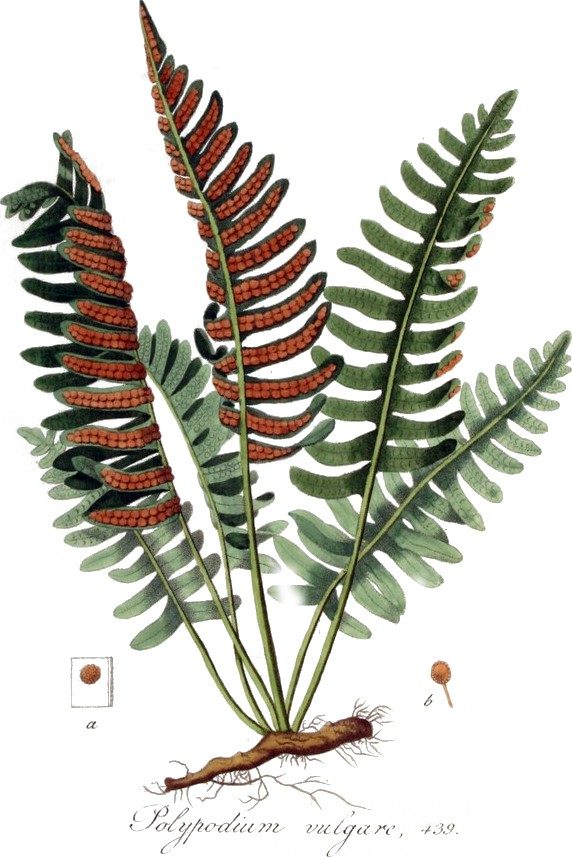
Polypody of mercurialis, syrup of
Polipodio del Mercuriale
- Known today as
- A syrup of polypody fern root (Polypodium vulgare), named in Canale the syrup of polypody “del Mercuriale,” perhaps with annual mercury (Mercurialis annua).
- Kind
- Compound, in 1 older authority
- Constituents
- osladin, polypodosaponin, ecdysteroids
- Earliest authority here
- Pliny (AD 23/24–79)
- In other databases
- GBIF search · Wikidata search
- In the Canale glossary
- On the Manner of Discerning and Healing the Bewitched, Appendix A: Treatise One, Part Three, Chapters 2–3: Purgative and Preparative Medicines
Revised October 3, 2026: An older authority added from a text read in full. Checked against its sources, each read in full, in part, or in its abstract. Version 1, first published September 25, 2026.
Caution. Hazardous in some form or dose; see the modern assessment below.
Polypody of mercurialis, syrup of: what did Canale use it for?
A purge used at the outset and again in the stronger purges for melancholic patients (chs. 2, 4).
Polypody of mercurialis, syrup of: what does modern science say?
Polypody root is a laxative. Annual mercury has long been a laxative and purgative in Spanish folk medicine, though the genus is counted toxic to humans and animals.
Polypody of mercurialis, syrup of: is it poisonous?
Yes, in some form or dose. Historical description, not medical advice; in a poisoning, call a poison centre.
Pharmacognosy & Toxicology
- Constituents
- osladina saponin of the rhizome, responsible for its sweet taste
- polypodosaponin
- ecdysteroids
- Mechanism
- The rhizome of the polypody fern, which Culpeper calls “a gallant, though gentle purger of Melancholly”: Dar and colleagues list it as laxative and expectorant, with a fatty oil said to purge and the saponin osladin giving its sweetness. Annual mercury, if that is what the name means, is a laxative of Spanish folk medicine.
- Toxic dose
- Culpeper bids it be bruised and boiled in white wine, more or less according to the strength of the patient, and says it works very safely.
- Standing
- Polypody root is still used in European herbal medicine, for the liver and for indigestion, by Dar and colleagues’ account; its saponin is said to suppress cough.
- Jizba, J., et al. (1971). “Polypodosaponin, a new type of saponin from Polypodium vulgare.” Chemische Berichte 104. Abstract read · the text read
The abstract of each source, beneath its citation. For Club members. About the Club or sign in.
Constituent names open the compound’s record at PubChem, and “ChEMBL” beside a name opens its record at ChEMBL, the European Bioinformatics Institute’s database of bioactive molecules. Where a mechanism line was checked against ChEMBL (ChEMBL 37, read 1 October 2026), the check is shown with the measured value and its source paper, or says plainly that nothing has been measured. Doses are as the references give them, for description only; this is not medical advice. Each source carries the result of its check against Crossref, PubMed, or the authority’s page: see Verification.
The Recipe
The recipe: 3 ingredients, each linked to its entry. For Club members. Create a free account or sign in.
Polypody of mercurialis, syrup of: what did the older authorities say?
- Pliny
- Among the remedies drawn from poultry, gives a broth of cock or capon boiled with the plant mercurialis, polypodium, or dill (or sea-cabbage, salted tunny, capers, or parsley), the bird boiled in three congii of water down to three semi-sextarii, cooled in the open air, and given “just after an emetic has been administered,” for the liver, kidneys, bladder, indigestion, and asthma.
Sources
- [11] Blanco-Salas, J., Vázquez, F. M., Hortigón-Vinagre, M. P., & Ruiz-Téllez, T. (2019). Bioactive phytochemicals from Mercurialis spp. used in traditional Spanish medicine. Plants 8(7): 193. doi:10.3390/plants8070193 Read in full · the text read
- [30] Dar, P. A., Sofi, G., & Jafri, M. A. (2012). Polypodium vulgare Linn.: a versatile herbal medicine: a review. International Journal of Pharmaceutical Sciences and Research 3(6): 1616–1620. doi:10.13040/IJPSR.0975-8232.3(6).1616-20 Read in full · the text read
- Pliny the Elder, Natural History 29.25, trans. J. Bostock & H. T. Riley (1855), Perseus Digital Library. Read in full · the text read
Verification
- Checked
- October 1, 2026, and October 3, 2026
- Passes
- Every sentence read against its sources, in the pass over the remaining 343 entries
- The Standing line checked against the authority it names (EMA, WHO, FDA, CITES, Commission E)
- Every dated or regulatory claim checked by category across the database
- Each quotation from the older authorities checked word for word against the text, read in full
- Every source read, in full, in part, or in its abstract, and every sentence checked against what was read (October 3, 2026)
- Sources
- 4 cited: 3 read in full, 1 abstract read. 1 with the abstract on file.
- Corrections
- None were needed.
What was checked, how, and what was found is set out on the Verification page. A checked source is one whose record was found; it does not make the entry medical advice.
Cite This Entry
Version 1 · first published September 25, 2026 · last revised October 3, 2026
- Chicago
“Polypody of mercurialis, syrup of.” In Materia Medica, edited by B. C. P. Statema. Version 1. The Thinking Press, 2026–. Last modified October 3, 2026. https://thethinkingpress.org/materia-medica/polypody-of-mercurialis-syrup-of.
- MLA
“Polypody of mercurialis, syrup of.” Materia Medica, edited by B. C. P. Statema, version 1, The Thinking Press, 3 Oct. 2026, thethinkingpress.org/materia-medica/polypody-of-mercurialis-syrup-of. Accessed 8 Oct. 2026.
- APA
Polypody of mercurialis, syrup of. (2026, October 3). In B. C. P. Statema (Ed.), Materia medica (Version 1). The Thinking Press. Retrieved October 8, 2026, from https://thethinkingpress.org/materia-medica/polypody-of-mercurialis-syrup-of
Club members keep entries on a shelf with private notes, print the plates as cards, and receive an entry by email each week. Create a free account before January 1, 2027 and all of it is yours for good. About the Club
See Also
Also in Pliny the Elder
Ragwort in Pliny the Elder · Pilewort in Pliny the Elder · Rocket in Pliny the Elder · Pennyroyal in Pliny the Elder · everything Pliny the Elder names →
Nearby in the alphabet
Pomander (of ambergris, musk, civet, and spices, carried in a pierced case) · Pokeweed (the American pokeweed) · Pomegranate (Punica granatum) · Poison fire coral (finger-like fungus of Japan, Korea, and Southeast Asia) · The precious stones (emerald, jacinth, garnet, and topaz, as they were used in medicine) · Plantain (Plantago major) · The prologue of John · Pilgrim badges and ampullae
Historical description, not medical advice.