
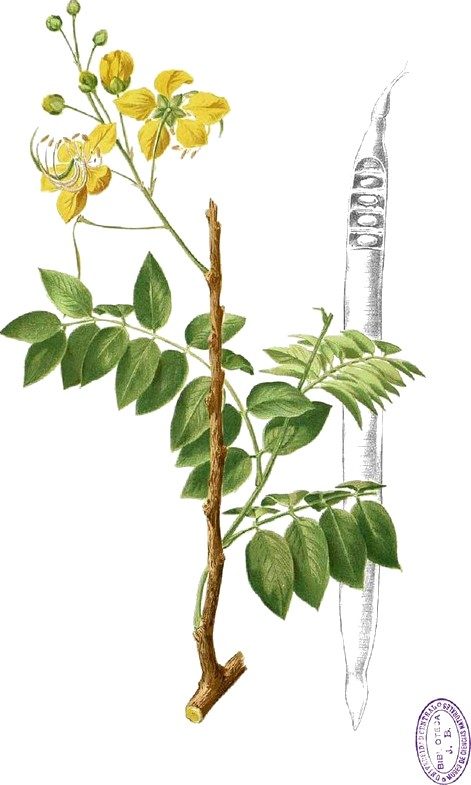
Cassia, flower of
Fior di cassia
- Known today as
- The sweet black pulp of the pods of Cassia fistula, the Indian laburnum; not the bark spice called cassia.
- Kind
- Plant
- Constituents
- rhein, sennosides, fistulic acid
- Poisoning
- The anthranoid purgatives
- In other databases
- Plants of the World Online search · GBIF search · Wikidata search
- In the Canale glossary
- On the Manner of Discerning and Healing the Bewitched, Appendix A: Treatise One, Part Three, Chapters 2–3: Purgative and Preparative Medicines
Revised October 1, 2026: Lore added from texts read in full. Version 1, first published September 25, 2026.
Cassia, flower of: what did Canale use it for?
Freshly extracted, with lenitive electuary or rhubarb, in purging pills (chs. 2, 4).
Cassia, flower of: what does modern science say?
A genuine laxative, still used in Ayurvedic medicine.
Pharmacognosy & Toxicology
- Constituents
- rhein ChEMBLan anthraquinone of the pulp and flower
- sennosides
- fistulic acid
- Mechanism
- Cassia fistula, the purging cassia: its anthranoids reach the colon unabsorbed, where bacteria free the anthrones, which stimulate the bowel wall and draw water into it, eight to twelve hours after the dose. The pulp of the pod is the drug; the flower is a milder form of the same.
- Toxic dose
- The pulp at 30–60 g purges; griping and cramps in excess, and loss of potassium with long use.
- Syndrome
- The anthranoid purgatives
- Standing
- In the Indian and Unani pharmacopoeias; no EMA monograph; senna has replaced it in Western practice.
- Danish, M., et al. (2011). “Cassia fistula Linn.: a comprehensive review.” Journal of Natural Product and Plant Resources 1. Matched to its record and reviewed
- Bruneton, J. (1999). Pharmacognosy, Phytochemistry, Medicinal Plants, 2nd ed., “Anthracene derivatives.” Verified against its record · doi:10.1016/s1010-6030(99)00094-5
Constituent names open the compound’s record at PubChem, and “ChEMBL” beside a name opens its record at ChEMBL, the European Bioinformatics Institute’s database of bioactive molecules. Where a mechanism line was checked against ChEMBL (ChEMBL 37, read 1 October 2026), the check is shown with the measured value and its source paper, or says plainly that nothing has been measured. Doses are as the references give them, for description only; this is not medical advice. Each source carries the result of its check against Crossref, PubMed, or the authority’s page: see Verification.
Cassia, flower of: what lore surrounds it?
Folkard notes of the Cassia Fistula, the Indian laburnum whose pulp is the flower of cassia of the old shops, that “a sugary substance extracted from the pulp between the seeds is commonly used as a laxative,” and that Gerarde “says this pulp of Cassia Fistula, when extracted with Violet water, is a most sweet and pleasant medicine, and may be given without danger to all weak people of what age and sex soever.” He attaches the Chinese moon-tree to the name: “in the middle of the Moon there grows a Cassia-tree, at the foot of which is a man who is endeavouring continually to fell it,” Kang Wou, condemned by a Geni to cut it down for ever.
In Their Own Words
The 1911 Britannica distinguishes the cassia bark of Cinnamomum cassia from cassia pulp, a laxative taken from the pods of Cassia fistula, the pudding pipe tree.
“Cassia pulp, used as a laxative, is obtained from the pods of Cassia fistula, or pudding pipe tree, a native of Africa which is cultivated in both the East and West Indies.”
Encyclopædia Britannica, eleventh edition: Cassia, “Cassia”, vol. 5. The 1911 Encyclopædia Britannica, as transcribed on Wikisource. The text, read in full
Culpeper calls cassia fistula temperate in quality, gently purging choler and phlegm, clarifying the blood, resisting fevers, and cleansing the breast and lungs.
“…is temperate in quality, gently purgeth choler and flegm, clarifies the blood, resists fevers, cleanses the breast and lungs”
Nicholas Culpeper, M.D., The Complete Herbal ... to which are now first annexed, the English Physician Enlarged, and Key to Physic, Simples: Fruits and their Buds. A new edition. London: Thomas Kelly, 17, Paternoster Row, MDCCCL (Project Gutenberg eBook #49513). The text, read in part
Each passage is quoted from the text named, which the press fetched and read, and was checked word for word against a fresh copy of it; the link opens that copy. Passages are given as printed, without the editors’ footnote numbers, and with words broken across lines joined.
Sources
- [90] Mwangi, R. W., Macharia, J. M., Wagara, I. N., & Bence, R. L. (2021). The medicinal properties of Cassia fistula L.: a review. Biomedicine & Pharmacotherapy 144: 112240. doi:10.1016/j.biopha.2021.112240 Verified against its record · doi:10.1016/j.biopha.2021.112240
- Folkard, R. (1884). Plant Lore, Legends, and Lyrics, “Cassia-Tree.” Project Gutenberg #44638. Primary text
Verification
- Checked
- October 1, 2026
- Passes
- Every sentence read against its sources, in the pass over the remaining 343 entries
- The Standing line checked against the authority it names (EMA, WHO, FDA, CITES, Commission E)
- Every dated or regulatory claim checked by category across the database
- Each quotation from the older authorities checked word for word against the text, read in full
- Sources
- 4 cited: 2 verified against its record, 1 matched to its record and reviewed, 1 primary text. 1 with the abstract on file.
- Corrections
- None were needed.
What was checked, how, and what was found is set out on the Verification page. A checked source is one whose record was found; it does not make the entry medical advice.
Cite This Entry
Version 1 · first published September 25, 2026 · last revised October 1, 2026
- Chicago
“Cassia, flower of.” In Materia Medica, edited by B. C. P. Statema. Version 1. The Thinking Press, 2026–. Last modified October 1, 2026. https://thethinkingpress.org/materia-medica/cassia-flower-of.
- MLA
“Cassia, flower of.” Materia Medica, edited by B. C. P. Statema, version 1, The Thinking Press, 1 Oct. 2026, thethinkingpress.org/materia-medica/cassia-flower-of. Accessed 8 Oct. 2026.
- APA
Cassia, flower of. (2026, October 1). In B. C. P. Statema (Ed.), Materia medica (Version 1). The Thinking Press. Retrieved October 8, 2026, from https://thethinkingpress.org/materia-medica/cassia-flower-of
Club members keep entries on a shelf with private notes, print the plates as cards, and receive an entry by email each week. Create a free account before January 1, 2027 and all of it is yours for good. About the Club
See Also
Poisoned alike: the anthranoid purgatives
Compound fumitory · Yellow dock · Diacatholicon · Rhubarb · Hiera picra · Myrobalans · Lenitive electuary · Madder · the syndrome, with all of them →
Drawing on the same sources: Folkard, Bruneton
Cinchona · Cassia wood · Cinquefoil · Sarsaparilla · the bibliography →
Nearby in the alphabet
Castor-oil plant, seeds of (Ricinus communis) · Castoreum (The scent gland secretion of the beaver) · Carmelite water (with lemon peel, nutmeg, coriander, and angelica, distilled in spirit) · Caterpillar fungus (sending up a slender stalk) · Cardamom · Catmint (Clinopodium nepeta) · Caraway broth (Carum carvi)
Historical description, not medical advice.