
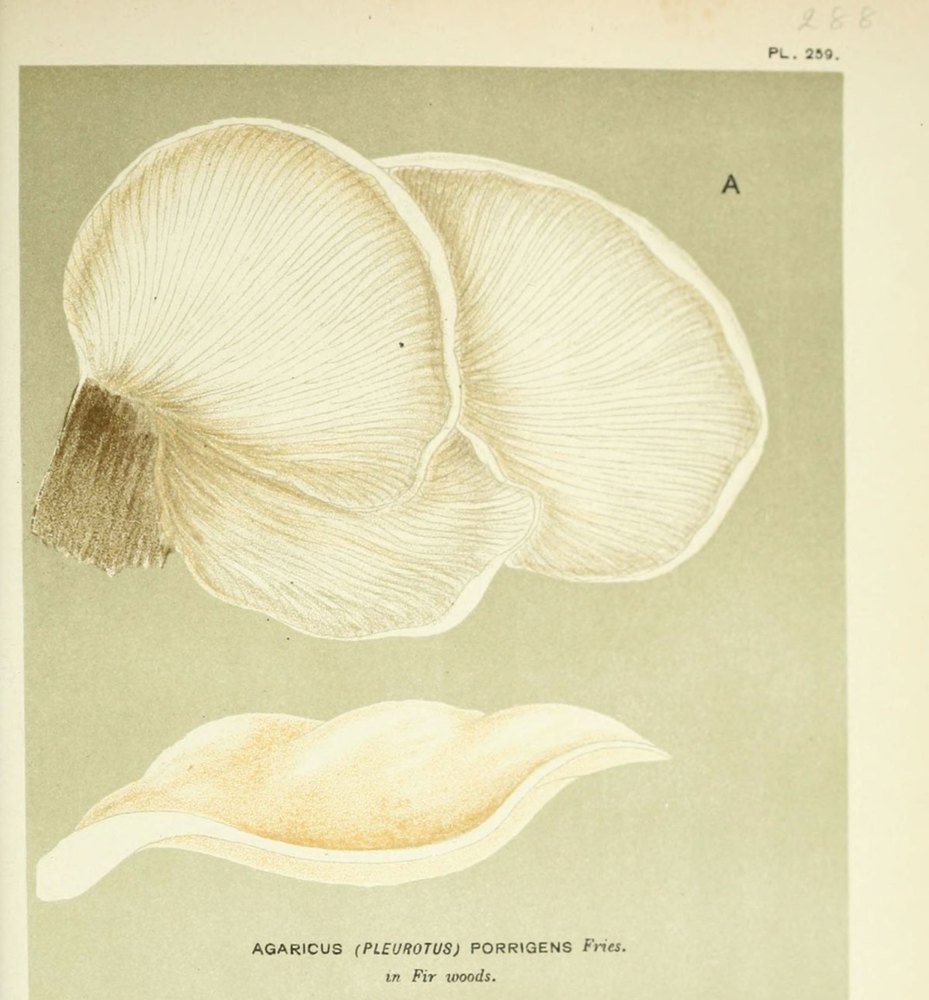
Angel’s wings
Pleurocybella porrigens
- Known today as
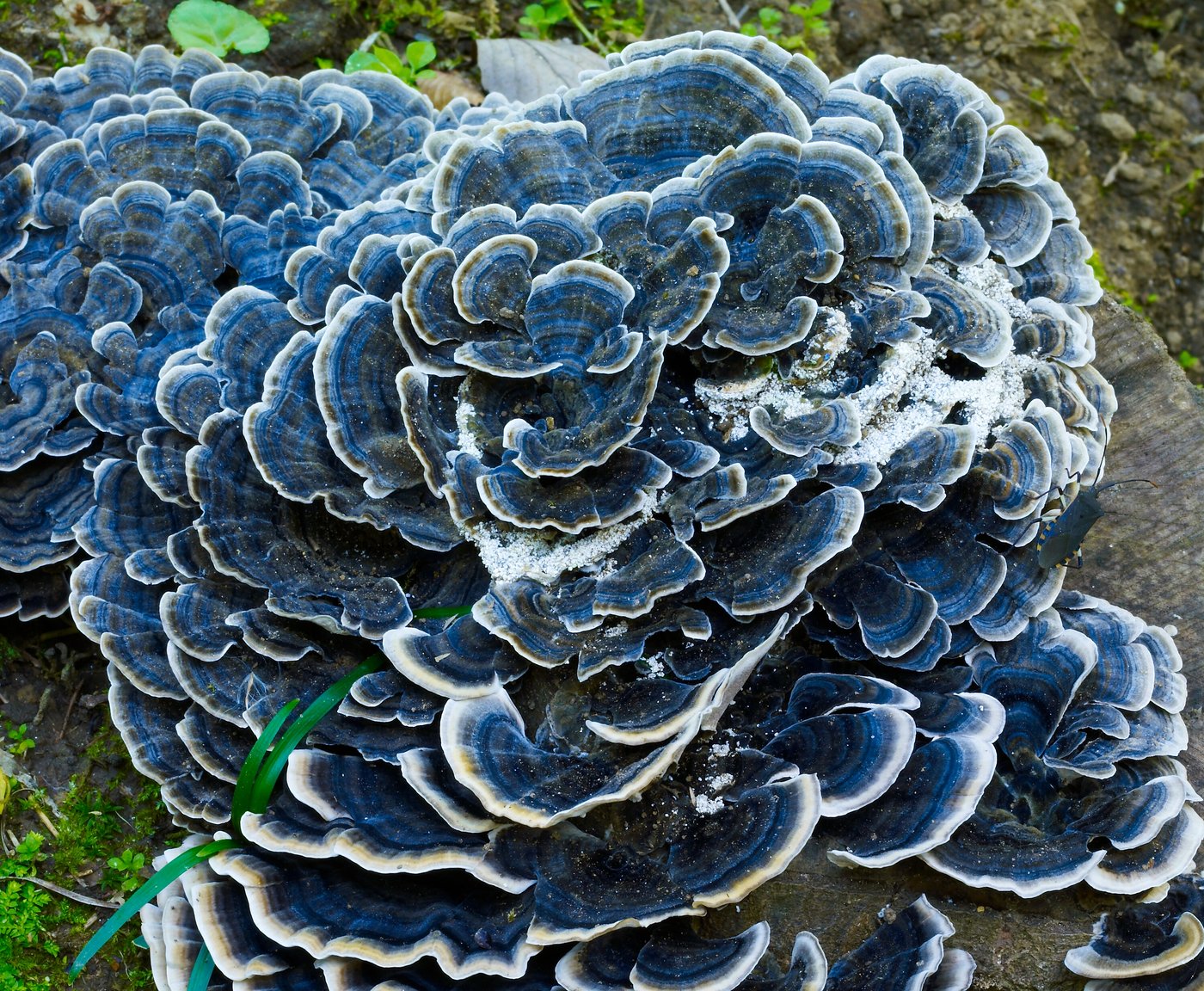
- A whitish, fan-shaped fungus that rots conifer wood.
- Kind
- Fungus
- Constituents
- pleurocybellaziridine
- In other databases
- GBIF search · Wikidata search
Revised October 3, 2026: Checked against its sources, each read in full, in part, or in its abstract. Version 1, first published September 25, 2026.
Caution. Poisonous, especially to those with kidney disease.
Angel’s wings: what was it used for?
Once generally regarded as edible.
Angel’s wings: what does modern science say?
The cause is not yet established; it is now listed as not to be eaten.
Angel’s wings: is it poisonous?
Yes, in some form or dose. Poisonous, especially to those with kidney disease. Historical description, not medical advice; in a poisoning, call a poison centre.
Pharmacognosy & Toxicology
- Constituents
- pleurocybellaziridinean unusual amino acid
- Mechanism
- The aziridine amino acid is toxic to rat oligodendrocytes, brain cells, in culture; in 2004, fifty-nine people in nine Japanese prefectures, most with kidney disorders, fell ill with an encephalopathy within three weeks of eating it, and seventeen died.
- Toxic dose
- Ordinary meals, in the kidney-impaired.
- Standing
- Once regarded as edible; now listed as not to be eaten, the danger greatest for anyone with kidney disease.
- Wakimoto, T., et al. (2011). “Proof of the existence of an unstable amino acid: pleurocybellaziridine in Pleurocybella porrigens.” Angewandte Chemie 50. Abstract read · the text read
- Gejyo, F., et al. (2005). “A novel type of encephalopathy associated with mushroom Sugihiratake ingestion in patients with chronic kidney diseases.” Kidney International 68. Abstract read · the text read
The abstract of each source, beneath its citation. For Club members. About the Club or sign in.
Constituent names open the compound’s record at PubChem, and “ChEMBL” beside a name opens its record at ChEMBL, the European Bioinformatics Institute’s database of bioactive molecules. Where a mechanism line was checked against ChEMBL (ChEMBL 37, read 1 October 2026), the check is shown with the measured value and its source paper, or says plainly that nothing has been measured. Doses are as the references give them, for description only; this is not medical advice. Each source carries the result of its check against Crossref, PubMed, or the authority’s page: see Verification.
Angel’s wings: what lore surrounds it?
In the autumn of 2004 it was linked to an outbreak of brain disease in Japan, fatal to several people with kidney disease.
In Their Own Words
Cooke describes Agaricus porrigens as white, its cap fleshy and tough, rising from a spreading base, ear-shaped and smooth above, with very narrow gills.
“White; pileus fleshy, tough, at first resupinate, then ascending from the extended base, ear-shaped, smooth above; gills very narrow, linear.”
M. C. Cooke, M.A., Handbook of British Fungi, with full descriptions of all the species, and illustrations of the genera, no. 125, Agaricus (Pleurotus) porrigens, 'Pine Pleurotus'. London and New York: Macmillan and Co., 1871 (Internet Archive OCR text). The text, read in part
Each passage is quoted from the text named, which the press fetched and read, and was checked word for word against a fresh copy of it; the link opens that copy. Passages are given as printed, without the editors’ footnote numbers, and with words broken across lines joined.
Sources
- “Pleurocybella porrigens.” Wikipedia (read 2 October 2026). Read in full · the text read
Verification
- Checked
- October 1, 2026, and October 3, 2026
- Passes
- Every sentence read against its sources, in the pass over the remaining 343 entries
- The Standing line checked against the authority it names (EMA, WHO, FDA, CITES, Commission E)
- Every dated or regulatory claim checked by category across the database
- Every source read, in full, in part, or in its abstract, and every sentence checked against what was read (October 3, 2026)
- Sources
- 3 cited: 1 read in full, 2 abstract read. 2 with the abstract on file.
- Corrections
- None were needed.
What was checked, how, and what was found is set out on the Verification page. A checked source is one whose record was found; it does not make the entry medical advice.
Cite This Entry
Version 1 · first published September 25, 2026 · last revised October 3, 2026
- Chicago
“Angel’s wings.” In Materia Medica, edited by B. C. P. Statema. Version 1. The Thinking Press, 2026–. Last modified October 3, 2026. https://thethinkingpress.org/materia-medica/angels-wings.
- MLA
“Angel’s wings.” Materia Medica, edited by B. C. P. Statema, version 1, The Thinking Press, 3 Oct. 2026, thethinkingpress.org/materia-medica/angels-wings. Accessed 8 Oct. 2026.
- APA
Angel’s wings. (2026, October 3). In B. C. P. Statema (Ed.), Materia medica (Version 1). The Thinking Press. Retrieved October 8, 2026, from https://thethinkingpress.org/materia-medica/angels-wings
Club members keep entries on a shelf with private notes, print the plates as cards, and receive an entry by email each week. Create a free account before January 1, 2027 and all of it is yours for good. About the Club
See Also
Nearby in the alphabet
Aniseed (Pimpinella anisum) · The amulet herbs (See each above) · Antimony (The metallic element and its compounds) · Ambergris (A waxy substance formed in the gut of the sperm whale) · Apples, syrup of (A syrup of sweet apples) · Amber (chiefly from the Baltic coast) · Armenian bole (colored by iron oxide) · Alum (Potassium aluminum sulfate)
,_to_serve_as_an_atlas_to_the_%22Handbook_of_British_Fungi%22_(Pl._259)_(6055690411).jpg)
Historical description, not medical advice.