
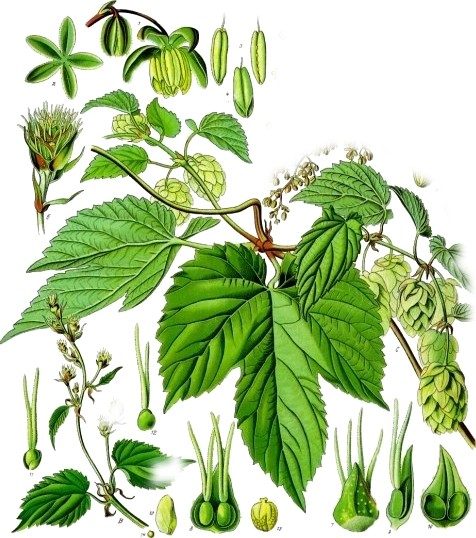
Hop
Lupoli
- Known today as
- Humulus lupulus.
- Kind
- Plant, in 1 older authority
- Constituents
- humulone, lupulone, xanthohumol, and 1 more
- Earliest authority here
- Hildegard of Bingen (1098–1179)
- In other databases
- Plants of the World Online search · GBIF search · Wikidata search
- In the Canale glossary
- On the Manner of Discerning and Healing the Bewitched, Appendix A: Treatise One, Part Three, Chapters 2–3: Purgative and Preparative Medicines
Revised October 1, 2026: Lore added from texts read in full. Version 1, first published September 25, 2026.
Hop: what did Canale use it for?
Syrup of hops in the preparative for the melancholic (ch. 3).
Hop: foraging it in the Midwest
- Part
- Fruit
- When
- Late summer
The Pillager Ojibwe made a tea of the hop that eased the urine and reduced its acidity, and used the fruit as a substitute for baking soda.
After Smith. All the foragables of the Midwest. Historical record, not a field guide: identify before you gather, and read the whole entry.
Hop: what does modern science say?
Hops are a traditional mild calming remedy, which suits the purpose here; the effect is modest.
Pharmacognosy & Toxicology
- Constituents
- humulone ChEMBLthe bitter acid
- lupulone ChEMBL
- xanthohumol ChEMBL
- 2-methyl-3-buten-2-ol ChEMBLthe sedative, formed as the cones age
- Mechanism
- The bitter acids preserve beer; 2-methyl-3-buten-2-ol is sedative in animals, the basis of the hop pillow and of hops with valerian in sleep remedies; 8-prenylnaringenin is among the strongest plant oestrogens known.
- Toxic dose
- No toxicity; dermatitis in hop-pickers.
- Standing
- Approved in Europe as a traditional remedy for restlessness and sleep, usually with valerian.
- Zanoli, P., and Zavatti, M. (2008). “Pharmacognostic and pharmacological profile of Humulus lupulus L.” Journal of Ethnopharmacology 116. Verified against its record · doi:10.1016/j.jep.2008.01.011
The abstract of each source, beneath its citation. For Club members. About the Club or sign in.
Constituent names open the compound’s record at PubChem, and “ChEMBL” beside a name opens its record at ChEMBL, the European Bioinformatics Institute’s database of bioactive molecules. Where a mechanism line was checked against ChEMBL (ChEMBL 37, read 1 October 2026), the check is shown with the measured value and its source paper, or says plainly that nothing has been measured. Doses are as the references give them, for description only; this is not medical advice. Each source carries the result of its check against Crossref, PubMed, or the authority’s page: see Verification.
Hop: what lore surrounds it?
Thiselton-Dyer notes that “the cowslip, and the hop, have the reputation of inducing sleep,” and the growers' proverb “that ‘hops make or break,’” since “an estate has been lost or won in the course of a single season.”
Grieve describes the farmhouse “stingo” brewed from wayside herbs, the hop tea that “consists of Kentish Hop leaves, dried, crushed under rollers and then mixed with ordinary Ceylon or Indian Tea,” and the old honeycomb “from the thatch of an ancient cottage, filled with rich and nearly black honey,” boiled into syrup for herb beer.
Hop: what did the older authorities say?
- Hildegard of Bingen
- Writes in her Physica that the hop makes the melancholy of a man grow, but that its bitterness keeps drinks from spoiling.
Sources
- [41] European Medicines Agency, Committee on Herbal Medicinal Products (HMPC). Herbal monographs, assessment reports and public statements, ema.europa.eu, cited under the herb concerned: aniseed (summary, EMA/305345/2016); Aristolochia (public statement, EMEA/HMPC/138381/2005); asarone (public statement, EMEA/HMPC/139215/2005); caraway (EMA/HMPC/715092/2013); centaury (EMA/HMPC/277493/2015); chicory root (assessment report, EMA/HMPC/113041/2010); cinnamon (EMA/HMPC/246774/2009); clove (assessment report, EMA/HMPC/534946/2010); ethanol in herbal products (reflection paper, EMA/HMPC/85114/2008); fennel (EMEA/HMPC/372839/2016, Rev. 1, 2024); fumitory (draft assessment report, EMA/HMPC/367013/2021); greater celandine (public statement, EMA/HMPC/743927/2010); hops (EMA/HMPC/682384/2013); horehound (EMA/HMPC/604271/2012); mallow (assessment report, EMA/HMPC/749518/2016); marshmallow root (Althaeae radix); melissa (summary, EMA/HMPC/310761/2013); myrrh (assessment report and monograph, EMA/HMPC/96910/2010 and 96911/2010); peppermint oil (assessment report, EMEA/HMPC/349465/2006); pyrrolizidine alkaloids (public statement, EMA/HMPC/893108/2011); rhubarb (EMA/HMPC/113700/2019); sage (Salviae officinalis folium); wormwood (EMA/HMPC/751490/2016). Read in full · the text read
- Thiselton-Dyer, T. F. (1889). The Folk-lore of Plants. Project Gutenberg #10118. Read in part · the text read
- Grieve, M. (1931). A Modern Herbal, “Mints.” botanical.com/botanical/mgmh/m/mints-39.html Standard reference work
- Grieve, M. (1931). A Modern Herbal, “Hops.” botanical.com/botanical/mgmh/h/hops--32.html Standard reference work
Verification
- Checked
- October 1, 2026
- Passes
- Every sentence read against its sources, in the pass over the remaining 343 entries
- The Standing line checked against the authority it names (EMA, WHO, FDA, CITES, Commission E)
- Every dated or regulatory claim checked by category across the database
- Each quotation from the older authorities checked word for word against the text, read in full
- Sources
- 5 cited: 1 read in full, 1 read in part, 1 verified against its record, 2 standard reference work. 1 with the abstract on file.
- Corrections
- None were needed.
What was checked, how, and what was found is set out on the Verification page. A checked source is one whose record was found; it does not make the entry medical advice.
Cite This Entry
Version 1 · first published September 25, 2026 · last revised October 1, 2026
- Chicago
“Hop.” In Materia Medica, edited by B. C. P. Statema. Version 1. The Thinking Press, 2026–. Last modified October 1, 2026. https://thethinkingpress.org/materia-medica/hop.
- MLA
“Hop.” Materia Medica, edited by B. C. P. Statema, version 1, The Thinking Press, 1 Oct. 2026, thethinkingpress.org/materia-medica/hop. Accessed 8 Oct. 2026.
- APA
Hop. (2026, October 1). In B. C. P. Statema (Ed.), Materia medica (Version 1). The Thinking Press. Retrieved October 8, 2026, from https://thethinkingpress.org/materia-medica/hop
Club members keep entries on a shelf with private notes, print the plates as cards, and receive an entry by email each week. Create a free account before January 1, 2027 and all of it is yours for good. About the Club
See Also
Also in Hildegard of Bingen
The precious stones in Hildegard of Bingen · Galangal in Hildegard of Bingen · Tansy in Hildegard of Bingen · everything Hildegard of Bingen names →
Drawing on the same sources: Thiselton-Dyer, Grieve
Mallow and marshmallow · Galbanum · Masterwort and angelica · Horehound · Herb bennet · Hungary water · the bibliography →
Nearby in the alphabet
Honeyed wine and honeyed water (Wine or water sweetened with honey) · Houndstongue (Cynoglossum officinale) · Honey fungus (from black cords, the “shoestrings,” that spread beneath the bark) · Houseleek (Sempervivum tectorum) · Honey (Honey of bees) · Human fat (Fat rendered from the bodies of the executed) · Holy wells (many of them sacred long before Christianity, visited for cures)
Historical description, not medical advice.