
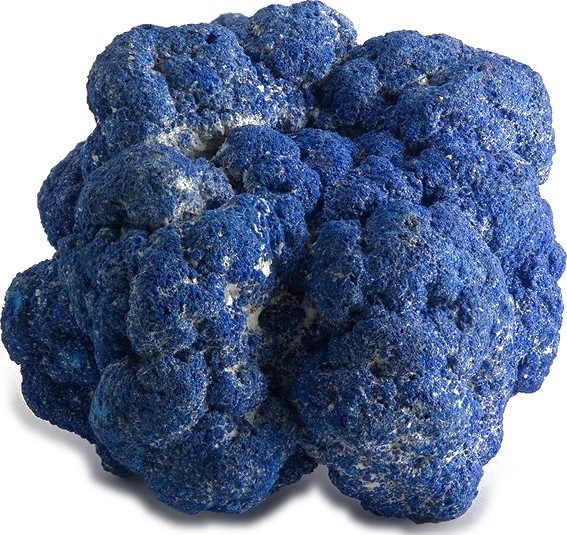
Armenian stone, pills of
Pillole di lapide armeno
- Known today as
- Lapis armenus, azurite, a blue copper carbonate.
- Kind
- Compound, in 1 older authority
- Constituents
- azurite, aloes, epithyme and polypody, and 1 more
- Poisoning
- Mercury, arsenic, lead, and antimony
- Earliest authority here
- Pliny (AD 23/24–79)
- In the Canale glossary
- On the Manner of Discerning and Healing the Bewitched, Appendix A: Part Three, Chapter 4: Stronger Purgatives and Compound Medicines
Revised October 3, 2026: An older authority added from a text read in full. Checked against its sources, each read in full, in part, or in its abstract. Version 1, first published September 25, 2026.
Caution. Hazardous in some form or dose; see the modern assessment below.
Armenian stone, pills of: what did Canale use it for?
Among the pills commended for melancholy (ch. 4).
Armenian stone, pills of: what does modern science say?
Formerly given as an aperient and for epilepsy, and held to purge melancholy and to provoke vomiting.
Armenian stone, pills of: is it poisonous?
Yes, in some form or dose. Its poisoning is mercury, arsenic, lead, and antimony: Minutes to hours for a large dose; months or years for the slow poisoning of the trades. Historical description, not medical advice; in a poisoning, call a poison centre.
Pharmacognosy & Toxicology
- Constituents
- azuritebasic copper carbonate, the Armenian stone
- aloes ChEMBL
- epithyme and polypody
- scammony
- Mechanism
- The blue stone is a copper carbonate; copper salts such as the sulphate are emetic and corrode the gut, and absorbed copper breaks down the red cells and can bring on acute liver failure. Mesue read the stone as a purge of black bile, and warned that unwashed it purged by vomiting as well as downward, troubling the stomach; the hiera picra (aloes) and scammony in his pill purged on their own account.
- Toxic dose
- Mesue gave the washed stone at one to two drams, the unwashed at half a dram to a dram and a half.
- Syndrome
- Mercury, arsenic, lead, and antimony
- Standing
- Doubted in its own time: Mesue’s editor noted that some held the lapis Armenus on sale not to be the true stone, and Culpeper in 1653, granting that it purged melancholy and caused vomiting, would say no more of it.
Constituent names open the compound’s record at PubChem, and “ChEMBL” beside a name opens its record at ChEMBL, the European Bioinformatics Institute’s database of bioactive molecules. Where a mechanism line was checked against ChEMBL (ChEMBL 37, read 1 October 2026), the check is shown with the measured value and its source paper, or says plainly that nothing has been measured. Doses are as the references give them, for description only; this is not medical advice. Each source carries the result of its check against Crossref, PubMed, or the authority’s page: see Verification.
What Medicine Makes of It
- Melancholy and the DemonThe black bile, the devil’s bath, and depression.
Armenian stone, pills of: what lore surrounds it?
Malachite, the green copper ore found with azurite, was ground to paint round the eyes in Predynastic Egypt; azurite itself, a basic carbonate of copper found native in the eastern desert and in Sinai, is the earliest Egyptian blue pigment of which analyses are recorded, used in the Fourth Dynasty.
Armenian stone, pills of: what did the older authorities say?
- Pliny
- Knows armenium as a pigment, one of the “florid colours” the employer supplies to the painter at his own cost, resembling chrysocolla and the colour of caeruleum; once thirty sesterces a pound, it fell to six denarii when a Spanish sand was found that would take the same preparation; and “the only use made of it in medicine is for the purpose of giving nourishment to the hair, that of the eyelids in particular.”
Sources
- [27] Cox, N., & Dannehl, K. (2007). Dictionary of Traded Goods and Commodities 1550–1820. University of Wolverhampton; British History Online. Entries: Hiera cum agarico; Lapis armenus. Read in part · the text read
- [28] Culpeper, N. (1653). Pharmacopœia Londinensis, or, The London Dispensatory [the Royal College of Physicians’ pharmacopoeia in English, with Culpeper’s commentary]. London: Peter Cole. Text Creation Partnership edition A35381. Read in part · the text read
- Pliny the Elder, Natural History 35.12, 35.28, trans. J. Bostock & H. T. Riley (1855), Perseus Digital Library. Read in part · the text read
- Lucas, A. (1926). Ancient Egyptian Materials. London: Edward Arnold. Read in part · the text read
- Zhao, Y., et al. (2026). Successful treatment of acute oral copper sulfate poisoning: a case report. Frontiers in Pharmacology 17: 1879318. Read in full · the text read
- Mesue (1589). I libri di Gio. Mesue de i semplici purgativi, et delle medicine composte, ed. G. Rossetto. Venice. Read in part · the text read
Verification
- Checked
- October 1, 2026, and October 3, 2026
- Passes
- Every sentence read against its sources, in the pass over the remaining 343 entries
- The Standing line checked against the authority it names (EMA, WHO, FDA, CITES, Commission E)
- Every dated or regulatory claim checked by category across the database
- Each quotation from the older authorities checked word for word against the text, read in full
- Every source read, in full, in part, or in its abstract, and every sentence checked against what was read (October 3, 2026)
- Sources
- 6 cited: 1 read in full, 5 read in part.
- Corrections
- None were needed.
What was checked, how, and what was found is set out on the Verification page. A checked source is one whose record was found; it does not make the entry medical advice.
Cite This Entry
Version 1 · first published September 25, 2026 · last revised October 3, 2026
- Chicago
“Armenian stone, pills of.” In Materia Medica, edited by B. C. P. Statema. Version 1. The Thinking Press, 2026–. Last modified October 3, 2026. https://thethinkingpress.org/materia-medica/armenian-stone-pills-of.
- MLA
“Armenian stone, pills of.” Materia Medica, edited by B. C. P. Statema, version 1, The Thinking Press, 3 Oct. 2026, thethinkingpress.org/materia-medica/armenian-stone-pills-of. Accessed 8 Oct. 2026.
- APA
Armenian stone, pills of. (2026, October 3). In B. C. P. Statema (Ed.), Materia medica (Version 1). The Thinking Press. Retrieved October 8, 2026, from https://thethinkingpress.org/materia-medica/armenian-stone-pills-of
Club members keep entries on a shelf with private notes, print the plates as cards, and receive an entry by email each week. Create a free account before January 1, 2027 and all of it is yours for good. About the Club
See Also
Poisoned alike: mercury, arsenic, lead, and antimony
Aurum potabile · Antimony · Cinnabar · White lead · Iron and steel · White arsenic · James’s powder · Vitriol · the syndrome, with all of them →
Also in Pliny the Elder
Arthritica in Pliny the Elder · Aniseed in Pliny the Elder · Asarabacca in Pliny the Elder · Amber in Pliny the Elder · everything Pliny the Elder names →
Drawing on the same sources: Lucas, Zhao
Nearby in the alphabet
Armenian bole (colored by iron oxide) · Asafoetida (“devil’s dung) · Apples, syrup of (A syrup of sweet apples) · The aspergillum (or perforated ball on a handle, with which holy water is sprinkled)
Historical description, not medical advice.