
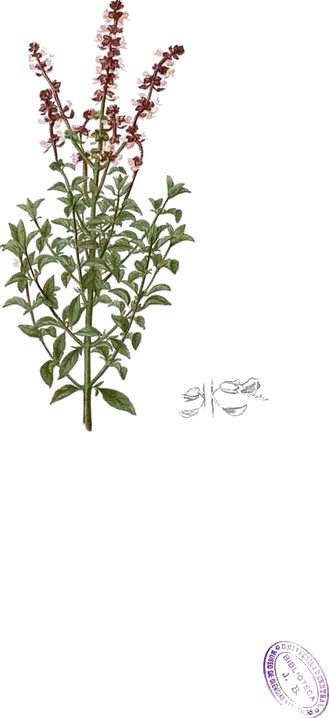
Basil
Ocimo
- Known today as
- Ocimum basilicum.
- Kind
- Plant
- Constituents
- linalool, estragole, eugenol, and 1 more
- In other databases
- Plants of the World Online search · GBIF search · Wikidata search
- In the Canale glossary
- On the Manner of Discerning and Healing the Bewitched, Appendix A: Part Three, Chapter 6: Remedies Given by Mouth After the Purge
Basil: what did Canale use it for?
Seed in the electuary and the pills (ch. 6).
Basil: what does modern science say?
Aromatic.
Pharmacognosy & Toxicology
- Constituents
- Mechanism
- The oil is carminative and antimicrobial; estragole is genotoxic and carcinogenic in rodents, which is why the European authorities limit the oil but not the herb. Basil seed swells in water into a mucilage that is a bulk laxative, which is the seed of Canale’s electuary.
- Toxic dose
- The herb is safe as food; the oil is restricted on account of estragole, and a 2001 European opinion found it genotoxic with no safe level.
- Standing
- No monograph for the herb; the seed is used in South Asia as a cooling drink and bulk laxative.
- EMA/HMPC (2021). Public statement on the use of herbal medicinal products containing estragole. Verified against its record
- Scientific Committee on Food (2001). Opinion on estragole. Book, seen in reviews
Constituent names open the compound’s record at PubChem, and “ChEMBL” beside a name opens its record at ChEMBL, the European Bioinformatics Institute’s database of bioactive molecules. Where a mechanism line was checked against ChEMBL (ChEMBL 37, read 1 October 2026), the check is shown with the measured value and its source paper, or says plainly that nothing has been measured. Doses are as the references give them, for description only; this is not medical advice. Each source carries the result of its check against Crossref, PubMed, or the authority’s page: see Verification.
Basil: what lore surrounds it?
The name comes from the Greek basilikon, “royal,” and legend credits Alexander the Great with bringing the plant to Greece. A Greek Orthodox tradition holds that St. Helena found the True Cross by following basil growing at the site, so that the plant is treated as holy and still used to sprinkle holy water. In Hinduism, holy basil, tulsi, is the goddess Tulasi, wife of Krishna. French tradition gave it the opposite valence, holding that basil must be cursed as it is sown or it will not grow, whence semer le basilic, “to rant.” In Italian courtship a young woman set a pot of basil on her windowsill, and a suitor who came with a sprig of his own was assured of her love: the plant behind Boccaccio’s tale in the Decameron and Keats’s “Isabella, or the Pot of Basil.”
In Their Own Words
Pliny reports that experience had shown the smell of ocimum in vinegar to be good for fainting fits, lethargy and inflammations.
“Experience has proved, too, that the smell of this plant in vinegar is good for fainting fits and lethargy, as well as inflammations”
Pliny; translated by John Bostock and H. T. Riley, The Natural History of Pliny, Vol. IV, Book XX, ch. 48, 'Ocimum'. Translated, with copious notes and illustrations, by the late John Bostock, M.D., F.R.S., and H. T. Riley, Esq., B.A. London: Henry G. Bohn, York Street, Covent Garden. MDCCCLVI (Project Gutenberg eBook #61113). The text, read in part
Culpeper says basil is the herb the authorities quarrel over: Galen and Dioscorides held it unfit to be taken inwardly and Chrysippus railed at it, while Pliny and the Arabian physicians defended it.
“This is the herb which all authors are together by the ears about, and rail at one another (like lawyers). Galen and Dioscorides hold it not fit to be taken inwardly; and Chrysippus rails at it with downright Billingsgate rhetoric; Pliny, and the Arabian physicians defend it.”
Nicholas Culpeper, M.D., The Complete Herbal ... to which are now first annexed, the English Physician Enlarged, and Key to Physic, Garden Bazil, or Sweet Bazil: Government and virtues. A new edition. London: Thomas Kelly, 17, Paternoster Row, MDCCCL (Project Gutenberg eBook #49513). The text, read in part
Each passage is quoted from the text named, which the press fetched and read, and was checked word for word against a fresh copy of it; the link opens that copy. Passages are given as printed, without the editors’ footnote numbers, and with words broken across lines joined.
Sources
- Herb Society of America, on basil. Book, seen in reviews
Verification
- Checked
- October 1, 2026
- Passes
- Every sentence read against its sources, in the pass over the remaining 343 entries
- The Standing line checked against the authority it names (EMA, WHO, FDA, CITES, Commission E)
- Every dated or regulatory claim checked by category across the database
- Sources
- 3 cited: 1 verified against its record, 2 book, seen in reviews.
- Corrections
- the estragole finding is the 2001 European opinion (genotoxic, no safe level), not a later date.
What was checked, how, and what was found is set out on the Verification page. A checked source is one whose record was found; it does not make the entry medical advice.
Cite This Entry
Version 1 · first published September 25, 2026
- Chicago
“Basil.” In Materia Medica, edited by B. C. P. Statema. Version 1. The Thinking Press, 2026–. Last modified September 25, 2026. https://thethinkingpress.org/materia-medica/basil.
- MLA
“Basil.” Materia Medica, edited by B. C. P. Statema, version 1, The Thinking Press, 25 Sept. 2026, thethinkingpress.org/materia-medica/basil. Accessed 8 Oct. 2026.
- APA
Basil. (2026, September 25). In B. C. P. Statema (Ed.), Materia medica (Version 1). The Thinking Press. Retrieved October 8, 2026, from https://thethinkingpress.org/materia-medica/basil
Club members keep entries on a shelf with private notes, print the plates as cards, and receive an entry by email each week. Create a free account before January 1, 2027 and all of it is yours for good. About the Club
See Also
Sharing linalool, estragole, eugenol
Salvia sclarea · Lavandula angustifolia · Coriandrum sativum · Foeniculum vulgare · Pimpinella anisum · Cinnamomum verum · Myristica fragrans · Clove
Nearby in the alphabet
Bells (and wrongly, called their “baptism) · Barley water (A thin decoction of barley) · Ben-nut (Moringa oleifera (or M) · Balsam of Peru (vanilla-scented balsam from Myroxylon balsamum var) · Benzoin (the resin of Styrax benzoin of Sumatra) · Balm of Gilead (The resin of Commiphora gileadensis) · Betony (Betonica officinalis) · Balm (Melissa officinalis)
Historical description, not medical advice.