
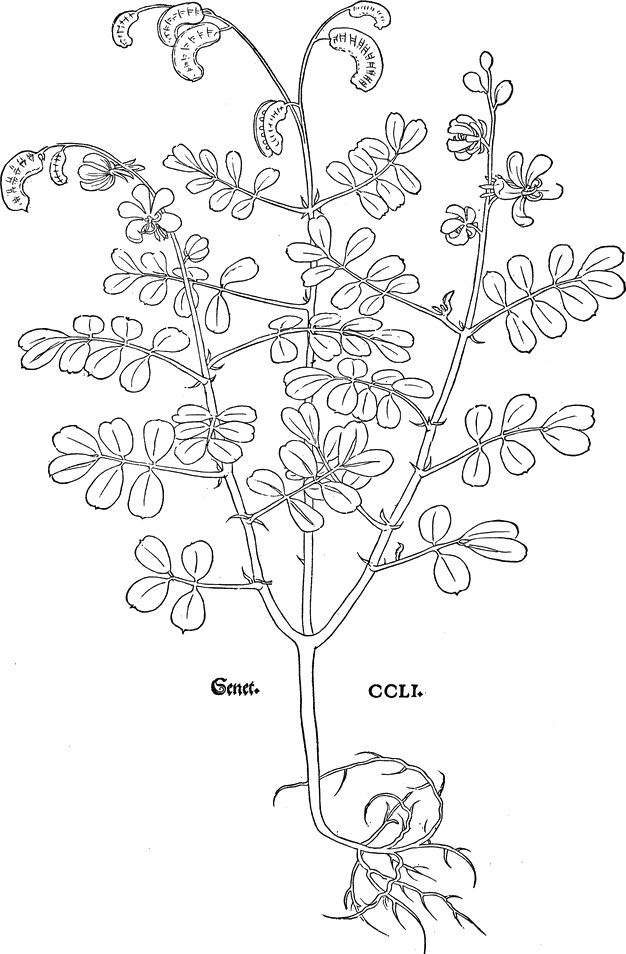
Senna
Sena
- Known today as
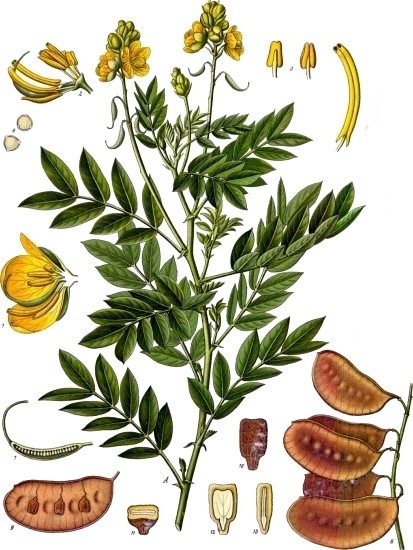
- The leaves and pods of Senna alexandrina.
- Kind
- Plant, in 2 older authorities
- Constituents
- sennoside A, sennoside B
- Earliest authority here
- The Arab physicians
- In other databases
- Plants of the World Online search · GBIF search · Wikidata search
- In the Canale glossary
- On the Manner of Discerning and Healing the Bewitched, Appendix A: Treatise One, Part Three, Chapters 2–3: Purgative and Preparative Medicines
Revised October 1, 2026: Tradition, lore, modern assessment, and sources extended. Version 1, first published September 25, 2026.
Senna: what did Canale use it for?
Infused or powdered, in nearly every purge for every complexion; “choice” senna is specified (chs. 2, 4).
Senna: what does modern science say?
Confirmed. Senna’s sennosides are among the most reliable stimulant laxatives and remain in pharmacies today. Its sennosides are converted by the bacteria of the colon into compounds that stimulate the bowel wall some six to twelve hours after a dose, which is why it was given at night. It is on the World Health Organization’s list of essential medicines; long daily use stains the lining of the colon brown (melanosis coli), which is harmless, and can cause dependence.
Pharmacognosy & Toxicology
- Constituents
- Mechanism
- Gut bacteria free the anthrone, which stimulates the nerves of the colon and holds water in it.
- Toxic dose
- Overdose brings cramps and dehydration; chronic use, dependence and a brown colon.
- Standing
- On the WHO list of essential medicines as a laxative.
- World Health Organization, Model List of Essential Medicines. Standard reference work
Constituent names open the compound’s record at PubChem, and “ChEMBL” beside a name opens its record at ChEMBL, the European Bioinformatics Institute’s database of bioactive molecules. Where a mechanism line was checked against ChEMBL (ChEMBL 37, read 1 October 2026), the check is shown with the measured value and its source paper, or says plainly that nothing has been measured. Doses are as the references give them, for description only; this is not medical advice. Each source carries the result of its check against Crossref, PubMed, or the authority’s page: see Verification.
What Medicine Makes of It
- Melancholy and the DemonThe black bile, the devil’s bath, and depression.
- The Purge, the Vomit, and the BathWhat the regimen did to the body.
Senna: what lore surrounds it?
Mecca senna, Tinnevelly senna, and Alexandrian senna were long argued over in the trade, the Alexandrian leaf fetching the most; the pods, milder than the leaves, were steeped overnight as “senna tea.”
Used in These Compounds
Senna is an ingredient of 3 compound medicines in the database. For Club members. Create a free account or sign in.
Senna: what did the older authorities say?
- The Arab physicians
- Brought senna into the pharmacopoeia in the ninth century: Serapion and Mesue prescribe it, and the Alexandrian leaf, shipped from Nubia and the Sudan through Alexandria, gave the plant its Latin name and its reputation as the gentlest of the strong purges.
- The Salernitan school
- Took it up from the Arabs, and by the fourteenth century senna stood in nearly every European purge for every complexion, usually corrected with ginger, aniseed, or raisins against its griping.
Sources
- [80] LiverTox: Clinical and Research Information on Drug-Induced Liver Injury. Bethesda (MD): National Institute of Diabetes and Digestive and Kidney Diseases. Entries: Germander (updated 12 March 2018); Pennyroyal Oil (updated 28 March 2020); Senna (updated 1 April 2020). Abstract read · the text read
- Mesue, De simplicibus. Book, seen in reviews
- World Health Organization, Model List of Essential Medicines. Standard reference work
Verification
- Checked
- October 1, 2026
- Passes
- Every sentence read against its sources, in the pass over the remaining 343 entries
- The Standing line checked against the authority it names (EMA, WHO, FDA, CITES, Commission E)
- Every dated or regulatory claim checked by category across the database
- Sources
- 3 cited: 1 abstract read, 1 standard reference work, 1 book, seen in reviews. 1 with the abstract on file.
- Corrections
- None were needed.
What was checked, how, and what was found is set out on the Verification page. A checked source is one whose record was found; it does not make the entry medical advice.
Cite This Entry
Version 1 · first published September 25, 2026 · last revised October 1, 2026
- Chicago
“Senna.” In Materia Medica, edited by B. C. P. Statema. Version 1. The Thinking Press, 2026–. Last modified October 1, 2026. https://thethinkingpress.org/materia-medica/senna.
- MLA
“Senna.” Materia Medica, edited by B. C. P. Statema, version 1, The Thinking Press, 1 Oct. 2026, thethinkingpress.org/materia-medica/senna. Accessed 8 Oct. 2026.
- APA
Senna. (2026, October 1). In B. C. P. Statema (Ed.), Materia medica (Version 1). The Thinking Press. Retrieved October 8, 2026, from https://thethinkingpress.org/materia-medica/senna
Club members keep entries on a shelf with private notes, print the plates as cards, and receive an entry by email each week. Create a free account before January 1, 2027 and all of it is yours for good. About the Club
See Also
Drawing on the same sources: Mesue
Diamoschu, sweet · Red roses · Gallia moschata · the bibliography →
Nearby in the alphabet
Shepherd’s purse · Self-heal (Prunella vulgaris) · Shiitake (cultivated in China and Japan for about a thousand years) · Scapular (worn over the shoulders, a miniature of the monastic scapular) · The sickener (brittle mushroom of wet pine woods) · Scammony (The dried root resin of Convolvulus scammonia) · Silphium (probably a giant fennel (Ferula)) · Savin (a low juniper)
Historical description, not medical advice.