
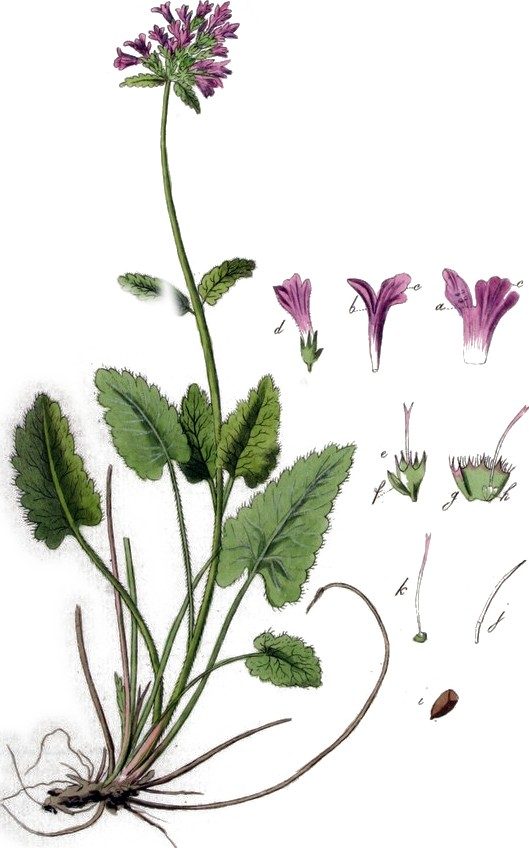
Betony
Betonica
- Known today as
- Wood betony, Betonica officinalis.
- Kind
- Plant, in 2 older authorities
- Constituents
- stachydrine, betonicine, harpagide, and 1 more
- Earliest authority here
- Antonius Musa (attributed)
- Qualities
- Hot and dry (Galenic tradition). What the degrees mean
- In other databases
- Plants of the World Online search · GBIF search · Wikidata search
- In the Canale glossary
- On the Manner of Discerning and Healing the Bewitched, Appendix A: Treatise One, Part Three, Chapters 2–3: Purgative and Preparative Medicines
Betony: what did Canale use it for?
Its water and syrup in preparatives for phlegmatic patients; the root among the gentle vomitories; also among the amulets (chs. 2–5, 10).
Betony: how is it taken as a tea?
A pint of boiling water on an ounce of the dried herb. The weak infusion was drunk in many districts as a substitute for tea, having its taste and its good qualities without the bad, and a wineglassful three times a day was taken against languid nervous headaches.
All the herbal teas of the database. Historical directions, not medical advice.
Betony: what does modern science say?
Betony was one of the most esteemed herbs of the Middle Ages, credited with power against almost everything, including evil spirits. Modern evidence for any effect is slight. The root is unpleasant to the stomach, which fits Canale’s use of it among the vomitories.
Pharmacognosy & Toxicology
- Constituents
- stachydrine ChEMBLa betaine
- betonicine ChEMBL
- harpagide ChEMBLan iridoid
- tannins
- Mechanism
- Astringent tannins and a mild bitterness; the alkaloid betaines are not sedative in any measured sense, and the ancient reputation against nearly every disease (Antonius Musa’s forty-seven) has no pharmacological footing.
- Toxic dose
- No toxicity at tea doses; the root is emetic and purgative in quantity, which is the “gentle vomit” of Canale.
- Standing
- No monograph; a herb of the older herbals only.
- Wichtl, M. (2004). Herbal Drugs and Phytopharmaceuticals, 3rd ed. Verified against its record · doi:10.1021/np030752h
- Háznagy-Radnai, E., et al. (2012). “Antiinflammatory activities of Hungarian Stachys species.” Phytotherapy Research 26. Verified against its record · doi:10.1002/ptr.3582
The abstract of each source, beneath its citation. For Club members. About the Club or sign in.
Constituent names open the compound’s record at PubChem, and “ChEMBL” beside a name opens its record at ChEMBL, the European Bioinformatics Institute’s database of bioactive molecules. Where a mechanism line was checked against ChEMBL (ChEMBL 37, read 1 October 2026), the check is shown with the measured value and its source paper, or says plainly that nothing has been measured. Doses are as the references give them, for description only; this is not medical advice. Each source carries the result of its check against Crossref, PubMed, or the authority’s page: see Verification.
What Medicine Makes of It
- The Living LightHildegard's visions, and the migraine aura.
Betony: what lore surrounds it?
“Sell your coat and buy betony,” ran an Italian proverb; it was planted in churchyards and worn against evil spirits.
Betony: what did the older authorities say?
- Antonius Musa (attributed)
- A late antique treatise under the name of Augustus’s physician lists forty-seven ailments betony will cure.
- The Old English Herbal
- Says betony guards a man against frightful night visitors and terrible visions and dreams.
Sources
- [54] Grieve, M. (1931). A Modern Herbal. Online edition, botanical.com, cited under the plant concerned. Read in part · the text read
- [76] Larkin, D. The Medieval Garden Enclosed (blog), The Metropolitan Museum of Art, The Cloisters: Herb Paris (23 June 2010); Salvia, Save Us (7 September 2010); Beneficent Betony (24 June 2011). Book, seen in reviews
- [114] Tomou, E.-M., Barda, C., & Skaltsa, H. (2020). Genus Stachys: a review of traditional uses, phytochemistry and bioactivity. Medicines 7(10): 63. doi:10.3390/medicines7100063 Verified against its record · doi:10.3390/medicines7100063
- Grieve, M. A Modern Herbal, “Betony, Wood.” As published on botanical.com.
Verification
- Checked
- October 1, 2026
- Passes
- Every sentence read against its sources, in the pass over the remaining 343 entries
- The Standing line checked against the authority it names (EMA, WHO, FDA, CITES, Commission E)
- Every dated or regulatory claim checked by category across the database
- Sources
- 6 cited: 1 read in part, 3 verified against its record, 1 book, seen in reviews, 1 not yet checked. 1 with the abstract on file.
- Corrections
- None were needed.
What was checked, how, and what was found is set out on the Verification page. A checked source is one whose record was found; it does not make the entry medical advice.
Cite This Entry
Version 1 · first published September 25, 2026
- Chicago
“Betony.” In Materia Medica, edited by B. C. P. Statema. Version 1. The Thinking Press, 2026–. Last modified September 25, 2026. https://thethinkingpress.org/materia-medica/betony.
- MLA
“Betony.” Materia Medica, edited by B. C. P. Statema, version 1, The Thinking Press, 25 Sept. 2026, thethinkingpress.org/materia-medica/betony. Accessed 8 Oct. 2026.
- APA
Betony. (2026, September 25). In B. C. P. Statema (Ed.), Materia medica (Version 1). The Thinking Press. Retrieved October 8, 2026, from https://thethinkingpress.org/materia-medica/betony
Club members keep entries on a shelf with private notes, print the plates as cards, and receive an entry by email each week. Create a free account before January 1, 2027 and all of it is yours for good. About the Club
See Also
Sharing stachydrine, tannins
Leonurus cardiaca · The amulet herbs · Bistorta officinalis · Rumex crispus · Potentilla reptans · Juglans regia
Drawing on the same sources: Grieve, Wichtl
Bladderwrack · Balm · Bloodroot · Agrimony · Cubeb · the bibliography →
Of the same qualities: hot and dry
Bitter aloes · Black hellebore · Asafoetida · Black pepper · Aniseed · what the degrees mean →
Nearby in the alphabet
Bezoar stone (A concretion formed in the stomach of goats and other animals) · Benzoin (the resin of Styrax benzoin of Sumatra) · Birch polypore (A white bracket of dead birch) · Ben-nut (Moringa oleifera (or M) · Bells (and wrongly, called their “baptism) · Basil (Ocimum basilicum)
Historical description, not medical advice.