
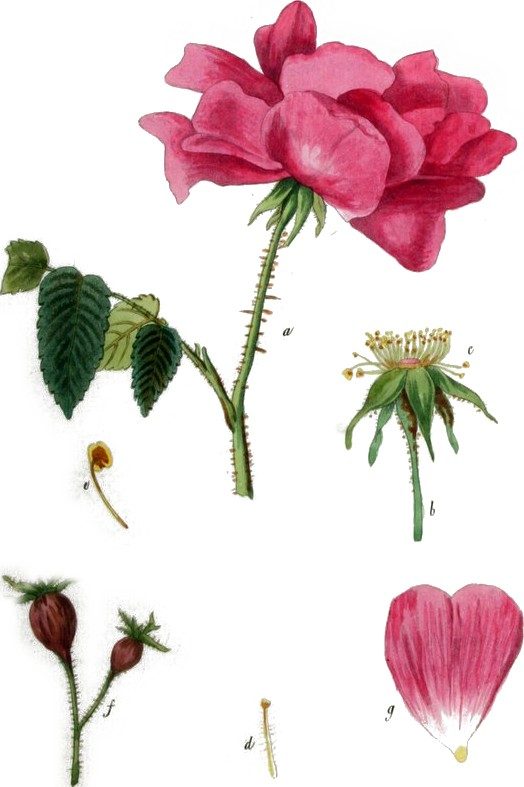
Rose
Rosa
- Known today as
- Chiefly the red or apothecary’s rose, Rosa gallica, and the damask rose, Rosa × damascena, as syrup, honey, sugar, water, and powder.
- Kind
- Plant, in 2 older authorities
- Constituents
- citronellol, geraniol, nerol, phenylethyl alcohol, tannins, and 1 more
- Earliest authority here
- Dioscorides (c. AD 40–90)
- Qualities
- Cold and dry (Galenic tradition). What the degrees mean
- In other databases
- Plants of the World Online search · GBIF search · Wikidata search
- In the Canale glossary
- On the Manner of Discerning and Healing the Bewitched, Appendix A: Treatise One, Part Three, Chapters 2–3: Purgative and Preparative Medicines
Rose: what did Canale use it for?
Dissolved rose syrup and rose honey carry many of the purges; aromatic rose powder and rose-sugar settle the stomach after vomiting (chs. 2–6, 9).
Rose: foraging it in the Midwest
- Part
- Hips; flowers
- When
- Hips in autumn, flowers in June
The Pillager Ojibwe used the skin of the hip of the smooth wild rose for stomach trouble and indigestion, and the Flambeau dried and powdered the flowers for heartburn.
After Smith. All the foragables of the Midwest. Historical record, not a field guide: identify before you gather, and read the whole entry.
Rose: what does modern science say?
The “dissolved” (solutive) rose syrup was made from damask petals steeped again and again, and was used as a gentle laxative; the rest is flavor, astringency, and comfort.
Pharmacognosy & Toxicology
- Constituents
- citronellol, geraniol, nerolthe oil
- phenylethyl alcohol ChEMBL
- tanninsin the petal
- vitamin C ChEMBLin the hip, 0.3–1.7 per cent
- Mechanism
- The petal is a mild astringent and the sugar of the syrup and conserve was the vehicle for the purges, which is Canale’s use; rose oil inhaled lowered anxiety in several small trials, and the hip’s galactolipid GOPO reduced pain in three trials of osteoarthritis, the one rose product with a clinical literature.
- Toxic dose
- Safe.
- Standing
- The petal, not the hip, has the EMA monograph (2014): Rosae flos for mild inflammation of the mouth and throat and of the skin; the hip has the osteoarthritis trials and no monograph; Damask rose water is in the Iranian pharmacopoeia.
- Christensen, R., et al. (2008). “Does the hip powder of Rosa canina reduce pain in osteoarthritis patients? A meta-analysis.” Osteoarthritis and Cartilage 16. Verified against its record · doi:10.1016/s1063-4584(08)60552-x
- EMA/HMPC (2014). Community herbal monograph on Rosa gallica L., Rosa centifolia L., Rosa damascena Mill., flos (EMA/HMPC/137299/2013). Verified against its record
Constituent names open the compound’s record at PubChem, and “ChEMBL” beside a name opens its record at ChEMBL, the European Bioinformatics Institute’s database of bioactive molecules. Where a mechanism line was checked against ChEMBL (ChEMBL 37, read 1 October 2026), the check is shown with the measured value and its source paper, or says plainly that nothing has been measured. Doses are as the references give them, for description only; this is not medical advice. Each source carries the result of its check against Crossref, PubMed, or the authority’s page: see Verification.
Rose: what lore surrounds it?
The rose’s association with secrecy is older than its use in Canale’s oils: Hellenistic myth had Cupid give a rose to Harpocrates, god of silence, to keep Venus’s secrets, and Roman banquet rooms were carved with roses as a reminder that what was said there should stay there, a custom later carried into the confessional, where the rose marked the seal of confession. The Latin phrase sub rosa, “under the rose,” passed through German into English by at least 1654, and still means anything done in confidence.
Used in These Compounds
Rose is an ingredient of 2 compound medicines in the database. For Club members. Create a free account or sign in.
Rose: what did the older authorities say?
- Dioscorides
- Describes rose oil and the rose’s cooling, binding virtue.
- Avicenna
- Tradition credits the Persian physician with perfecting the distillation of rose water.
Sources
- [28] Culpeper, N. (1653). Pharmacopœia Londinensis, or, The London Dispensatory [the Royal College of Physicians’ pharmacopoeia in English, with Culpeper’s commentary]. London: Peter Cole. Text Creation Partnership edition A35381. Read in part · the text read
- [75] Kunc, N., Hudina, M., Mikulič-Petkovšek, M., Bavcon, J., Ravnjak, B., & Osterc, G. (2023). Detailed metabolic characterization of flowers and hips of Rosa gallica L. grown in open nature. Plants 12(16): 2979. doi:10.3390/plants12162979 Verified against its record · doi:10.3390/plants12162979
- Wikipedia, “Sub rosa.” Book, not indexed
In Symbols of the Psyche
The Rose: what it stood for in alchemy and in analytical psychology.
Verification
- Checked
- October 1, 2026
- Passes
- Every sentence read against its sources, in the pass over the remaining 343 entries
- The Standing line checked against the authority it names (EMA, WHO, FDA, CITES, Commission E)
- Every dated or regulatory claim checked by category across the database
- Sources
- 5 cited: 1 read in part, 3 verified against its record, 1 book, not indexed. 1 with the abstract on file.
- Corrections
- None were needed.
What was checked, how, and what was found is set out on the Verification page. A checked source is one whose record was found; it does not make the entry medical advice.
Cite This Entry
Version 1 · first published September 25, 2026
- Chicago
“Rose.” In Materia Medica, edited by B. C. P. Statema. Version 1. The Thinking Press, 2026–. Last modified September 25, 2026. https://thethinkingpress.org/materia-medica/rose.
- MLA
“Rose.” Materia Medica, edited by B. C. P. Statema, version 1, The Thinking Press, 25 Sept. 2026, thethinkingpress.org/materia-medica/rose. Accessed 8 Oct. 2026.
- APA
Rose. (2026, September 25). In B. C. P. Statema (Ed.), Materia medica (Version 1). The Thinking Press. Retrieved October 8, 2026, from https://thethinkingpress.org/materia-medica/rose
Club members keep entries on a shelf with private notes, print the plates as cards, and receive an entry by email each week. Create a free account before January 1, 2027 and all of it is yours for good. About the Club
See Also
Sharing phenylethyl alcohol, tannins, vitamin C
Rosa gallica · Sorbus aucuparia · Rheum officinale · Prunella vulgaris · Lepidium sativum · Oxalis acetosella
Also in Dioscorides
Rosemary in Dioscorides · Rocket in Dioscorides · Rue in Dioscorides · everything Dioscorides names →
Also in Avicenna
Drawing on the same sources: Wikipedia
Of the same qualities: cold and dry
Sandalwood · Quince · Vinegar · Opium poppy · White willow · Endive · what the degrees mean →
Nearby in the alphabet
Rosary (Strings of prayer beads) · Rosemary rice water (A rinse for the hair and the skin made in the kitchen) · Roquefort mould (The blue mould of blue cheeses) · Round birthwort (Aristolochia rotunda) · The Roman Ritual (issued by Pope Paul V in 1614, the year of Canale’s treatise)
Historical description, not medical advice.