
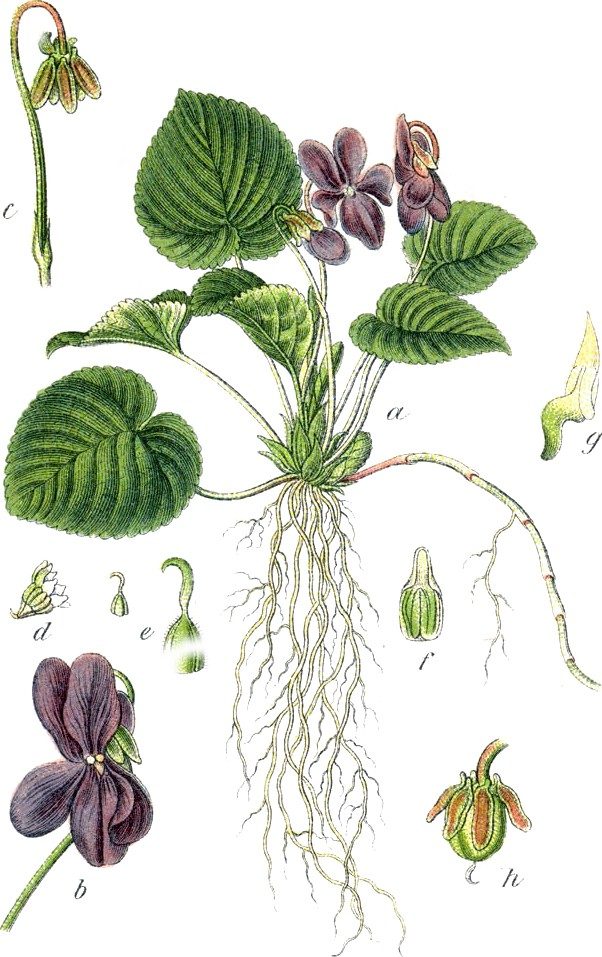
Violet, lettuce, sow-thistle
Viola; lattuca; sonco
- Known today as
- Sweet violet (Viola odorata), garden lettuce (Lactuca sativa), sow-thistle (Sonchus oleraceus).
- Kind
- Plant, in 1 older authority
- Constituents
- lactucin and lactucopicrin, methyl salicylate glycosides, mucilage, and 1 more
- Earliest authority here
- Pliny (AD 23/24–79)
- Qualities
- Cold and moist (Galenic tradition). What the degrees mean
- In other databases
- Plants of the World Online search · GBIF search · Wikidata search
- In the Canale glossary
- On the Manner of Discerning and Healing the Bewitched, Appendix A: Part Three, Chapters 7–8: The Bath and Fumigations
Revised October 1, 2026: An older authority added from a text read in full. Lore added from texts read in full. Version 1, first published September 25, 2026.
Violet, lettuce, sow-thistle: what did Canale use it for?
Cooling herbs, added to the bath for hot and dry complexions (ch. 7).
Violet, lettuce, sow-thistle: what does modern science say?
Mild herbs. Two bitter compounds of lettuce, lactucin and lactucopicrin, are sedative in mice.
Pharmacognosy & Toxicology
- Constituents
- lactucin and lactucopicrinthe sedative bitters of lettuce latex
- methyl salicylate glycosidesin the violet
- mucilage
- taraxasterol ChEMBLin the sow-thistle
- Mechanism
- Three cooling herbs of the bath: lettuce’s lactones are mildly sedative and analgesic in mice, the basis of the Victorian lettuce opium; the violet’s salicylates are anti-inflammatory; the sow-thistle is a bitter. In a bath they are a scent and a mucilage.
- Toxic dose
- Safe.
- Standing
- Violet has a traditional-use listing in France; lettuce and sow-thistle are foods.
- Wesołowska, A., et al. (2006). “Analgesic and sedative activities of lactucin and some lactucin-like guaianolides in mice.” Journal of Ethnopharmacology 107. Verified against its record · doi:10.1016/j.jep.2006.03.003
Constituent names open the compound’s record at PubChem, and “ChEMBL” beside a name opens its record at ChEMBL, the European Bioinformatics Institute’s database of bioactive molecules. Where a mechanism line was checked against ChEMBL (ChEMBL 37, read 1 October 2026), the check is shown with the measured value and its source paper, or says plainly that nothing has been measured. Doses are as the references give them, for description only; this is not medical advice. Each source carries the result of its check against Crossref, PubMed, or the authority’s page: see Verification.
Violet, lettuce, sow-thistle: what lore surrounds it?
Folkard has the lettuce as the food of mourning: the ancients “employed it largely in their funeral repasts in commemoration of the death of Adonis, son of Myrrha, whom Venus had concealed in a bed of Lettuces,” and Eubulus “bitterly reproached his wife for having served up at a meal Lettuces, which were only recommended for funeral repasts.” In mediæval days “it was superstitiously thought that an evil spirit lurked in a bed of Lettuces,” whence perhaps the Richmond saying, “O'er-much Lettuce in the garden will stop a young wife's bearing.” Pliny held that lettuces “were thought to cause sleep,” and Pope has “Lettuce and Cowslip wine, probatum est.” The sow-thistle Theseus “is said to have received as a gift from the hands of Hecate,” and in Italian stories “Open Sow-thistle” works like Open Sesame. Of the violet, “according to Rapin, the Violet was once a fair nymph, who was changed by Diana into this flower to avoid the importunities of Apollo”; the Greek Ion was given “because, when Jupiter had metamorphosed Io into a white heifer, he caused sweet Violets to spring from the earth”; the Athenians preferred above all names that of “Athenian crowned with Violets”; and at the floral games of Toulouse the prize for the best poem “consisted of a golden Violet.”
Thiselton-Dyer has lettuce-beds as a haunt of spirits: “Evil spirits were once said to lurk in lettuce-beds, and a certain species was regarded with ill favour by mothers,” which may account for the Surrey saying, “O'er much lettuce in the garden will stop a young wife's bearing.” The sow-thistle “in Russia is said to belong to the devil,” yet in Italy mangers are decked at Christmas “with moss, sow-thistle, cypress, and holly.” The smooth sow-thistle and the garden lettuce both keep the flower-clock.
Grieve adds that violets were used by the Athenians “to moderate anger,” to procure sleep and “to comfort and strengthen the heart,” that Pliny “states that a garland or chaplet of Violets worn about the head will dispel the fumes of wine and prevent headache and dizziness,” that a Celtic poem recommends them “steeped in goats' milk to increase female beauty,” and that in the days of Charles II a conserve called “Violet Plate” “was considered of excellent use in consumption and was sold by all apothecaries.”
Used in These Compounds
Violet, lettuce, sow-thistle is an ingredient of 1 compound medicine in the database. For Club members. Create a free account or sign in.
Violet, lettuce, sow-thistle: what did the older authorities say?
- Pliny
- Of the violet: “Next after the roses and the lilies, the violet is held in the highest esteem,” in three kinds, the purple, the yellow, and the white; the purple, called ion, springs up of itself in sunny spots with a thin soil; and of the garland flowers the Romans of old knew “hardly any but the violet and the rose.”
Sources
- [121] Wesołowska, A., Nikiforuk, A., Michalska, K., Kisiel, W., & Chojnacka-Wójcik, E. (2006). Analgesic and sedative activities of lactucin and some lactucin-like guaianolides in mice. Journal of Ethnopharmacology 107(2): 254–258. doi:10.1016/j.jep.2006.03.003 Verified against its record · doi:10.1016/j.jep.2006.03.003
- Pliny the Elder, Natural History 21.14, 21.10, trans. J. Bostock & H. T. Riley (1855), Perseus Digital Library. Primary text
- Folkard, R. (1884). Plant Lore, Legends, and Lyrics, “Lettuce.” Project Gutenberg #44638. Primary text
- Folkard, R. (1884). Plant Lore, Legends, and Lyrics, “Cowslip.” Project Gutenberg #44638. Primary text
- Folkard, R. (1884). Plant Lore, Legends, and Lyrics, “Sow-Thistle.” Project Gutenberg #44638. Primary text
- Folkard, R. (1884). Plant Lore, Legends, and Lyrics, “Violet.” Project Gutenberg #44638. Primary text
- Thiselton-Dyer, T. F. (1889). The Folk-lore of Plants. Project Gutenberg #10118. Read in part · the text read
- Grieve, M. (1931). A Modern Herbal, “Violet, Sweet.” botanical.com/botanical/mgmh/v/vioswe12.html Standard reference work
Verification
- Checked
- October 1, 2026
- Passes
- Every sentence read against its sources, in the pass over the remaining 343 entries
- The Standing line checked against the authority it names (EMA, WHO, FDA, CITES, Commission E)
- Every dated or regulatory claim checked by category across the database
- Each quotation from the older authorities checked word for word against the text, read in full
- Sources
- 9 cited: 1 read in part, 2 verified against its record, 5 primary text, 1 standard reference work.
- Corrections
- None were needed.
What was checked, how, and what was found is set out on the Verification page. A checked source is one whose record was found; it does not make the entry medical advice.
Cite This Entry
Version 1 · first published September 25, 2026 · last revised October 1, 2026
- Chicago
“Violet, lettuce, sow-thistle.” In Materia Medica, edited by B. C. P. Statema. Version 1. The Thinking Press, 2026–. Last modified October 1, 2026. https://thethinkingpress.org/materia-medica/violet-lettuce-sow-thistle.
- MLA
“Violet, lettuce, sow-thistle.” Materia Medica, edited by B. C. P. Statema, version 1, The Thinking Press, 1 Oct. 2026, thethinkingpress.org/materia-medica/violet-lettuce-sow-thistle. Accessed 8 Oct. 2026.
- APA
Violet, lettuce, sow-thistle. (2026, October 1). In B. C. P. Statema (Ed.), Materia medica (Version 1). The Thinking Press. Retrieved October 8, 2026, from https://thethinkingpress.org/materia-medica/violet-lettuce-sow-thistle
Club members keep entries on a shelf with private notes, print the plates as cards, and receive an entry by email each week. Create a free account before January 1, 2027 and all of it is yours for good. About the Club
See Also
Sharing lactucin and lactucopicrin, mucilage, taraxasterol
Cichorium intybus · Borago officinalis · Polygonatum multiflorum · Tussilago farfara · Cydonia oblonga · Taraxacum officinale
Also in Pliny the Elder
Walnut, middle bark of in Pliny the Elder · Verbena in Pliny the Elder · Water germander in Pliny the Elder · Turpentine in Pliny the Elder · everything Pliny the Elder names →
Drawing on the same sources: Folkard, Thiselton-Dyer, Grieve
White hellebore · Wild rue · Snapdragon · Woody nightshade · Vinegar of the four thieves · Yarrow · the bibliography →
Of the same qualities: cold and moist
Caesar’s mushroom · Truffle · Houseleek · Saffron milk cap · Purslane · Quicksilver · what the degrees mean →
Nearby in the alphabet
Viper (Vipera species, dried into troches) · Vitriol (blue vitriol (copper sulfate), and white vitriol (zinc sulfate)) · Vinegar (Soured wine) · Vine ash (Ash of burnt vine wood) · The vernicle (leaving his image)
Historical description, not medical advice.