
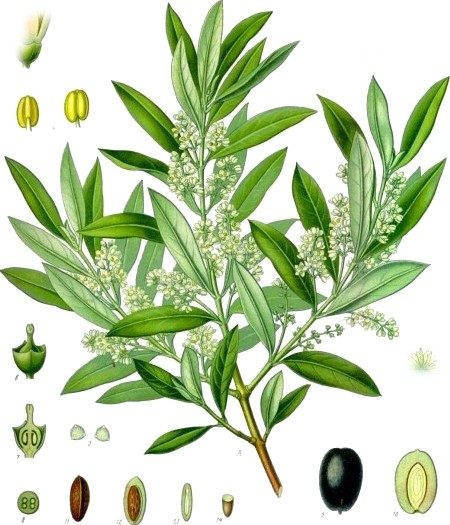
Olive-wood ash lye
Lissivio di cenere d’oliva
- Known today as
- Lye made by steeping the ash of olive wood in river water.
- Kind
- Mineral
- Constituents
- potassium carbonate, potassium hydroxide, calcium carbonate
- In other databases
- Wikidata search
- In the Canale glossary
- On the Manner of Discerning and Healing the Bewitched, Appendix A: Part Three, Chapters 7–8: The Bath and Fumigations
Revised October 1, 2026: Lore added from texts read in full. Version 1, first published September 25, 2026.
Olive-wood ash lye: what did Canale use it for?
The base of the bath (ch. 7).
Olive-wood ash lye: what does modern science say?
Lye, the alkaline liquor leached from wood ashes, was the old washing and soap-making liquid.
Pharmacognosy & Toxicology
- Constituents
- potassium carbonate ChEMBLthe chief alkali of wood ash
- potassium hydroxide ChEMBLformed in the lye
- calcium carbonate ChEMBL
- Mechanism
- Water leached through wood ash is a caustic alkali, pH 11–13 when strong: it saponifies the skin’s oils, which is why it cleans and why a strong lye burns; in a warm bath, dilute, it is a soap. The alkalinity is the whole action.
- Toxic dose
- Dilute, a soap; strong, a chemical burn of the skin and eyes.
- Standing
- The origin of potash and of soap; obsolete as a bath.
- Hoffmann, R. C. (2014). An Environmental History of Medieval Europe. Cambridge University Press. Verified against its record · doi:10.1017/cbo9781139050937
Constituent names open the compound’s record at PubChem, and “ChEMBL” beside a name opens its record at ChEMBL, the European Bioinformatics Institute’s database of bioactive molecules. Where a mechanism line was checked against ChEMBL (ChEMBL 37, read 1 October 2026), the check is shown with the measured value and its source paper, or says plainly that nothing has been measured. Doses are as the references give them, for description only; this is not medical advice. Each source carries the result of its check against Crossref, PubMed, or the authority’s page: see Verification.
Olive-wood ash lye: what lore surrounds it?
Of the wood itself Folkard notes that “the club of Hercules, which was made of Olive-wood, took root, and became a tree,” that the club of Polyphemus “was the green trunk of an Olive-tree,” and that “the caps of the priests of Jupiter were surmounted with a twig of Olive.” The Athenians “punished with great severity those who damaged their venerated Olive,” and Pliny “asserts that the identical Olive-tree, called up by Minerva, was standing in his time.”
Sources
- [38] Encyclopaedia Britannica, online edition, britannica.com. Articles: Ambergris; Aristolochiaceae; Asafetida; Azurite; Castor-oil plant; Civet; Dragon’s blood; Garden cress; Jet; Kermes; Laudanum; Lye; Monemvasía; Musk; Precious coral; Saltpetre; Sulfur dioxide; Tartar emetic; Tropaeolum. Book, seen in reviews
- Folkard, R. (1884). Plant Lore, Legends, and Lyrics, “Olive.” Project Gutenberg #44638. Read in part · the text read
Verification
- Checked
- October 1, 2026
- Passes
- Every sentence read against its sources, in the pass over the remaining 343 entries
- The Standing line checked against the authority it names (EMA, WHO, FDA, CITES, Commission E)
- Every dated or regulatory claim checked by category across the database
- Each quotation from the older authorities checked word for word against the text, read in full
- Sources
- 3 cited: 1 read in part, 1 verified against its record, 1 book, seen in reviews.
- Corrections
- None were needed.
What was checked, how, and what was found is set out on the Verification page. A checked source is one whose record was found; it does not make the entry medical advice.
Cite This Entry
Version 1 · first published September 25, 2026 · last revised October 1, 2026
- Chicago
“Olive-wood ash lye.” In Materia Medica, edited by B. C. P. Statema. Version 1. The Thinking Press, 2026–. Last modified October 1, 2026. https://thethinkingpress.org/materia-medica/olive-wood-ash-lye.
- MLA
“Olive-wood ash lye.” Materia Medica, edited by B. C. P. Statema, version 1, The Thinking Press, 1 Oct. 2026, thethinkingpress.org/materia-medica/olive-wood-ash-lye. Accessed 8 Oct. 2026.
- APA
Olive-wood ash lye. (2026, October 1). In B. C. P. Statema (Ed.), Materia medica (Version 1). The Thinking Press. Retrieved October 8, 2026, from https://thethinkingpress.org/materia-medica/olive-wood-ash-lye
Club members keep entries on a shelf with private notes, print the plates as cards, and receive an entry by email each week. Create a free account before January 1, 2027 and all of it is yours for good. About the Club
See Also
Sharing potassium carbonate, calcium carbonate
Drawing on the same sources: Folkard
Oxymel, and oxymel of squill · Olive oil and holy water · Purslane · the bibliography →
Nearby in the alphabet
Onion (Allium cepa) · Onycha and stacte (Ingredients of the Temple incense (Exodus 30) · Oil of the sick · Opium poppy (Papaver somniferum) · Oil of catechumens · Opopanax (a Mediterranean plant of the carrot family) · Oil of bricks
Historical description, not medical advice.