
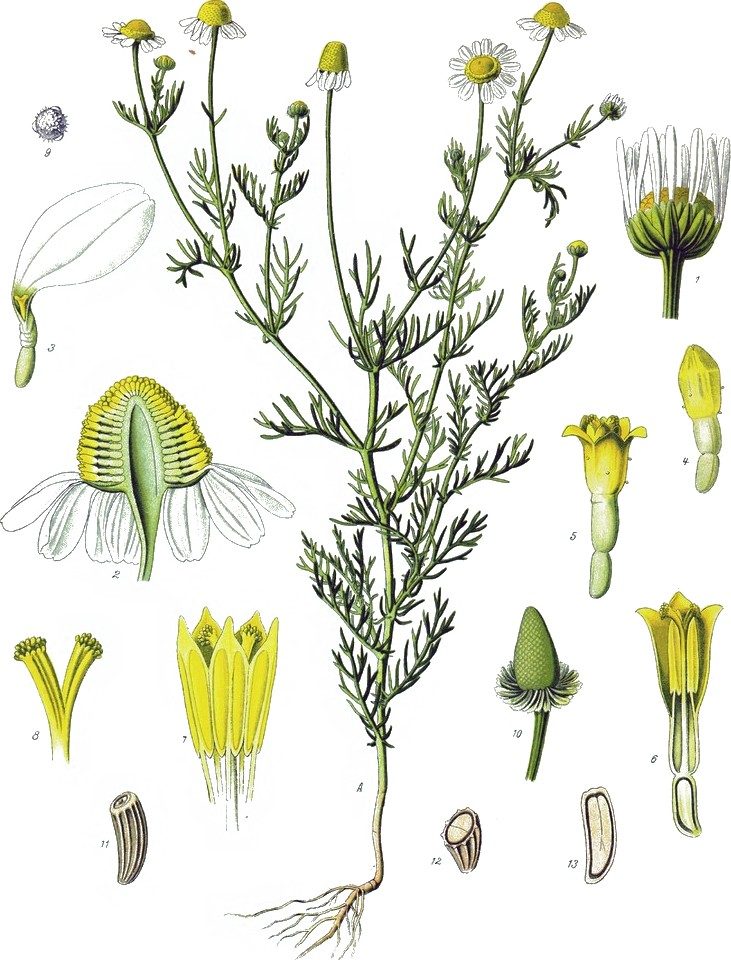
Chamomile
Camomilla
- Known today as
- Matricaria chamomilla.
- Kind
- Plant, in 3 older authorities
- Constituents
- apigenin, bisabolol, chamazulene
- Earliest authority here
- Dioscorides (c. AD 40–90)
- In other databases
- Plants of the World Online search · GBIF search · Wikidata search
- In the Canale glossary
- On the Manner of Discerning and Healing the Bewitched, Appendix A: Part Three, Chapters 7–8: The Bath and Fumigations
Revised October 1, 2026: Tradition, lore, modern assessment, and sources extended. Version 1, first published September 25, 2026.
Chamomile: what did Canale use it for?
In the bath for cold and moist complexions (ch. 7).
Chamomile: what does modern science say?
There is modest early evidence that it eases anxiety. Its flavonoid apigenin binds the same receptors as the benzodiazepines, weakly; a controlled trial at the University of Pennsylvania in 2009 found a standardised extract modestly eased generalised anxiety, and it is approved in Germany for mild inflammations of the mouth and skin. People allergic to ragweed may react to it.
Pharmacognosy & Toxicology
- Constituents
- Mechanism
- Apigenin binds the benzodiazepine site weakly; bisabolol and chamazulene calm inflammation.
- Checked against ChEMBL
- apigenin: Measured, as the entry says (“binds the benzodiazepine site weakly”): GABA-A receptor; anion channel (rat), Ki 770 nM, CHEMBL1132447; GABA-A receptor; anion channel (human), Ki 3 µM, CHEMBL1134495.
- Toxic dose
- No toxicity; allergy in those sensitive to the daisy family.
- Standing
- Approved in Europe for mild inflammation and digestive complaints.
- Amsterdam, J. D., et al. (2009). Journal of Clinical Psychopharmacology 29. Book, not indexed
Constituent names open the compound’s record at PubChem, and “ChEMBL” beside a name opens its record at ChEMBL, the European Bioinformatics Institute’s database of bioactive molecules. Where a mechanism line was checked against ChEMBL (ChEMBL 37, read 1 October 2026), the check is shown with the measured value and its source paper, or says plainly that nothing has been measured. Doses are as the references give them, for description only; this is not medical advice. Each source carries the result of its check against Crossref, PubMed, or the authority’s page: see Verification.
What Medicine Makes of It
- The Purge, the Vomit, and the BathWhat the regimen did to the body.
Chamomile: what lore surrounds it?
Ancient Egyptian tradition dedicated chamomile to the sun god Ra for its golden-centered, sun-like flower, and credited it on that account with power over agues and fevers.
Roman chamomile, Chamaemelum nobile, was planted in lawns and seats in Tudor gardens, since it grows the better for being walked on, and Falstaff is told that chamomile, “the more it is trodden on, the faster it grows.” Peter Rabbit’s mother put him to bed with a cup of it.
Chamomile: what did the older authorities say?
- Dioscorides
- Gives anthemis for fevers, the womb, and the stone, in baths and drinks, and the Greek physicians after him held it among the gentlest of the warming herbs.
- Its names
- The Greek chamaimēlon, “earth-apple,” is for the apple scent of the crushed flower; the Latin Matricaria for its use in the complaints of the womb.
- Culpeper
- Says the Egyptians dedicated it to the sun, and that a decoction of the flowers, bathed in, “taketh away weariness, easeth pains.”
Sources
- [91] National Center for Complementary and Integrative Health, NIH. Usefulness and Safety pages: Boswellia (April 2025); Chamomile (November 2024); St. John’s Wort (May 2025). nccih.nih.gov. Book, not indexed
- Shakespeare, Henry IV, Part 1 II.iv. Verified against its record · doi:10.1093/actrade/9780198123644.book.1
- Amsterdam, J. D., et al. (2009). “A randomized, double-blind, placebo-controlled trial of oral Matricaria recutita extract therapy for generalized anxiety disorder.” Journal of Clinical Psychopharmacology 29. Verified against its record · doi:10.1097/jcp.0b013e3181ac935c
Verification
- Checked
- October 1, 2026
- Passes
- Every sentence read against its sources, in the pass over the remaining 343 entries
- The Standing line checked against the authority it names (EMA, WHO, FDA, CITES, Commission E)
- Every dated or regulatory claim checked by category across the database
- The mechanism read against ChEMBL (ChEMBL 37): curated mechanisms and measured activity
- Sources
- 4 cited: 2 verified against its record, 2 book, not indexed. 1 with the abstract on file.
- Corrections
- None were needed.
What was checked, how, and what was found is set out on the Verification page. A checked source is one whose record was found; it does not make the entry medical advice.
Cite This Entry
Version 1 · first published September 25, 2026 · last revised October 1, 2026
- Chicago
“Chamomile.” In Materia Medica, edited by B. C. P. Statema. Version 1. The Thinking Press, 2026–. Last modified October 1, 2026. https://thethinkingpress.org/materia-medica/chamomile.
- MLA
“Chamomile.” Materia Medica, edited by B. C. P. Statema, version 1, The Thinking Press, 1 Oct. 2026, thethinkingpress.org/materia-medica/chamomile. Accessed 8 Oct. 2026.
- APA
Chamomile. (2026, October 1). In B. C. P. Statema (Ed.), Materia medica (Version 1). The Thinking Press. Retrieved October 8, 2026, from https://thethinkingpress.org/materia-medica/chamomile
Club members keep entries on a shelf with private notes, print the plates as cards, and receive an entry by email each week. Create a free account before January 1, 2027 and all of it is yours for good. About the Club
See Also
Sharing apigenin, chamazulene
Petroselinum crispum · Agrimonia eupatoria · Achillea millefolium
Also in Dioscorides
Chaste tree in Dioscorides · Caterpillar fungus in Dioscorides · Coltsfoot in Dioscorides · Cardamom in Dioscorides · everything Dioscorides names →
Also in Nicholas Culpeper
Chicory in Nicholas Culpeper · Centaury in Nicholas Culpeper · Cowslip in Nicholas Culpeper · Catmint in Nicholas Culpeper · everything Nicholas Culpeper names →
Drawing on the same sources: Shakespeare
Nearby in the alphabet
Chanterelle (apricot-scented mushroom with blunt ridges for gills) · Chaga (cracked, charcoal-like growth on living birch) · Cattail · Chocolate
Historical description, not medical advice.