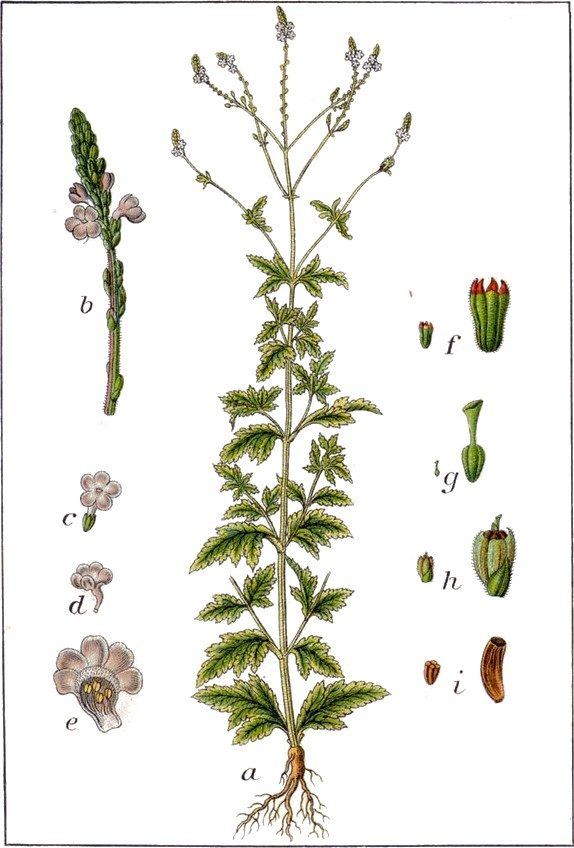
Verbena
Verbena
- Known today as
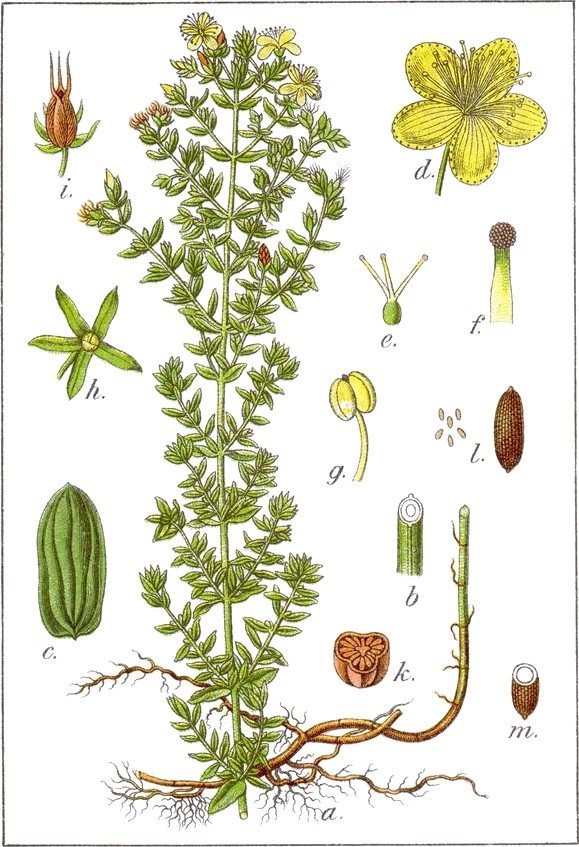
- Vervain, Verbena officinalis.
- Kind
- Plant, in 1 older authority
- Constituents
- verbenalin, hastatoside and aucubin, verbascoside
- Earliest authority quoted here
- Pliny (AD 23/24–79)
- In other databases
- Plants of the World Online · GBIF · Wikidata
- In the Canale glossary
- On the Manner of Discerning and Healing the Bewitched, Appendix A: Part Three, Chapter 6: Remedies Given by Mouth After the Purge
Revised November 1, 2026: Checked against its sources, each read in full, in part, or in its abstract. Corrected from the press's evidence dossier on the entry, every change checked in the sources read. Version 1, first published September 25, 2026.
Verbena: what did Canale use it for?
In the cockerel, the bath, the oil; as an amulet (chs. 6–7, 9–10).
Before anyone takes it
- Warnings
- Lemon verbena is a different plant (Aloysia citrodora); do not confuse the two. EMA, 2026
Verbena: what does modern science say?
The sacred herb of Roman and druidic rite, later tied by legend to Calvary and called Herb of Grace. Mild effects only.
Before anyone takes it
- Warnings
- Lemon verbena is a different plant (Aloysia citrodora); do not confuse the two. EMA, 2026
- Side effects
- In the combination BNO 1016, the trials reported no serious adverse events; nothing is known of vervain alone. Vardouniotis and colleagues, 2025
- With the regulators
- No EMA monograph exists for vervain; its own herbal monograph is in the European Pharmacopoeia, a quality standard. Kubica and colleagues, 2020
The toxic dose and the poisoning
- Toxic dose
- No toxic dose is recorded in the sources read, and no study has tested its safety, in pregnancy or otherwise.
The references for these lines are listed under Pharmacognosy, in Science. Doses are as the references give them, for description only; this is not medical advice. In a poisoning, call a poison centre.
The claims on its safety, checked
The evidence beneath each verdict here, in the words of the sources read, is for members. Join free
Plausible, untestedToxic dose: safe at tea doses.
No safety study of vervain tea found.
Each verdict is on the press’s scale, from confirmed to never documented, and rests on the sources read, in full, in part or in their abstracts. How the press checks. A summary of what was read, not medical advice.
Verbena: what did the older authorities say?
- PlinyAD 23/24–79
- Calls it the most renowned plant among the Romans: carried by envoys to the enemy, used to cleanse Jupiter’s table and to purify houses; the Gauls used it for soothsaying, and the magicians’ claims for it he calls ridiculous follies.
Verbena: what lore surrounds it?
Christian legend made it the herb that staunched Christ’s wounds on Calvary, and it was gathered with a prayer; the rhyme runs, as Folkard gives it, “The Verdain and the Dill / That hindreth Witches of their will.”
Its history and lore, checked
The evidence beneath each verdict here, in the words of the sources read, is for members. Join free
History and names7 claims
Partly confirmedCanale used vervain in the cockerel, the bath and the oil, and as an amulet.
The oil recipe and the amulet found in the 1622 text; the cockerel and the bath not found in its garbled OCR.
ConfirmedVervain is the sacred herb of Roman and druidic rite.
ConfirmedVervain was later tied by legend to Calvary and called Herb of Grace.
ConfirmedNo EMA monograph of its own; the herb has been in the European Pharmacopoeia since 2008; the Sinupret trials are of the combination.
ConfirmedChristian legend made vervain the herb that staunched Christ’s wounds on Calvary, and it was gathered with a prayer.
Partly confirmedThe English rhyme runs ‘Vervain and dill / hinder witches from their will.’
Folkard gives it as ‘The Verdain and the Dill / That hindreth Witches of their will’, without naming its source.
Partly confirmedPliny calls vervain the most honoured of Roman plants: carried by the envoys of Rome, swept on Jupiter’s altar, and used by the Gauls and the Persian Magi for divination.
Renown, envoys and the Gauls’ soothsaying are Pliny’s; he says Jupiter’s table, not altar, and calls the magicians’ claims ‘ridiculous follies’ without saying they divined with it or that they were Persian.
Belief1 claim
Not testable, but explainedVervain and dill hinder witches.
Why it was believed: Vervain was a sacred plant of Roman and druidic rite and, by legend, the herb of Calvary, so it was a natural charm against witchcraft; this is the press’s interpretation from Grieve and Pliny.
Each verdict is on the press’s scale, from confirmed to never documented, and rests on the sources read, in full, in part or in their abstracts. How the press checks. A summary of what was read, not medical advice.
Verbena: what does the evidence say?
The press read 9 sources for this entry and checked 14 of its claims against them (November 1, 2026). The claims are given as they stood when checked; where the reading found the entry wrong, the entry was corrected that day. Of the verdicts in this entry, 5 confirmed, 5 partly confirmed, 3 plausible but untested and 1 beliefs explained rather than tested.
The evidence beneath each verdict here, in the words of the sources read, is for members. One verdict’s is open, as a sample. Join free
Medicine3 claims
Plausible, untestedVervain has mild effects only.
No trial of vervain alone found; its reported activities are from cell and animal studies.
The evidence: one source read
pharmacological in vitro and in vivo studies that prove new important applications
Kubica, P., Szopa, A., Dominiak, J., Luczkiewicz, M., & Ekiert, H. (2020). Verbena officinalis (common vervain): a review on the investigations of this medicinally important plant species. Planta Medica 86: 1241–1257. Abstract read · the text read
This verdict’s evidence is open to every reader, as a sample of what members read under each.
Plausible, untestedIts iridoids verbenalin and hastatoside are ‘primarily known for their sedating and sleep-promoting properties’, and are antioxidant and anti-inflammatory as well (a 2025 review).
Sleep-promoting in animal work by the review’s account; no human trial found.
Partly confirmedVervain is in a licensed German sinusitis mixture (Sinupret) with cowslip, elder, gentian and sorrel, which has controlled trials.
The extract BNO 1016 of five herbs including verbena has placebo-controlled trials; the brand name and licence are not in the sources read; the herb alone is untested.
The trials are of the combination; no harm signal is reported in the abstracts read, which come largely from the maker.
The plant2 claims
ConfirmedVervain is a mild bitter and astringent.
Partly confirmedIts constituents are verbenalin and hastatoside (iridoid glycosides), verbascoside (a phenylethanoid) and citral (in lemon verbena, a different plant).
Verbenalin, hastatoside and verbascoside confirmed; citral not found in the sources read on vervain.
The verdicts on its safety under Safety and on its history and lore under History.
What no one yet knows
- Does vervain alone do anything measurable in people, for sleep, nerves or anything else? No trial of the herb alone was found; the evidence is in cells and animals, or in a five-herb combination.
- Is vervain tea safe, including in pregnancy, and what dose is toxic? No safety study, poisoning report or toxic dose was found.
- How much does vervain contribute to the effect of the sinus combination? The trials test the five-herb extract against placebo, never the herbs one by one.
- Did the Persian magi divine with vervain? Pliny’s chapter, as translated, gives soothsaying to the Gauls and other claims to the magicians; the Latin was not read.
Each verdict is on the press’s scale, from confirmed to never documented, and rests on the sources read, in full, in part or in their abstracts. How the press checks. A summary of what was read, not medical advice.
Pharmacognosy
- Constituents
- verbenalin, hastatoside and aucubiniridoid glycosides
- verbascoside ChEMBLa phenylethanoid
- Mechanism
- Vervain, Verbena officinalis, the herb of the altar: a mild bitter and astringent whose iridoids verbenalin and hastatoside, a 2025 review notes, are “primarily known for their sedating and sleep-promoting properties” and are antioxidant and anti-inflammatory as well. It is one of five herbs (with gentian root, primrose flower, sorrel and elder flower) in the sinus extract BNO 1016, whose placebo-controlled trials were run largely by its maker; they say nothing of vervain alone.
- Standing
- No EMA monograph of its own (the herb has been in the European Pharmacopoeia since 2008); the Sinupret trials are of the combination.
- Kubica, P., et al. (2020). “Verbena officinalis (common vervain): a review on the investigations of this medicinally important plant species.” Planta Medica 86. Verified against its record · doi:10.1055/a-1232-5758
- Vardouniotis, A., Doulaptsi, M., Liva, G., et al. (2025). Herbal medicine in acute and chronic sinusitis; still a Cinderella? Current Allergy and Asthma Reports. Read in part · the text read
The abstract of each source, beneath its citation. For Club members. About the Club or sign in.
Constituent names open the compound’s record at PubChem, and “ChEMBL” beside a name opens its record at ChEMBL, the European Bioinformatics Institute’s database of bioactive molecules. Where a mechanism line was checked against ChEMBL (ChEMBL 37, read 1 October 2026), the check is shown with the measured value and its source paper, or says plainly that nothing has been measured. Doses are as the references give them, for description only; this is not medical advice. Each source carries the result of its check against Crossref, PubMed, or the authority’s page: see Verification.
What Medicine Makes of It
- The Living LightHildegard's visions, and the migraine aura.
Sources
- [54] Grieve, M. (1931). A Modern Herbal. Online edition, botanical.com, cited under the plant concerned. Read in full · the text read
- Mihaylova, R., Elincheva, V., Gevrenova, R., Zheleva-Dimitrova, D., Momekov, G., & Simeonova, R. (2025). Targeting inflammation with natural products: a mechanistic review of iridoids from Bulgarian medicinal plants. Molecules 30(17): 3456. Read in full · the text read
- Pliny the Elder. The Natural History, trans. J. Bostock and H. T. Riley, vol. 5. London: Henry G. Bohn. Internet Archive naturalhistoryof05plinrich. Read in part · the text read
- Folkard, R. (1884). Plant Lore, Legends, and Lyrics. London. Project Gutenberg #44638. Read in part · the text read
Verification
- Checked
- October 1, 2026, October 17, 2026
- Passes
- Read against its sources in the fifty-entry sample
- Every dated or regulatory claim checked by category across the database
- Every source read, in full, in part, or in its abstract, and every sentence checked against what was read (October 17, 2026)
- Sources
- 6 cited: 2 read in full, 3 read in part, 1 verified against its record. 1 with the abstract on file.
- Corrections
- None recorded.
What was checked, how, and what was found is set out on the Verification page. A checked source is one whose record was found; it does not make the entry medical advice.
Club members can point at a technical term in this entry, such as a constituent, an action, or a word of Jung’s, to read its definition from the source. The Club.
Cite This Entry
Version 1 · first published September 25, 2026 · last revised November 1, 2026
- Chicago
“Verbena.” In Materia Medica, edited by B. C. P. Statema. Version 1. The Thinking Press, 2026–. Last modified November 1, 2026. https://thethinkingpress.org/materia-medica/verbena.
- MLA
“Verbena.” Materia Medica, edited by B. C. P. Statema, version 1, The Thinking Press, 1 Nov. 2026, thethinkingpress.org/materia-medica/verbena. Accessed 22 Nov. 2026.
- APA
Verbena. (2026, November 1). In B. C. P. Statema (Ed.), Materia medica (Version 1). The Thinking Press. Retrieved November 22, 2026, from https://thethinkingpress.org/materia-medica/verbena
See Also
Sharing verbascoside
Also in Pliny the Elder
Violet, lettuce, sow-thistle in Pliny the Elder · Turpentine in Pliny the Elder · Walnut, middle bark of in Pliny the Elder · Truffle in Pliny the Elder · everything Pliny the Elder names →
Drawing on the same sources: Folkard
Nearby in the alphabet
Verdigris (the green rust of copper) · Valerian (Valeriana officinalis) · The vernicle (leaving his image) · Unicorn’s horn (Monodon monoceros) · Vine ash (Ash of burnt vine wood) · Vinegar (Soured wine) · Turmeric (of the ginger family, whose root is deep yellow within)
Historical description, not medical advice.
