
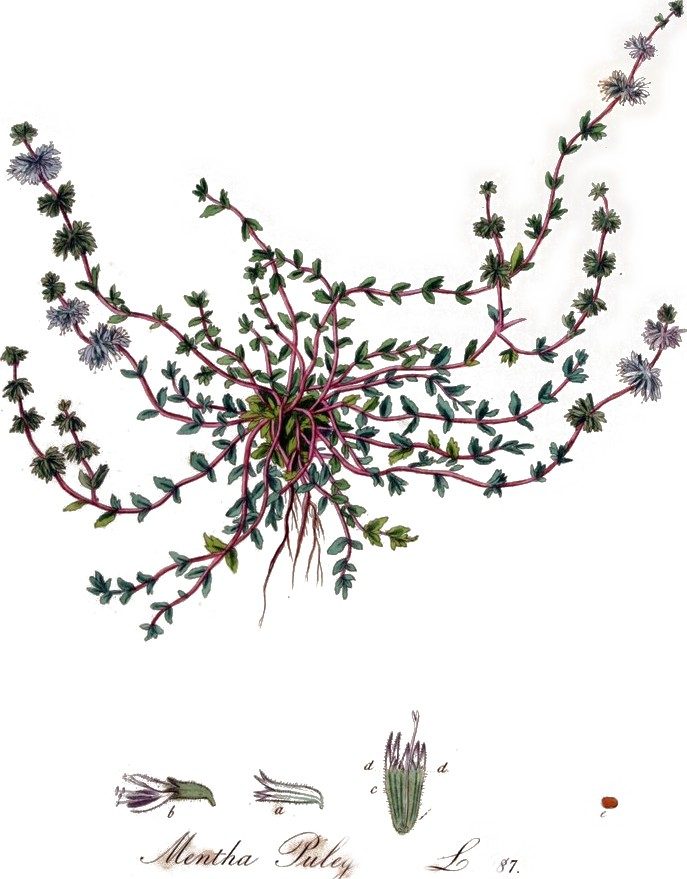
Pennyroyal
Pulegio
- Known today as
- Mentha pulegium.
- Kind
- Plant, in 2 older authorities
- Constituents
- pulegone, menthofuran
- Poisoning
- Hepatotoxic monoterpenes (pulegone)
- Earliest authority here
- Pliny (AD 23/24–79)
- In other databases
- Plants of the World Online search · GBIF search · Wikidata search
- In the Canale glossary
- On the Manner of Discerning and Healing the Bewitched, Appendix A: Part Three, Chapters 7–8: The Bath and Fumigations
Revised October 1, 2026: Tradition, lore, modern assessment, and sources extended. Version 1, first published September 25, 2026.
Caution. Hazardous in some form or dose; see the modern assessment below.
Pennyroyal: what did Canale use it for?
In the bath for cold complexions (ch. 7).
Pennyroyal: how is it taken as a tea?
An ounce of the herb to a pint of boiling water, taken warm by the teacupful, frequently repeated.
All the herbal teas of the database. Historical directions, not medical advice.
Pennyroyal: what does modern science say?
Its oil is highly toxic to the liver and has killed people taking it as an abortifacient. The oil is about four-fifths pulegone, which the liver turns into menthofuran, a poison to itself: ten millilitres has caused liver failure, and women taking it to end pregnancies have died. The herb in a tea is far weaker, but carries the same risk in quantity.
Pennyroyal: is it poisonous?
Yes, in some form or dose. Its poisoning is hepatotoxic monoterpenes (pulegone): Hours. Historical description, not medical advice; in a poisoning, call a poison centre.
Pharmacognosy & Toxicology
- Constituents
- pulegone ChEMBL80–90 per cent of the oil
- menthofuran ChEMBLits toxic metabolite
- Mechanism
- Menthofuran destroys the liver cell by binding its proteins.
- Toxic dose
- 10 ml of the oil has caused liver failure; the tea is far weaker.
- Syndrome
- Hepatotoxic monoterpenes (pulegone)
- Standing
- Sold as a supplement in the United States with no approved use; poison centres and the herbal references warn against it in pregnancy.
- Anderson, I. B., et al. (1996). Annals of Internal Medicine 124. Book, seen in reviews
Constituent names open the compound’s record at PubChem, and “ChEMBL” beside a name opens its record at ChEMBL, the European Bioinformatics Institute’s database of bioactive molecules. Where a mechanism line was checked against ChEMBL (ChEMBL 37, read 1 October 2026), the check is shown with the measured value and its source paper, or says plainly that nothing has been measured. Doses are as the references give them, for description only; this is not medical advice. Each source carries the result of its check against Crossref, PubMed, or the authority’s page: see Verification.
What Medicine Makes of It
- The Nightmare and the HagThe incubus that sits on the chest, and sleep paralysis.
- The Wandering Womb and the ConvulsionsSuffocation of the mother, hysteria, and functional neurological disorder.
Pennyroyal: what lore surrounds it?
The Romans cooked with it, and Apicius calls for it often; colonists in Virginia strewed it against insects, and in 1665 the Royal Society’s Philosophical Transactions carried a report from Virginia of a wild “pennyroyal” (the American dittany) whose bruised leaves, held to a rattlesnake’s face, were said to kill it. Its old English name, pudding grass, is from its place in the black pudding.
Pennyroyal: what did the older authorities say?
- Pliny
- Praises pulegium for driving away fleas, whence its Latin name, from pulex, the flea, and gives it to bring on the menses and to expel the dead child.
- Aristophanes
- In Peace (421 BC) a character is offered pennyroyal as a contraceptive, one of the oldest such references in literature.
Sources
- [80] LiverTox: Clinical and Research Information on Drug-Induced Liver Injury. Bethesda (MD): National Institute of Diabetes and Digestive and Kidney Diseases. Entries: Germander (updated 12 March 2018); Pennyroyal Oil (updated 28 March 2020); Senna (updated 1 April 2020). Abstract read · the text read
- Grieve, M. A Modern Herbal, “Pennyroyal.” As published on botanical.com.
- Pliny, Natural History XX. Primary text
- Anderson, I. B., et al. (1996). “Pennyroyal toxicity.” Annals of Internal Medicine 124. Verified against its record · doi:10.7326/0003-4819-124-8-199604150-00004
Verification
- Checked
- October 1, 2026
- Passes
- Every sentence read against its sources, in the pass over the remaining 343 entries
- The Standing line checked against the authority it names (EMA, WHO, FDA, CITES, Commission E)
- Every dated or regulatory claim checked by category across the database
- Sources
- 5 cited: 1 abstract read, 1 verified against its record, 1 primary text, 1 book, seen in reviews, 1 not yet checked. 2 with the abstract on file.
- Corrections
- said that since 1994 US products must carry a pregnancy warning. No such requirement exists; pennyroyal is sold as an unregulated supplement. Removed from the modern note and the standing.
- the Royal Society report of 1665 was not of pennyroyal against rattlesnake bite. It describes a Virginian plant with leaves like pennyroyal (the American dittany) whose bruised leaves, held to the snake's face, were said to kill it. Reworded.
What was checked, how, and what was found is set out on the Verification page. A checked source is one whose record was found; it does not make the entry medical advice.
Cite This Entry
Version 1 · first published September 25, 2026 · last revised October 1, 2026
- Chicago
“Pennyroyal.” In Materia Medica, edited by B. C. P. Statema. Version 1. The Thinking Press, 2026–. Last modified October 1, 2026. https://thethinkingpress.org/materia-medica/pennyroyal.
- MLA
“Pennyroyal.” Materia Medica, edited by B. C. P. Statema, version 1, The Thinking Press, 1 Oct. 2026, thethinkingpress.org/materia-medica/pennyroyal. Accessed 8 Oct. 2026.
- APA
Pennyroyal. (2026, October 1). In B. C. P. Statema (Ed.), Materia medica (Version 1). The Thinking Press. Retrieved October 8, 2026, from https://thethinkingpress.org/materia-medica/pennyroyal
Club members keep entries on a shelf with private notes, print the plates as cards, and receive an entry by email each week. Create a free account before January 1, 2027 and all of it is yours for good. About the Club
See Also
Poisoned alike: hepatotoxic monoterpenes (pulegone)
Rue · Parsley · Savin · Water germander · the syndrome, with all of them →
Sharing pulegone
Also in Pliny the Elder
Pilewort in Pliny the Elder · Pearls, prepared in Pliny the Elder · Polypody of mercurialis, syrup of in Pliny the Elder · Palm of Christ in Pliny the Elder · everything Pliny the Elder names →
Drawing on the same sources: Grieve, Pliny, Anderson
Periwinkle · Pawpaw · Quicksilver · Orpiment and realgar · Rocket · Raisins · the bibliography →
Nearby in the alphabet
Peony (the kind formerly grown for its medicinal root) · Penicillin mould (fruit, and damp) · Pilgrim badges and ampullae · Passarino’s white powder (a man skilled in the spagyric (chemical) art (note XXXIX))
Historical description, not medical advice.