
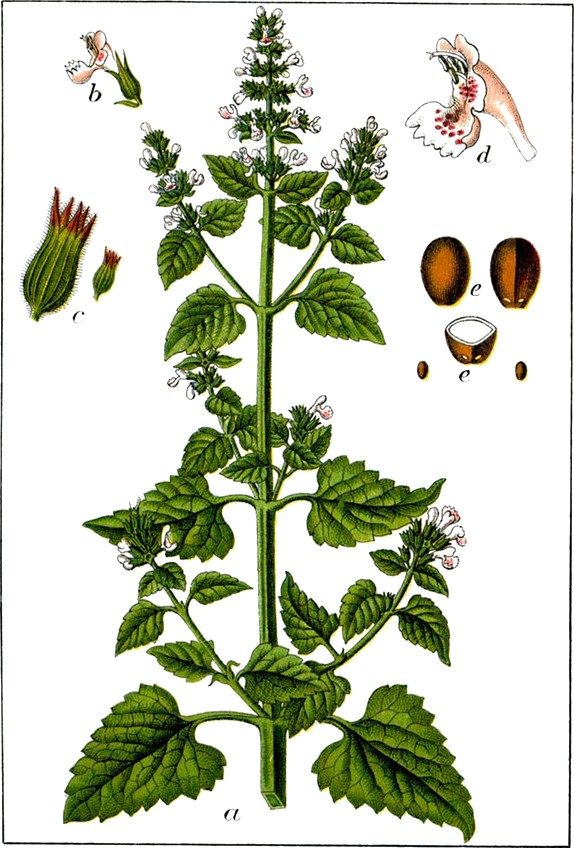
Catmint
Nepita
- Known today as
- Nepeta cataria or calamint, Clinopodium nepeta.
- Kind
- Plant, in 2 older authorities
- Constituents
- nepetalactone, thymol, carvacrol
- Earliest authority here
- Pliny (AD 23/24–79)
- In other databases
- Plants of the World Online search · GBIF search · Wikidata search
- In the Canale glossary
- On the Manner of Discerning and Healing the Bewitched, Appendix A: Part Three, Chapters 7–8: The Bath and Fumigations
Revised October 1, 2026: An older authority added from a text read in full. Version 1, first published September 25, 2026.
Catmint: what did Canale use it for?
In the bath for cold complexions (ch. 7).
Catmint: foraging it in the Midwest
- Part
- Leaves
- When
- Summer
The Flambeau Ojibwe brewed a tea of the leaves as a beverage and as a blood purifier, and bathed a patient in the mint water to raise the body’s heat. A dooryard escape in the Lake country.
After Smith. All the foragables of the Midwest. Historical record, not a field guide: identify before you gather, and read the whole entry.
Catmint: how is it taken as a tea?
An ounce to a pint of boiling water, two tablespoonfuls at a time for adults and two or three teaspoonfuls for children: a fever drink that brings sleep and sweat without heating the body, Grieve says, though very large warm doses act as an emetic.
All the herbal teas of the database. Historical directions, not medical advice.
Catmint: what does modern science say?
Mildly aromatic.
Pharmacognosy & Toxicology
- Constituents
- nepetalactonethe iridoid that excites cats
- thymol ChEMBL
- carvacrol ChEMBL
- Mechanism
- Nepetalactone binds olfactory receptors in cats and acts, it was shown in 2021, as a mosquito repellent through the TRPA1 irritant channel; in people the tea is a mild carminative and diaphoretic. Nothing in it is sedative in any measured dose.
- Toxic dose
- Safe; smoked, it does not intoxicate, a 1969 report notwithstanding.
- Standing
- No monograph; the repellent action is the one with modern evidence.
- Melo, N., et al. (2021). “The irritant receptor TRPA1 mediates the mosquito repellent effect of catnip.” Current Biology 31. Verified against its record · doi:10.1016/j.cub.2021.02.010
- Uenoyama, R., et al. (2021). “The characteristic response of domestic cats to plant iridoids allows them to gain chemical defense against mosquitoes.” Science Advances 7. Verified against its record · doi:10.1126/sciadv.abd9135
The abstract of each source, beneath its citation. For Club members. About the Club or sign in.
Constituent names open the compound’s record at PubChem, and “ChEMBL” beside a name opens its record at ChEMBL, the European Bioinformatics Institute’s database of bioactive molecules. Where a mechanism line was checked against ChEMBL (ChEMBL 37, read 1 October 2026), the check is shown with the measured value and its source paper, or says plainly that nothing has been measured. Doses are as the references give them, for description only; this is not medical advice. Each source carries the result of its check against Crossref, PubMed, or the authority’s page: see Verification.
Catmint: what lore surrounds it?
Catnip’s effect on the domestic cat, the rubbing, rolling, and brief euphoria, has been observed and written about since antiquity, one of the most widely recognized plant-and-animal associations of the Western tradition.
Catmint: what did the older authorities say?
- Pliny
- Counts catmint with wild mint, endive, and pennyroyal among the plants that “will grow even without any cultivation”; it is kept for use in the larder like mint and pennyroyal; and a wine was made of it, two handfuls to a cadus of must.
- Culpeper
- An herb of Venus: “Nep is generally used for women to procure their courses,” taken inwardly or in a bath or its fumes; it is of special use for windiness of the stomach and belly, for colds, coughs, and shortness of breath; the green herb bruised and applied for two or three hours eases the pains of the piles.
Sources
- Grieve, M. A Modern Herbal, “Catmint.” As published on botanical.com.
- Pliny the Elder, Natural History 19.37, 19.47, 14.19, trans. J. Bostock & H. T. Riley (1855), Perseus Digital Library. Primary text
- Culpeper, N. (1653). The Complete Herbal, “Nep, Or Catmint.” Project Gutenberg #49513. Primary text
Verification
- Checked
- October 1, 2026
- Passes
- Every sentence read against its sources, in the pass over the remaining 343 entries
- The Standing line checked against the authority it names (EMA, WHO, FDA, CITES, Commission E)
- Every dated or regulatory claim checked by category across the database
- Each quotation from the older authorities checked word for word against the text, read in full
- Sources
- 5 cited: 2 verified against its record, 2 primary text, 1 not yet checked. 2 with the abstract on file.
- Corrections
- None were needed.
What was checked, how, and what was found is set out on the Verification page. A checked source is one whose record was found; it does not make the entry medical advice.
Cite This Entry
Version 1 · first published September 25, 2026 · last revised October 1, 2026
- Chicago
“Catmint.” In Materia Medica, edited by B. C. P. Statema. Version 1. The Thinking Press, 2026–. Last modified October 1, 2026. https://thethinkingpress.org/materia-medica/catmint.
- MLA
“Catmint.” Materia Medica, edited by B. C. P. Statema, version 1, The Thinking Press, 1 Oct. 2026, thethinkingpress.org/materia-medica/catmint. Accessed 8 Oct. 2026.
- APA
Catmint. (2026, October 1). In B. C. P. Statema (Ed.), Materia medica (Version 1). The Thinking Press. Retrieved October 8, 2026, from https://thethinkingpress.org/materia-medica/catmint
Club members keep entries on a shelf with private notes, print the plates as cards, and receive an entry by email each week. Create a free account before January 1, 2027 and all of it is yours for good. About the Club
See Also
Sharing thymol, carvacrol
Diatrion piperion · Thymus vulgaris · Origanum vulgare · Origanum dictamnus
Also in Pliny the Elder
Centaury in Pliny the Elder · Castoreum in Pliny the Elder · Chaste tree in Pliny the Elder · Cassia wood in Pliny the Elder · everything Pliny the Elder names →
Also in Nicholas Culpeper
Burdock in Nicholas Culpeper · Chamomile in Nicholas Culpeper · Broom in Nicholas Culpeper · everything Nicholas Culpeper names →
Drawing on the same sources: Grieve, Culpeper
Chicory · Castor-oil plant, seeds of · Cinquefoil · Cantharides · the bibliography →
Nearby in the alphabet
Cattail · Caterpillar fungus (sending up a slender stalk) · Chaga (cracked, charcoal-like growth on living birch) · Cassia, flower of (the Indian laburnum)
Historical description, not medical advice.