
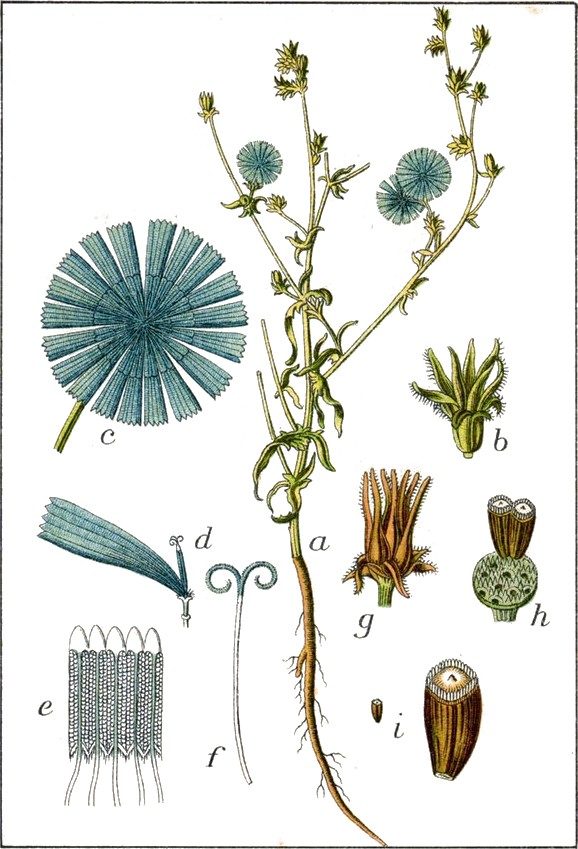
Chicory
Radicchio
- Known today as
- Cichorium intybus.
- Kind
- Plant, in 2 older authorities
- Constituents
- inulin, lactucin and lactucopicrin, chicoric acid
- Earliest authority here
- Pliny (AD 23/24–79)
- Qualities
- Cold and dry (Galenic tradition). What the degrees mean
- In other databases
- Plants of the World Online search · GBIF search · Wikidata search
- In the Canale glossary
- On the Manner of Discerning and Healing the Bewitched, Appendix A: Part Three, Chapter 5: Vomitory Medicines
Revised October 1, 2026: An older authority added from a text read in full. Version 1, first published September 25, 2026.
Chicory: what did Canale use it for?
In the relaxing broths (ch. 5).
Chicory: how is it taken as a tea?
A decoction of an ounce of the root to a pint of boiling water, taken freely, for jaundice, the liver, gout, and rheumatic complaints.
All the herbal teas of the database. Historical directions, not medical advice.
Chicory: what does modern science say?
Mildly laxative and bitter.
Pharmacognosy & Toxicology
- Constituents
- inulin ChEMBLthe root’s storage carbohydrate
- lactucin and lactucopicrinsesquiterpene lactone bitters
- chicoric acid ChEMBL
- Mechanism
- The root’s inulin is the standard industrial prebiotic, which feeds bifidobacteria and softens the stool; the lactones are the bitter and have sedative and analgesic action in mice, as in lettuce; the “relaxing broth” was the mucilage and the warmth.
- Toxic dose
- Safe as a vegetable; inulin at more than 10–15 g a day gives wind and bloating; the lactones cause contact dermatitis in handlers.
- Standing
- Inulin from chicory carries an EFSA-approved health claim (2015) for bowel function; the root has a traditional-use listing in several European pharmacopoeias.
- EFSA NDA Panel (2015). “Scientific opinion on the substantiation of a health claim related to native chicory inulin and maintenance of normal defecation.” EFSA Journal 13. Standard reference work
- Street, R. A., et al. (2013). “Cichorium intybus: traditional uses, phytochemistry, pharmacology, and toxicology.” Evidence-Based Complementary and Alternative Medicine. Verified against its record · doi:10.1155/2013/579319
The abstract of each source, beneath its citation. For Club members. About the Club or sign in.
Constituent names open the compound’s record at PubChem, and “ChEMBL” beside a name opens its record at ChEMBL, the European Bioinformatics Institute’s database of bioactive molecules. Where a mechanism line was checked against ChEMBL (ChEMBL 37, read 1 October 2026), the check is shown with the measured value and its source paper, or says plainly that nothing has been measured. Doses are as the references give them, for description only; this is not medical advice. Each source carries the result of its check against Crossref, PubMed, or the authority’s page: see Verification.
Chicory: what lore surrounds it?
European folk tradition, especially German and Central European, tells of a maiden who waited faithfully by the roadside for a sailor or soldier who never came home, and was turned for her constancy into the blue roadside flower, which is why several traditions call it “blue sailor.” The tale survives in many regional variants rather than a single telling.
Chicory: what did the older authorities say?
- Pliny
- Says that in Egypt, next to the colocasia, “it is the cichorium that is held in the highest esteem,” the plant he had called wild endive: it springs up after the rising of the Pleiades, blossoms by degrees, and “the root is supple, and hence is used for making withes even.”
- Culpeper
- An herb of Jupiter: garden succory, “more dry and less cold than Endive,” opens more, and a handful of the leaves or roots boiled in wine or water and drunk fasting drives forth choleric and phlegmatic humours and opens obstructions of the liver, gall, and spleen; a dram of the seed in wine before the fit helps drive away an ague; the wild succory, being more bitter, is more strengthening to the stomach.
Sources
- [41] European Medicines Agency, Committee on Herbal Medicinal Products (HMPC). Herbal monographs, assessment reports and public statements, ema.europa.eu, cited under the herb concerned: aniseed (summary, EMA/305345/2016); Aristolochia (public statement, EMEA/HMPC/138381/2005); asarone (public statement, EMEA/HMPC/139215/2005); caraway (EMA/HMPC/715092/2013); centaury (EMA/HMPC/277493/2015); chicory root (assessment report, EMA/HMPC/113041/2010); cinnamon (EMA/HMPC/246774/2009); clove (assessment report, EMA/HMPC/534946/2010); ethanol in herbal products (reflection paper, EMA/HMPC/85114/2008); fennel (EMEA/HMPC/372839/2016, Rev. 1, 2024); fumitory (draft assessment report, EMA/HMPC/367013/2021); greater celandine (public statement, EMA/HMPC/743927/2010); hops (EMA/HMPC/682384/2013); horehound (EMA/HMPC/604271/2012); mallow (assessment report, EMA/HMPC/749518/2016); marshmallow root (Althaeae radix); melissa (summary, EMA/HMPC/310761/2013); myrrh (assessment report and monograph, EMA/HMPC/96910/2010 and 96911/2010); peppermint oil (assessment report, EMEA/HMPC/349465/2006); pyrrolizidine alkaloids (public statement, EMA/HMPC/893108/2011); rhubarb (EMA/HMPC/113700/2019); sage (Salviae officinalis folium); wormwood (EMA/HMPC/751490/2016). Read in full · the text read
- Grieve, M. A Modern Herbal, “Chicory.” As published on botanical.com.
- Pliny the Elder, Natural History 21.52, trans. J. Bostock & H. T. Riley (1855), Perseus Digital Library. Primary text
- Culpeper, N. (1653). The Complete Herbal, “Succory, Or Chicory.” Project Gutenberg #49513. Primary text
Verification
- Checked
- October 1, 2026
- Passes
- Every sentence read against its sources, in the pass over the remaining 343 entries
- The Standing line checked against the authority it names (EMA, WHO, FDA, CITES, Commission E)
- Every dated or regulatory claim checked by category across the database
- Each quotation from the older authorities checked word for word against the text, read in full
- Sources
- 6 cited: 1 read in full, 1 verified against its record, 2 primary text, 1 standard reference work, 1 not yet checked. 1 with the abstract on file.
- Corrections
- None were needed.
What was checked, how, and what was found is set out on the Verification page. A checked source is one whose record was found; it does not make the entry medical advice.
Cite This Entry
Version 1 · first published September 25, 2026 · last revised October 1, 2026
- Chicago
“Chicory.” In Materia Medica, edited by B. C. P. Statema. Version 1. The Thinking Press, 2026–. Last modified October 1, 2026. https://thethinkingpress.org/materia-medica/chicory.
- MLA
“Chicory.” Materia Medica, edited by B. C. P. Statema, version 1, The Thinking Press, 1 Oct. 2026, thethinkingpress.org/materia-medica/chicory. Accessed 8 Oct. 2026.
- APA
Chicory. (2026, October 1). In B. C. P. Statema (Ed.), Materia medica (Version 1). The Thinking Press. Retrieved October 8, 2026, from https://thethinkingpress.org/materia-medica/chicory
Club members keep entries on a shelf with private notes, print the plates as cards, and receive an entry by email each week. Create a free account before January 1, 2027 and all of it is yours for good. About the Club
See Also
Sharing inulin, lactucin and lactucopicrin
Taraxacum officinale · Burdock · Inula helenium · Cichorium endivia · Viola odorata
Also in Pliny the Elder
Cinnabar in Pliny the Elder · Chaste tree in Pliny the Elder · Cinnamon in Pliny the Elder · Centaury in Pliny the Elder · everything Pliny the Elder names →
Also in Nicholas Culpeper
Cowslip in Nicholas Culpeper · Chamomile in Nicholas Culpeper · Crabs’ eyes in Nicholas Culpeper · everything Nicholas Culpeper names →
Drawing on the same sources: Grieve, Culpeper, Street
Cinquefoil · Catmint · Clove · Cochia pills · Confection of alkermes · the bibliography →
Of the same qualities: cold and dry
Coral, red · Camphor · White willow · Opium poppy · Vinegar · what the degrees mean →
Nearby in the alphabet
Chocolate · Chokecherry (the chokecherry of North America) · Chanterelle (apricot-scented mushroom with blunt ridges for gills) · Chrism (Olive oil mixed with balsam and consecrated by a bishop) · Cinchona (The bark of Cinchona trees of the Andes) · Chaga (cracked, charcoal-like growth on living birch)
Historical description, not medical advice.