
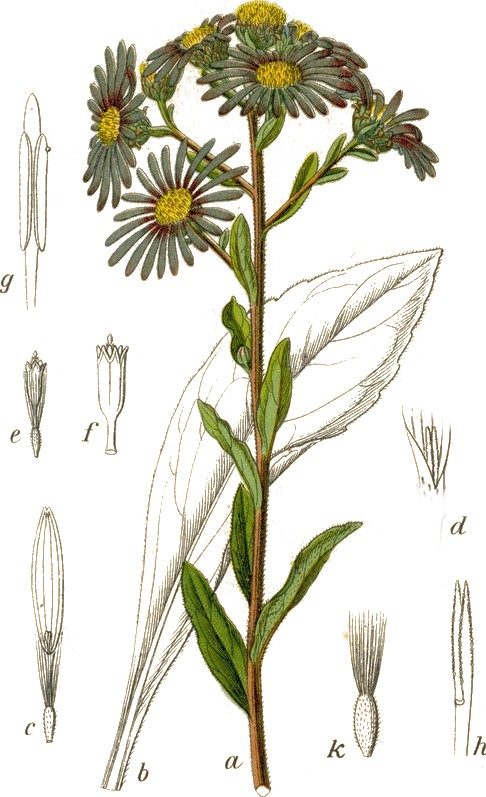
Aster
Aster attico
- Known today as
- Aster amellus.
- Kind
- Plant
- Constituents
- astersaponins, quercetin glycosides, caffeoylquinic acids
- In other databases
- Plants of the World Online search · GBIF search · Wikidata search
- In the Canale glossary
- On the Manner of Discerning and Healing the Bewitched, Appendix A: Part Three, Chapters 7–8: The Bath and Fumigations
Aster: what did Canale use it for?
In the first fumigation, with rue, sulfur, and asafoetida (ch. 8).
Aster: what does modern science say?
Aromatic smoke only.
Pharmacognosy & Toxicology
- Constituents
- astersaponinstriterpenoid saponins
- quercetin glycosides
- caffeoylquinic acids
- Mechanism
- The Attic aster, Aster amellus, burned in a fumigation gives smoke, not a drug; the Chinese A. tataricus root, with its saponins and shionone, is a recognised expectorant in that pharmacopoeia.
- Toxic dose
- No toxicity recorded.
- Standing
- Nothing in European medicine; Aster tataricus is in the Chinese Pharmacopoeia for cough.
- Chinese Pharmacopoeia Commission (2020). Pharmacopoeia of the People’s Republic of China, “Asteris Radix.” Standard reference work
Constituent names open the compound’s record at PubChem, and “ChEMBL” beside a name opens its record at ChEMBL, the European Bioinformatics Institute’s database of bioactive molecules. Where a mechanism line was checked against ChEMBL (ChEMBL 37, read 1 October 2026), the check is shown with the measured value and its source paper, or says plainly that nothing has been measured. Doses are as the references give them, for description only; this is not medical advice. Each source carries the result of its check against Crossref, PubMed, or the authority’s page: see Verification.
Aster: what lore surrounds it?
The name of the flower, like that of Astraea, derives from the Greek astēr, “star.” Astraea, the star-maiden of justice, abandoned a corrupted humanity and became the constellation Virgo. The often-repeated story that the aster sprang from her tears has no source in her myth and appears to be a modern invention of floral folklore.
In Their Own Words
Pliny says the aster was called bubonion because it was a sovereign remedy for diseases of the groin, and that for these it should be gathered with the left hand and tied on near the girdle.
“…is called “bubonion” by some, from the circumstance of its being a sovereign remedy for diseases of the groin. It has a diminutive stem with oblong leaves, two or three in number”
Pliny; translated by John Bostock and H. T. Riley, The Natural History of Pliny, Vol. V, Book XXVII, ch. 19, 'The Aster or Bubonion'. Translated, with copious notes and illustrations, by the late John Bostock, M.D., F.R.S., and H.T. Riley, Esq., B.A. London: Henry G. Bohn, York Street, Covent Garden. MDCCCLVI (Project Gutenberg eBook #60688). The text, read in part
The translators' note records that Fée follows Jussieu and Sprengel in taking Pliny's aster for Aster amellus, the Italian starwort.
“Desfontaines suggests the Inula bubonium, but Fée adopts the opinion of Jussieu and Sprengel, that it is the Aster amellus of Linnæus, the Italian starwort.”
Pliny; translated by John Bostock and H. T. Riley, The Natural History of Pliny, Vol. V, Book XXVII, note 1777. Translated, with copious notes and illustrations, by the late John Bostock, M.D., F.R.S., and H.T. Riley, Esq., B.A. London: Henry G. Bohn, York Street, Covent Garden. MDCCCLVI (Project Gutenberg eBook #60688). The text, read in part
Each passage is quoted from the text named, which the press fetched and read, and was checked word for word against a fresh copy of it; the link opens that copy. Passages are given as printed, without the editors’ footnote numbers, and with words broken across lines joined.
Sources
- “Astraea” (reference article). Book, seen in reviews
Verification
- Checked
- October 1, 2026
- Passes
- Every sentence read against its sources, in the pass over the remaining 343 entries
- The Standing line checked against the authority it names (EMA, WHO, FDA, CITES, Commission E)
- Every dated or regulatory claim checked by category across the database
- Sources
- 2 cited: 1 standard reference work, 1 book, seen in reviews.
- Corrections
- None were needed.
What was checked, how, and what was found is set out on the Verification page. A checked source is one whose record was found; it does not make the entry medical advice.
Cite This Entry
Version 1 · first published September 25, 2026
- Chicago
“Aster.” In Materia Medica, edited by B. C. P. Statema. Version 1. The Thinking Press, 2026–. Last modified September 25, 2026. https://thethinkingpress.org/materia-medica/aster.
- MLA
“Aster.” Materia Medica, edited by B. C. P. Statema, version 1, The Thinking Press, 25 Sept. 2026, thethinkingpress.org/materia-medica/aster. Accessed 8 Oct. 2026.
- APA
Aster. (2026, September 25). In B. C. P. Statema (Ed.), Materia medica (Version 1). The Thinking Press. Retrieved October 8, 2026, from https://thethinkingpress.org/materia-medica/aster
Club members keep entries on a shelf with private notes, print the plates as cards, and receive an entry by email each week. Create a free account before January 1, 2027 and all of it is yours for good. About the Club
See Also
Sharing quercetin glycosides, caffeoylquinic acids
Nearby in the alphabet
Aurum potabile (Gold dissolved or suspended in liquid for drinking) · The aspergillum (or perforated ball on a handle, with which holy water is sprinkled) · Balm (Melissa officinalis) · Asarabacca (wild ginger of European woods) · Balm of Gilead (The resin of Commiphora gileadensis) · Asafoetida (“devil’s dung) · Balsam of Peru (vanilla-scented balsam from Myroxylon balsamum var) · Arthritica (named for its use against gout (note XLIX))
Historical description, not medical advice.