
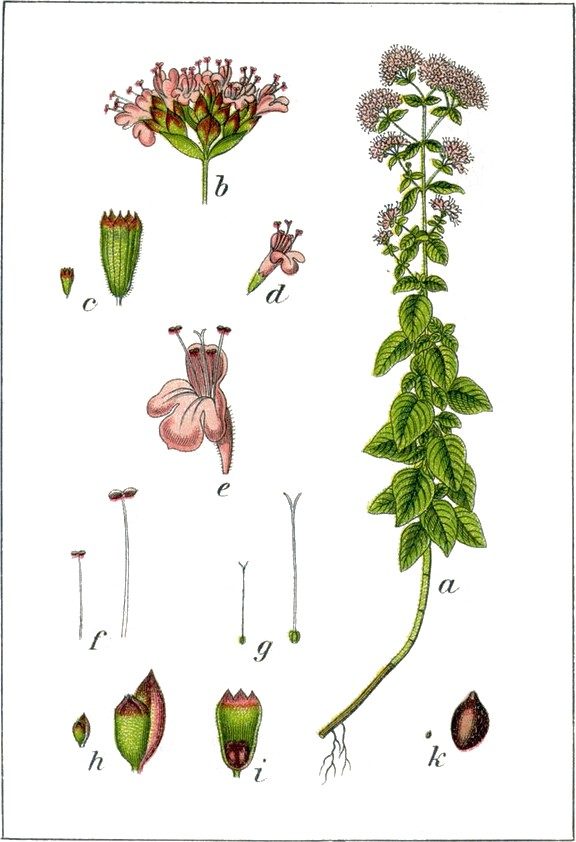
Oregano and squinanth
Origano; squinanto
- Known today as
- Oregano, Origanum vulgare; squinanth, Cymbopogon schoenanthus, a relative of lemongrass.
- Kind
- Plant, in 2 older authorities
- Constituents
- carvacrol, thymol, piperitone, and 1 more
- Earliest authority here
- Dioscorides (c. AD 40–90)
- In other databases
- Plants of the World Online search · GBIF search · Wikidata search
- In the Canale glossary
- On the Manner of Discerning and Healing the Bewitched, Appendix A: Part Three, Chapter 6: Remedies Given by Mouth After the Purge
Revised October 1, 2026: Tradition, lore, modern assessment, and sources extended. Version 1, first published September 25, 2026.
Oregano and squinanth: what did Canale use it for?
In the cockerel; oregano in baths for cold complexions (chs. 6–7).
Oregano and squinanth: what does modern science say?
Aromatic. Oregano oil is antibacterial in the laboratory. Carvacrol in oregano oil kills bacteria and fungi in the dish and is studied as a feed additive; squinanth is a lemongrass, with citral in its oil, and the two together are a sound warming aromatic for a bath.
Pharmacognosy & Toxicology
- Constituents
- Mechanism
- Carvacrol and thymol are broadly antibacterial and antifungal by disrupting membranes, which is the whole credential of “oil of oregano”; the camel grass of the Arab pharmacy is a carminative lemongrass relative.
- Toxic dose
- Oregano as a herb is safe; the oil undiluted burns the mouth and skin.
- Standing
- Oregano has no EMA monograph (the agency assessed its cousins, dittany of Crete and marjoram); it is a spice with a laboratory literature, and squinanth has nothing.
- Nostro, A., and Papalia, T. (2012). “Antimicrobial activity of carvacrol: current progress and future prospectives.” Recent Patents on Anti-Infective Drug Discovery 7. Verified against its record · doi:10.2174/157489112799829684
The abstract of each source, beneath its citation. For Club members. About the Club or sign in.
Constituent names open the compound’s record at PubChem, and “ChEMBL” beside a name opens its record at ChEMBL, the European Bioinformatics Institute’s database of bioactive molecules. Where a mechanism line was checked against ChEMBL (ChEMBL 37, read 1 October 2026), the check is shown with the measured value and its source paper, or says plainly that nothing has been measured. Doses are as the references give them, for description only; this is not medical advice. Each source carries the result of its check against Crossref, PubMed, or the authority’s page: see Verification.
Oregano and squinanth: what lore surrounds it?
Oregano is “joy of the mountain,” oros ganos, the herb Aphrodite grew on Olympus and the Greeks planted on graves for the peace of the dead; squinanth was the camel’s hay, the fodder of the caravans, and a tent of it smelled of lemons.
Oregano and squinanth: what did the older authorities say?
- Dioscorides
- Gives origanon, hot and biting, for the stomach and the chest, in baths and fumigations, and schoinos, the camel grass of Arabia, warming, for the womb and the stomach, in the great antidotes.
- The Arab trade
- Squinanth, idhkhir, came in bundles from Arabia and the Nile with the other aromatics of theriac and mithridate, and the Prophet is said to have allowed it to be cut in the sanctuary of Mecca for the smiths and the graves.
Sources
- [59] Hao, Y., Li, J., & Shi, L. (2021). A carvacrol-rich essential oil extracted from oregano (Origanum vulgare ‘Hot & Spicy’) exerts potent antibacterial effects against Staphylococcus aureus. Frontiers in Microbiology 12: 741861. doi:10.3389/fmicb.2021.741861 Verified against its record · doi:10.3389/fmicb.2021.741861
- Dioscorides, De materia medica I and III. Primary text
- Sahih al-Bukhari, on the idhkhir of Mecca. Book, seen in reviews
Verification
- Checked
- October 1, 2026
- Passes
- Every sentence read against its sources, in the pass over the remaining 343 entries
- The Standing line checked against the authority it names (EMA, WHO, FDA, CITES, Commission E)
- Every dated or regulatory claim checked by category across the database
- Sources
- 4 cited: 2 verified against its record, 1 primary text, 1 book, seen in reviews. 2 with the abstract on file.
- Corrections
- None were needed.
What was checked, how, and what was found is set out on the Verification page. A checked source is one whose record was found; it does not make the entry medical advice.
Cite This Entry
Version 1 · first published September 25, 2026 · last revised October 1, 2026
- Chicago
“Oregano and squinanth.” In Materia Medica, edited by B. C. P. Statema. Version 1. The Thinking Press, 2026–. Last modified October 1, 2026. https://thethinkingpress.org/materia-medica/oregano-and-squinanth.
- MLA
“Oregano and squinanth.” Materia Medica, edited by B. C. P. Statema, version 1, The Thinking Press, 1 Oct. 2026, thethinkingpress.org/materia-medica/oregano-and-squinanth. Accessed 8 Oct. 2026.
- APA
Oregano and squinanth. (2026, October 1). In B. C. P. Statema (Ed.), Materia medica (Version 1). The Thinking Press. Retrieved October 8, 2026, from https://thethinkingpress.org/materia-medica/oregano-and-squinanth
Club members keep entries on a shelf with private notes, print the plates as cards, and receive an entry by email each week. Create a free account before January 1, 2027 and all of it is yours for good. About the Club
See Also
Sharing carvacrol, thymol, citral
Thymus vulgaris · Origanum dictamnus · Nepeta cataria · Diatrion piperion · Verbena officinalis · Citrus medica · Melissa officinalis
Also in Dioscorides
Orris in Dioscorides · Orache in Dioscorides · Ox eye in Dioscorides · Opium poppy in Dioscorides · everything Dioscorides names →
Nearby in the alphabet
Orpiment and realgar (Yellow and red arsenic sulfides) · Opopanax (a Mediterranean plant of the carrot family) · Oxymel, and oxymel of squill (Honey boiled with vinegar) · Onycha and stacte (Ingredients of the Temple incense (Exodus 30)

Historical description, not medical advice.